Basic Workflow Tips for Building a PedalPCB

Aye, but...
The problem is, bedroom / workbench volumes don't tell you what that effect is like at stage volume in the signal chain within the band mix...
I'm pro-boxing them all up, for now, but given the amount of botched drill-jobs combined with the build backlog... Maybe I should sell all my PCBs and go back to just breadboarding.
 
Aye, but...
The problem is, bedroom / workbench volumes don't tell you what that effect is like at stage volume in the signal chain within the band mix...
I'm pro-boxing them all up, for now, but given the amount of botched drill-jobs combined with the build backlog... Maybe I should sell all my PCBs and go back to just breadboarding.
I like to just box them all. Even the ones I don’t like. It’s just part of the fun of building to me. A lot of my builds are perfectly working pedals that just sit on a shelf most of the time. I scratched that itch.
 
Aye, but...
The problem is, bedroom / workbench volumes don't tell you what that effect is like at stage volume in the signal chain within the band mix...
I'm pro-boxing them all up, for now, but given the amount of botched drill-jobs combined with the build backlog... Maybe I should sell all my PCBs and go back to just breadboarding.
Maybe an idea for you as well: I am thinking of doing all my pedals eurorack style, and fix the guts to a 2mm aluminum sheet faceplate and screw that on a box (or, in your case, old, fucked up boxes). The power and jack holes can be standardized, so one sturdy template should be helpful in getting a uniformed style going.

Origin Effects uses this faceplate-on-a-box thing to0, though the PCBs are mounted onto the box as well. Classy as all hell.

1000063465.jpg
 
Last edited:
I just use a 9v wall wart that I used to use for some pedals. Ideally you will want to have something at the voltage that matches what you plan to use for the pedal you are building.
Sorry for the long time in reply.... Most of my wall warts do not have ground, sometimes that introduces issues.
 
Maybe an idea for you as well: I am thinking of doing all my pedals eurorack style, and fix the guts to a 2mm aluminum sheet faceplate and screw that on a box (or, in your case, old, fucked up boxes). The power and jack holes can be standardized, so one sturdy template should be helpful in getting a uniformed style going.

Origin Effects uses this faceplate-on-a-box thing to0, though the PCBs are mounted onto the box as well. Classy as all hell.

View attachment 77524

The more switches and pots are exposed, the more dirt and grime gets in. It's good to play but once the pedal is in use it's likely they're not going to change. I'd prefer a removable metal covers for the toggle switches and pots.
 
I always find the led, depending on location, and dc jack to be the most difficult because it’s just so tight in there by then and the jack HAS to be in the enclosure while soldering. Anyone know of a good alternative jack that can be soldered outside of the enclosure and then inserted inside? I think I may try doing the jack and led before the switch and outputs jacks next. That little bit of extra room will help. Thanks for putting this together.
 
I always find the led, depending on location, and dc jack to be the most difficult because it’s just so tight in there by then and the jack HAS to be in the enclosure while soldering. Anyone know of a good alternative jack that can be soldered outside of the enclosure and then inserted inside? I think I may try doing the jack and led before the switch and outputs jacks next. That little bit of extra room will help. Thanks for putting this together.
After my first build, I switched over to a DC Jack that mounts from the inside for this reason. I am using the Same Sky PJ-064, and there is also the PJ-011, which is slightly larger (but more common). I suspect there is a Lumberg version and the PJ-011 style is ubiquitous on AliExpress.

Similarly, I use an LED bezel from
Tayda, into which the LED is just press fit from the inside.
 
I always find the led, depending on location, and dc jack to be the most difficult because it’s just so tight in there by then and the jack HAS to be in the enclosure while soldering. Anyone know of a good alternative jack that can be soldered outside of the enclosure and then inserted inside? I think I may try doing the jack and led before the switch and outputs jacks next. That little bit of extra room will help. Thanks for putting this together.
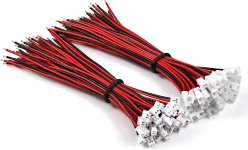
Most probably find this to be an unnecessary introduction of additional "stuff" in the box, but I love using micro JST connectors with DC jacks. They're pretty tiny. The wire can be kinda flimsy, so solder securely and use some heat shrink if you're gonna try that.

71FMmtsbtgL._AC_SL1500_.jpg
 
Thanks for the replies. I figured more would chime in on this. @Ginsly I’ve considered using those for several things. I’ve also considered the pre wired led/bezel that can be had very cheap.
 
Hello! This is my method for building a PedalPCB from start to finish. Is it the right way? Not necessarily. It's just what works for me and I hope it sheds some light on certain steps in the process along the way. I created this as a reference guide for anyone to use if needed. Thanks for reading!

Step 1: Drill the enclosure.
I recommend having this done before starting any soldering as it makes test fitting the fully populated board a whole lot easier later.
fig. 1
View attachment 1390

*Key step* Always print the drill template at 100%. Some printers default to "fit to page". You don't want "fit to page" because the template will be about 5% smaller if you do so...enough for a future struggle.

To attach the template to the enclosure I like using double sided tape. Place the template printed-side down on a flat surface. Put tape on the inside four corners of the drill template face and one in the middle.
fig. 2
View attachment 1391


With the template tape-side-up on a flat surface I then carefully lower the enclosure down onto it.
fig. 3
View attachment 1392

Once it's on centered and true fold the four sides of the template flush to the enclosure and secure them with regular tape. Use a center punch or an awl and hammer to mark the holes. I use a step bit and cordless drill to make the holes though a drill press is best. I always start by drilling a little bit where I marked the center to give me a more secure starting point then move to the next until all are done this way. This allows me to eyeball and see if I need to correct my final pass for each hole.
*Side note* After marking the enclosure, some of us like to use a regular drill bit to drill a pilot hole before moving onto the step bit.
fig. 4
View attachment 1393

Drill all holes then clean up any burrs from drilling with a needle file, if needed. Thoroughly clean inside and out afterwards with a towel and isopropyl alcohol. Optional, compressed air is nice to have to blow out any remaining debris.
fig. 5
View attachment 1394

Thanks so much for this thread. I used it today to complete the Spring Reverb PCB and the proxedure worked great. I am very thankful for the advice especially the alcohol cleaning.
 

Attachments

  • IMG_9273.jpeg
    IMG_9273.jpeg
    764.4 KB · Views: 9
Back
Top