PedalPCB Chop Shop

OD is Glorious

Well-known member
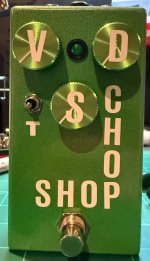
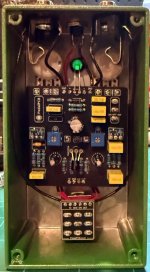
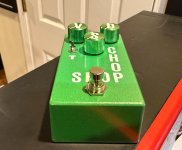
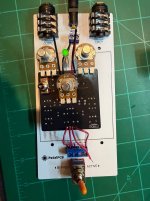
Fun project that you can knock out in a few hours. I did not adjust the internal trimmers, I just let it rip. It worked straight away on the PedalPCB auditorium platform and then I boxed it. It has plenty of gain and the sound is both useable and adjustable. It can sound like fuzz or overdrive. I dig it!

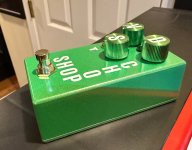
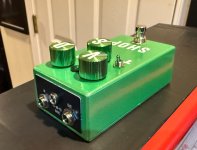
The components are mostly easy to find and the board layout is great. I used a Taiway short bat on/off/on switch and a light touch footswitch. I used a powder coated 125b enclosure and fitted it with Lumberg jacks, a PedalPCB top jack plate, a green 5mm LED

Have a great weekend everyone!
IMG_9869.jpeg IMG_9870.jpeg and 20mm anodized green knobs with vinyl labels.
 

Attachments

  • IMG_9871.jpeg
    IMG_9871.jpeg
    378.5 KB · Views: 11
  • IMG_9872.jpeg
    IMG_9872.jpeg
    281.4 KB · Views: 9
  • IMG_9873.jpeg
    IMG_9873.jpeg
    324.4 KB · Views: 13
  • IMG_9868.jpeg
    IMG_9868.jpeg
    413.8 KB · Views: 13
Fun project that you can knock out in a few hours. I did not adjust the internal trimmers, I just let it rip. It worked straight away on the PedalPCB auditorium platform and then I boxed it. It has plenty of gain and the sound is both useable and adjustable. It can sound like fuzz or overdrive. I dig it!

The components are mostly easy to find and the board layout is great. I used a Taiway short bat on/off/on switch and a light touch footswitch. I used a powder coated 125b enclosure and fitted it with Lumberg jacks, a PedalPCB top jack plate, a green 5mm LED

Have a great weekend everyone!
View attachment 112977View attachment 112978 and 20mm anodized green knobs with vinyl labels.
Really nice work. This is my next build. I got the j201 presoldered to a tiny board like what you have pictured. Question, how do you attach the j201 board to the pcb? Do you clip off a spare length from a resistor or something thicker like a schotky diode and insert that clipped off length through the 3 holes and solder on the top and bottom of the pcb? Tried looking this up on YouTube but not much is clear to me.
 
Really nice work. This is my next build. I got the j201 presoldered to a tiny board like what you have pictured. Question, how do you attach the j201 board to the pcb? Do you clip off a spare length from a resistor or something thicker like a schotky diode and insert that clipped off length through the 3 holes and solder on the top and bottom of the pcb? Tried looking this up on YouTube but not much is clear to me.
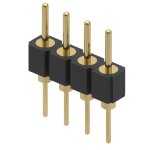
Yes, you use a pin header with male/male connectors and the J201s you can purchase already soldered to their boards at Stompbox Parts or here at PedalPCB. You solder the pin header to the board - the pin header breaks off in segments, and then you solder the J201 board to the other male - top of the pin header. It helps to have a flux pen also.

You will love this pedal!

MFG_350-10-104-00-001000.jpg
 
Last edited:
Yes, you use a pin header with male/male connectors and the J201s you can purchase already soldered to their boards at Stompbox Parts or here at PedalPCB. You solder the pin header to the board - the pin header breaks off in segments, and then you solder the J201 board to the other male - top of the pin header. It helps to have a flux pen also.

You will love this pedal!

View attachment 114357
Thanks for the quick reply!

Did not know these were a thing. But this is clearly handier than sticking a wire through the holes. I googled the part you listed. Is there one you prefer? Don’t know what diameter to look for on the pin head. Looks like it is all sold through digikey. None on stompboxparts.
 
Last edited:
Thanks for the quick reply!

Did not know these were a thing. But this is clearly handier than sticking a wire through the holes. I googled the part you listed. Is there one you prefer? Don’t know what diameter to look for on the pin head. Looks like it is all sold through digikey. Non on stompboxparts.
This would work
 
Got the pin headers. What a time saver. Thanks for suggesting them.

For the 2M resistor did you use a 2.2M? Thats the one i find available on stompboxparts.

I noticed the pcb explicitly labels the electrolytic cap values as 25V. Did you use that voltage value or higher? I have caps rated 35v and 50v. I’ve read posts on this topic and many observe that you need at least double the voltage on the cap that you are putting into the pedal from the power supply. So a 9v power supply would need at least a cap rated 18v, preferably slightly more. I never run my pedals on more than 9v.
 
Got the pin headers. What a time saver. Thanks for suggesting them.

For the 2M resistor did you use a 2.2M? Thats the one i find available on stompboxparts.

I noticed the pcb explicitly labels the electrolytic cap values as 25V. Did you use that voltage value or higher? I have caps rated 35v and 50v. I’ve read posts on this topic and many observe that you need at least double the voltage on the cap that you are putting into the pedal from the power supply. So a 9v power supply would need at least a cap rated 18v, preferably slightly more. I never run my pedals on more than 9v.
Cool, things I learned from just jumping in. I used a 2m resistor. There are ways to put resistors together in series or together to get the resistance you need; or order the correct resistors. I think the electrolytic caps 25v is great but I have used 18v and even 10v. Best practice is to use 25v.
 
I noticed the pcb explicitly labels the electrolytic cap values as 25V. Did you use that voltage value or higher? I have caps rated 35v and 50v. I’ve read posts on this topic and many observe that you need at least double the voltage on the cap that you are putting into the pedal from the power supply. So a 9v power supply would need at least a cap rated 18v, preferably slightly more. I never run my pedals on more than 9v.
For capacitors, you can go up in voltage rating. The 25v on the PPCB silkscreen can be interpreted as the minimum value. The only issues with going higher are cost and physical size.

1.5x to 2x is a common rule of thumb safety margin for capacitor voltage ratings. You can often get away with 1x (as quality caps themselves likely have some inbuilt safety margin), but capacitor life will be comparatively lower.
 
You can also buy 90-degree pin headers so the adapter board stays vertical, which is necessary on densely populated boards.
 
For capacitors, you can go up in voltage rating. The 25v on the PPCB silkscreen can be interpreted as the minimum value. The only issues with going higher are cost and physical size.

1.5x to 2x is a common rule of thumb safety margin for capacitor voltage ratings. You can often get away with 1x (as quality caps themselves likely have some inbuilt safety margin), but capacitor life will be comparatively lower.
Matt. This confirms my earlier research. Thanks so much for your reply.
 
Back
Top