
You are using an out of date browser. It may not display this or other websites correctly.
You should upgrade or use an alternative browser.
You should upgrade or use an alternative browser.
Overcast Fuzz - Spirit in the Sky Fuzz
- Thread starter Fever2112
- Start date


jessenator
Well-known member
Not sure what those turned out to be in that thread.Correction to what I said yesterday... I do not believe the transistors were sanded after all. I think maybe the primer etched the face of the transistor slightly and made the part number harder to see.
Aion mentions in the Oberon (Bosstone) doc:
The 2N5551 hits 150s all day, easily gotten from Tayda as well.The transistors used in the original Bosstone had a nominal hFE of around 135. This is lower than the
typical 2N3904, but right in the sweet spot for the 2N3903.
2x NPN?2N3903.
I'll have some in stock by the time the PCB is available.

Robert
Reverse Engineer
2x NPN?
Yessir.

Ahhh, you're riiiight. That didn't even catch my attention until just now.
Yep, two NPNs.
Q1
NPN Silicon BJT
hFE=127 at Ic=4.99mA
Vbe=0.673V at Ib=1.00mA
Vbe=0.759V at Ib=5.00mA
VceSat=0.066V at Ic=5.0mA and Ib=1.00mA
IcLeak=0.000mA
Q2
NPN Silicon BJT
hFE=125 at Ic=5.00mA
Vbe=0.680V at Ib=1.00mA
Vbe=0.766V at Ib=5.00mA
VceSat=0.066V at Ic=5.0mA and Ib=1.00mA
IcLeak=0.000mA
jessenator
Well-known member
"California" Bosstone
Yeah some of the early Alahabra cali, pre shobud, builds had 2xMPS6513, 2N3397/MPS6513"California" Bosstone
jessenator
Well-known member
I swear I bought a load of them from Circuit Specialists, but I'm only seeing the 6512 which are a bracket lower in gain, 80–100.MPS6513

BrainDrain
Active member
Used 2n5551 in my Overcast build and they both hit 127hfe. The 2n3903 I had were all around 200hfe.Not sure what those turned out to be in that thread.
Aion mentions in the Oberon (Bosstone) doc:
The 2N5551 hits 150s all day, easily gotten from Tayda as well.
i just replaced the two 2N3903 transistors with with two that have the exact specs as listed in the build document ( it took me 14 transistors to find the two) and IMO, it's WAY better now. Still not quite the Norman Greenbaum tone but a lot closer. I also ordered the original Circle Electric to see if it sounds any different. It should be here sometime later this week.
Last edited:

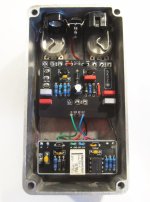
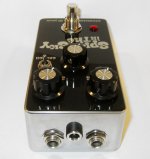
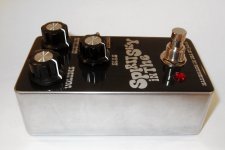

Betty Wont
Well-known member
I’ve got a question, and perhaps I’m missing something, but how does the circuit work with +v jumped to Ground?here's some pics of my build completed in a Hammond 1590B2:
View attachment 117766
View attachment 117767
View attachment 117768
View attachment 117769
Robert
Reverse Engineer
I’ve got a question, and perhaps I’m missing something, but how does the circuit work with +v jumped to Ground?
Correct me if I'm wrong @johnk_10, but I believe he drills out unused pads and uses them for stress relief.
The wire is just passing through the board, not actually making an electrical connection to the GND pad.

Nostradoomus
Well-known member
This is it.Correct me if I'm wrong @johnk_10, but I believe he drills out unused pads and uses them for stress relief.
The wire is just passing through the board, not actually making an electrical connection to the GND pad.
Betty Wont
Well-known member
Ok. Thank you Robert. That is a choice I guess. But now my question is, what stress can that wire possibly be subjected to inside a metal box with no moving parts?!Correct me if I'm wrong @johnk_10, but I believe he drills out unused pads and uses them for stress relief.
The wire is just passing through the board, not actually making an electrical connection to the GND pad.

owlexifry
Well-known member
my guess is it relieves stress for the builder, more so than the wiring.But now my question is, what stress can that wire possibly be subjected to inside a metal box with no moving parts?!
Betty Wont
Well-known member
That is probably the answer that will make me stop asking why on this one. Thank you.my guess is it relieves stress for the builder, more so than the wiring.
owlexifry
Well-known member
my bad.That is probably the answer that will make me stop asking why on this one. Thank you.
it's a fair question though.
marshall did it all over their boards
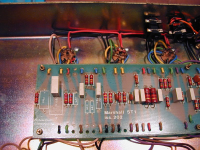
the benefit?
other than reinforcement,
- perhaps helps keep the wires pushed against the chassis (for less noise?) rather than flying around vertically..
- durability for future maintenance?
i wouldn't say it's necessary, but not entirely redundant
Betty Wont
Well-known member
For a one sided etched board with stranded wire I absolutely can see the benefit.my bad.
it's a fair question though.
marshall did it all over their boards
View attachment 117779
the benefit?
other than reinforcement,
- perhaps helps keep the wires pushed against the chassis (for less noise?) rather than flying around vertically..
- durability for future maintenance?
i wouldn't say it's necessary, but not entirely redundant
Similar threads

- Replies
- 1
- Views
- 205


- Replies
- 2
- Views
- 249

- Replies
- 0
- Views
- 127