
Stuff you wanted to know but were afraid to ask

Need a material that doesn't build static(or can be grounded) for the drawer. Otherwise you risk discharging your charge to the drawer.
Probably be fine though. Just wear a wristband or get a big piece of aluminum cornerstock and attach it to the bench and ground it. Same theory as resting your arm on the case of a PC.
Or keep the humidity above 30%
 
Or keep the humidity above 30%
*laughs in desert*

I think it's 29% today.

But thanks, I'll see what I can do. I'm sussing out my assembly line. I think I might change it to be more like trays, (rather than drawers), to hold parts as I assemble. Then they'll go back into safe things. So maybe not so much continuous static buildup motion of drawers.
 
Opened an old device after dealing with a bunch of stubborn copper screws. Took quite the effort and of course the soft screws took damage. Are these annoying screws used for a reason?

Only thing I can think of is that the soft material easily shows tampering with a device, turning any warranty void, when noticed by service personel?
 
AC not working in the shop today. Tons of walk in traffic because this is festival season so lots of last minute repairs. My socks and underwear were soaked by the time I got out of the place. Amazing day but a true test of my deodorant.
 
Random thought.

If you got a tube headphone amp, or a low wattage tube hifi amp with line or headphone out, and stick into a powerful solid state to feed guitar speakers... Does that have the potential to result into something good, when feeding an instrument audio chain through it? Sort of like a best of both worlds thing?
 
Last edited:
Random thought.

If you got a tube headphone amp, or a low wattage tube hifi amp with line or headphone out, and stick into a powerful solid state to feed guitar speakers... Does that have the potential to result into something good, when feeding an instrument audio chain through it? Sort of like a best of both worlds thing?
unless the tube device is leaning heavily into doing non-linear things, like distortion, i wouldn’t expect much benefit in this scenario
 
unless the tube device is leaning heavily into doing non-linear things, like distortion, i wouldn’t expect much benefit in this scenario
True, HiFi is all about clear, true reproduction of sound...but the tube amp could be modified to distort...but, but who would dare do such a thing?
 
I'm considering buying a Benidub Spring Amp 2. The manual says it can not be used directly with a guitar because it does not send the direct signal through, only the reverb signal, so you need to use a mixer with an AUX send.

...what's stopping me from building a very simple mixer pedal and using it together with that? Probably nothing I assume? Input/output impedances would probably be different, at least if it's passive, but that probably shouldn't be a big issue right? Or if it's an active pedal, even less so.

Edit: Maybe just the ROG Splitter Blend https://forum.pedalpcb.com/attachments/1784684488440-png.121267/
 
Last edited:
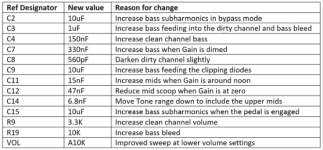
Morning fellas, dumb question alert. I'm sourcing parts for the first time, having only built from kits and in true paint-by-numbers fashion, my knowledge is severely lacking. I'm looking to take a stab at Chuck's Bass Klon and following the *parts list below but have some confusion about the capacitors and their voltages. How do I know which voltage I should be going for? Some caps have 35s, 50s and 100s while others only have 100s and above (on Tayda at least).

Am I right in thinking that I can use just about any of them, as if I'm running the pedal at 9V it won't get close to the max that the caps can handle? I'm thinking I should aim for 35-50 where possible.

*Parts list
1784795613378.png
 
Morning fellas, dumb question alert. I'm sourcing parts for the first time, having only built from kits and in true paint-by-numbers fashion, my knowledge is severely lacking. I'm looking to take a stab at Chuck's Bass Klon and following the *parts list below but have some confusion about the capacitors and their voltages. How do I know which voltage I should be going for? Some caps have 35s, 50s and 100s while others only have 100s and above (on Tayda at least).

Am I right in thinking that I can use just about any of them, as if I'm running the pedal at 9V it won't get close to the max that the caps can handle? I'm thinking I should aim for 35-50 where possible.

*Parts list
View attachment 121358

Use 25/35v for the electrolytic caps (10uf, 1uf etc) as the more voltage they tolerate the bigger the diameter of the cap will be. They may not fit comfortably in the board footprint and that sucks. The Klon has a built in charge pump/voltage doubler that takes your 9v and feeds the circuit 18v, but 25/35v ratings are good enough for that.

For all the nF value caps, go with 50 or 63v, they’ll fit. The 330nf cap is gonna be a wide boy regardless but it will work. pF value caps are generally always pretty small but stick to the small (50v or less)voltage ratings either way just in case you get stuck with a fatty 😂
 
Use 25/35v for the electrolytic caps (10uf, 1uf etc) as the more voltage they tolerate the bigger the diameter of the cap will be. They may not fit comfortably in the board footprint and that sucks. The Klon has a built in charge pump/voltage doubler that takes your 9v and feeds the circuit 18v, but 25/35v ratings are good enough for that.

For all the nF value caps, go with 50 or 63v, they’ll fit. The 330nf cap is gonna be a wide boy regardless but it will work. pF value caps are generally always pretty small but stick to the small (50v or less)voltage ratings either way just in case you get stuck with a fatty 😂
Much appreciated, thanks for the help. It all seems very obvious now that I think about it lol.
 
A good guideline to follow for electrolytics and tantalums is to have double the rating to what your circuit works on. An example list:
9v - 16v
12v - 25v
15v - 25v/35v
18v - 35v
24v - 50v
30v - 63v
36v - 80v/100v

I follow this list when selecting parts for builds using voltage multipliers like boosts and certain overdrives like the klon. It's not a hard rule but helps to keep you from running your components at their limit.
 
Back
Top