transistor clipper question

DDad

Active member
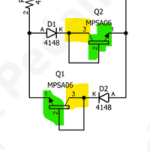
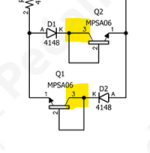
In this snip from the clipping section of the DriveGPT schematic do the yellow highlighted connections do anything? Isn't the Vf drop just the one PN junction of the base and emitter highlighted in green?

DriveGPT schematic

1794007024098.png
 

Attachments

  • 1794006928823.png
    1794006928823.png
    18.6 KB · Views: 1
Hey that’s an interesting question, yeah you’d think the BE PN junction would work just fine leaving the C floating.

I tried to read some about it, seems like there’s some technicalities of transistor science that makes the CB short work more like a predictable diode. But I think you could definitely try it both ways and see if you notice a sound difference in the sound.
 
Google AI says this

Risks & Limitations:
  • A floating terminal can pick up noise, exhibit unpredictable leakage currents, or have lower reverse-breakdown limits (e.g., the B-E junction typically breaks down around 5V–7V, whereas the C-B junction can handle much higher voltages like 40V–75V).
  • If you use the Collector-Base (C-B) junction as the diode, the emitter is left floating, though C-B diode behavior can show ramping or non-ideal rectification characteristics. [1, 2, 3]

Source:

What does it mean? idfk
 
Yes, it's "just a PN junction" - but it may well have different current-voltage behavior compared to your favorite diode. There are several well known stompboxes that use transistors and FETs this way for different sounds. E.g., check out the measured quantities at https://thomasbe86.github.io/plotly-plot/Diodes_Avg_Plotly.html and https://rhpfelectronics.com/rhpf-el...pedals-in-switzerland/rhpf-nerd-lab/iv-bench/
I was referring to whether leaving the collector floating would make a difference, not if a transistor PN Vf is different than any other diode or other PN Vf. I have many different diodes and other semiconductors that have different Vfs.
 
Google AI says this

Risks & Limitations:
  • A floating terminal can pick up noise, exhibit unpredictable leakage currents, or have lower reverse-breakdown limits (e.g., the B-E junction typically breaks down around 5V–7V, whereas the C-B junction can handle much higher voltages like 40V–75V).
  • If you use the Collector-Base (C-B) junction as the diode, the emitter is left floating, though C-B diode behavior can show ramping or non-ideal rectification characteristics. [1, 2, 3]

Source:

What does it mean? idfk
This is what I was wondering about. Time to breadboard it and find out. Was hoping someone would have experience on this specific question.
 
Back
Top