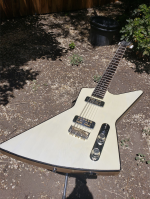
Buddy's Kit Build Journey - Show off yours as well!

ok, I've actually got two necks that will eventually need a fret level. I can bump them up in the queue.

I can show you two methods, the "Easy Way" which is functional but less precise.
And the "Right Way" heh.

(And to be clear a lot of high end mfgrs use the "easy way", like PRS for example, and they have legendary fret work on even their cheapest guitars.)
 
One big thing I’ve learned is that I don’t need fancy pants Fender necks to make a good build. From what I’ve experienced firsthand, I’d be perfectly happy with a Vintera Road Worn neck at a fraction of the cost of the American Originals. Not only did they cost a fortune, the amount of work they needed was embarrassing (for Fender)! I expected nut work, but one of them needed a majority of the frets to be re-glued. On a neck that cost as much as a whole-ass MIM Player series guitar.

I would love to build a Troublemaker Tele with Gibson appointments and P90s. After that, I’d love to build a Tele with a Certano Bender for B and G, like this one (not mine):

View attachment 51257
Here is some nice Bending on a Duesenberg, He has a vast video library of different lap steel playing!
 
Next time you swap out the strings and then I wouldn't worry about it until something sounds off like fret buzz when you hit a particular note but every other spot is just fine. and Ty Michael for finding that fret beam, better that cost and more universal usage than the 1's from Stewmac and most luthier suppliers. I've been cheatign and using 600 grit wet dry on my fret board shaping block and reeeeeaaaaly light touch :ROFLMAO:
 
How often would this need to be done from a maintenance standpoint? I figure if I'm going to do this on one I may as well try it on my other more used ones
Really only as needed. the primary fret level basically sets you up until you need a fret re-level. For some folks that can be never, for instance. I play with a pretty light touch and have never had to "re-level" my frets even on my oldest guitar (35 years.)
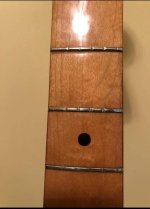
I also have a lot of guitars so no single guitar gets a ton of play wear.

After you get the whole guitar together and get it under string tension, let it sit for a couple of weeks to settle, then you may need to go back in and dial in a few frets.

Here's the trick, do your initial fret level, crown and polish, string it up and deal with any drastic fret issues. (Like a note won't play at all or you have serious dead spots on the neck). All are indications that the initial fret level wasn't done correctly. EXPECT THIS your first time.

But then let it sit under tension for a bit before chasing down any other fret issues. This is the hardest part for me because I HATE when the guitar doesn't play right. Like I can't do a 2 tone bend on the 13th fret or something. And of course that's the one note I keep hitting hahaha.

The guitar, frets, neck will all tend to "move" a little under tension until it reaches an equilibrium. I've spent countless hours chasing down rogue buzzing spots too early only to have the frets move again, heh. I've also had situations (like my recent Red Strat build) where after final assembly I had some spots where it was fretting out on bends up around the 14th-15th fret. I was resigned to doing some more fret work on it. But after a couple of weeks under tension, they all disappeared and it now plays very cleanly! Sometimes you get lucky:)
 
Really only as needed. the primary fret level basically sets you up until you need a fret re-level. For some folks that can be never, for instance. I play with a pretty light touch and have never had to "re-level" my frets even on my oldest guitar (35 years.)
Sorry for the derail but… Wow. This is a picture from last year of my 1977 Strat (I got it used in 1985) before I finally had to replace the frets (I went with stainless just in case I happen to live to be 125 years old. You never know). Apparently I really like playing on the high E string

Mike
IMG_1656.jpeg
 
Having the afternoon off (summer fridays here), I took some time prepping the body. What does this mean? Sanding.

As a budding woodworker, sanding is the most tedious, most boring, but also THE most important step before finishing your wood piece. I'm not talking just scuffing up the corners/edges for splinter reasons. I don't have any pics to post for this step, but that's ok. The body seemed pretty smooth to begin with, but sanding accomplished a few things here. First, if there is any sanding sealer or other "protection" on the wood it takes it all off. Secondly, sanding til a silky smooth finish allows the paint or stain to disperse more evenly. Especially stain here. I started with 220 grit and moved my way up to 400 before wiping it all down with mineral spirits. Why wipe it down? Well, we're working with wood and wood expands when moisture gets into it. The moisture pushed the grain up a little bit and you can sand it down even further for a smoother finish. The suns out today, so I left it outside for 15 min to dry and flipped it over once to make sure everything dries. Then I brought it back in and took some 800 grit paper to really let the smoothness out! Could I go higher grit from here? Maybe, but after a certain point there are diminishing returns. I didn't have any pads for my orbital sander, so I made a sanding block and did everything by hand. I think it took me a little over an hour. I may go back over it again with 1000 grit once my hand feels better, heh.
 
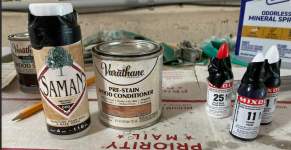
With sanding done for the day, I took some time with stains. Here is what I used. The stain and dyes came from Solo Guitars. The conditioner is something I've had lying around for a while.

1688153804902.png

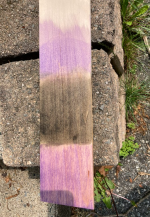
Taking my scrap basswood I also sanded it down to 800 grit. This went much faster than the body since there's less to do and can all be done with the block. I sectioned off 2 areas in pencil to try some test stains. I first used the wood conditioner on the bottom 2 sections cuz I wanted to see how stain would react without the conditioner. I mixed up a few tablespoons of the clear stain with 4-5 drops of just purple. I also wanted to try a regular water based dark stain to potentially make the wood grain pop when color is applied on top.

I'm not sure I like the results so far. I let the conditioned purple sit there for a few minute before wiping off. The wood barely took anything so I upped the dye amount in my mixing bowl. It looks better, but I think I may need another coat. The dark one I'm going to sand down and see how that does with some purple on top of it. The top purple section looks surprisingly good (ignore that massive line there. That's where I wiped off the stain. I have to be patient. More testing here is needed.

1688154094531.png
 
I just looked up the lightfastness on the Mixol violet, and it’s pretty remarkable, as in general, purple tints and dyes tend to be the most affected by UV. (Besides Gremlins, how many purple cars do you remember? This is due more to color chemistry than good taste…) Mixol rates it for outdoor use, with 2500 hours of sun exposure, which is their second highest rating.
 
I just looked up the lightfastness on the Mixol violet, and it’s pretty remarkable, as in general, purple tints and dyes tend to be the most affected by UV. (Besides Gremlins, how many purple cars do you remember? This is due more to color chemistry than good taste…) Mixol rates it for outdoor use, with 2500 hours of sun exposure, which is their second highest rating.
Wait. Are you saying purple is a bad choice?
 
Very often, yes. But in your case, NO, not at all. It has a very high colorfastness rating. I was curious, so looked it up, since I’ve had many issues with violet and purple dyes and pigments.
 
I built a GFS kit back in 2013. I shaped the headstock with some rasps in a shape inspired by G&L. I finished the body (pawlonia? I think it’s just a fancy name for basswood) with linseed based pigment and linseed oil and I was pretty happy with it. It’s a very thin and delicate finish but it looks nice, kinda like a thinner nitro. I did mess up the position of the bridge a bit (too close to the pickguard) so the intonation is crappy. I do like the maple neck though, not bad at all and the action is nice and low.

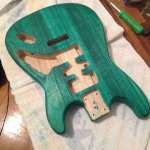
Here’s a pic of the body in progress:

2022-12-11_Original.jpeg

And my face that says “I can’t believe it’s a guitar that I built!”:

2022-12-11_Original.jpeg

(I was rocking a mustache back then)
 
I built a GFS kit back in 2013. I shaped the headstock with some rasps in a shape inspired by G&L. I finished the body (pawlonia? I think it’s just a fancy name for basswood) with linseed based pigment and linseed oil and I was pretty happy with it. It’s a very thin and delicate finish but it looks nice, kinda like a thinner nitro. I did mess up the position of the bridge a bit (too close to the pickguard) so the intonation is crappy. I do like the maple neck though, not bad at all and the action is nice and low.

Here’s a pic of the body in progress:

View attachment 51509

And my face that says “I can’t believe it’s a guitar that I built!”:

View attachment 51510

(I was rocking a mustache back then)
Pawlonia and basswood are different species of tree
 
Back
Top