Buddy's Kit Build Journey - Show off yours as well!

One bit of warning if you use boiled linseed oil. Soak the used rags with some water and put them in a plastic grocery bag before disposing.
They can spontaneously combust under the right conditions.
I've heard this too, even if you're using solvents or chemicals in general with a rag/paper towel. Dispose of them properly!!!!
 
Unless seen in person, I DOUBT the linseed rags did that... otherwise a LOT of impressionist art would have toasted museums world wide! Bet a few other things happened... but other chem soaked materials, do be careful... sick/dead pets may result, destroyed carpets/floor finishes.

The thin layers is the proper way, can always add more, royal hemorrhoid taking it back off 😉
 
Drum roll please...........🥁🥁🥁🥁🥁🥁

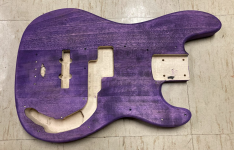
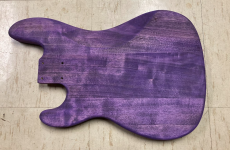
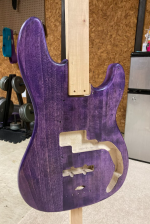
Here's the body with one coat of purple. I think the front came out better than the back. The pickguard will cover up some of the blotchiness in the middle. I've come this far in the finishing process. Do I keep going this route, possibly another stain coat, sealing it, and calling it done OR do I attempt to paint over everything for a more professional looking finish? Below is the other route I may take.


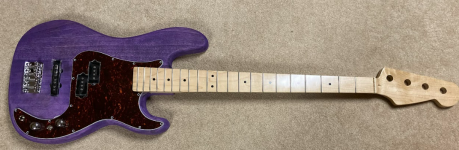
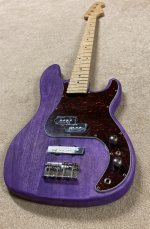
Am I happy with this? In some spots, yes, and in some spots, no. This really boils down to the wood quality and if I'm ok with keeping the blotchiness. In keeping the stain you can tell this looks "homemade", which is both good and bad. I've had people come over to my house and ask about my other kit build (not the reason they came over, haha) since it doesn't look like a factory finish. Thoughts anyone?

1688663817466.png
1688663860212.png
 
I say stick with the stain!

I forget if you said what your plan is for top-coat, but I bet that would pop real nice with some kind of clear on top.
 
Drum roll please...........🥁🥁🥁🥁🥁🥁

Here's the body with one coat of purple. I think the front came out better than the back. The pickguard will cover up some of the blotchiness in the middle. I've come this far in the finishing process. Do I keep going this route, possibly another stain coat, sealing it, and calling it done OR do I attempt to paint over everything for a more professional looking finish? Below is the other route I may take.


Am I happy with this? In some spots, yes, and in some spots, no. This really boils down to the wood quality and if I'm ok with keeping the blotchiness. In keeping the stain you can tell this looks "homemade", which is both good and bad. I've had people come over to my house and ask about my other kit build (not the reason they came over, haha) since it doesn't look like a factory finish. Thoughts anyone?

View attachment 51904
View attachment 51905
I love that purple. This is exactly where I was with mine. Your staining looks better to me than mine does and mine is ash. If you are clear coating (as opposed to TruOil which yellows things) it will probably look absolutely amazing.
 
I love that purple. This is exactly where I was with mine. Your staining looks better to me than mine does and mine is ash. If you are clear coating (as opposed to TruOil which yellows things) it will probably look absolutely amazing.
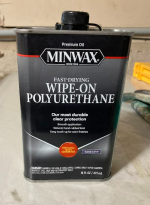
I’m going to clear coat it going the simpler route of wipe on poly. I’m debating a satin or gloss finish
 
I’m going to clear coat it going the simpler route of wipe on poly. I’m debating a satin or gloss finish
I love a satin finish and that was what I was going to do on mine, but I ended up with more of a gloss. I put too much oil on in my second coat and it was all "downhill" from there.
 
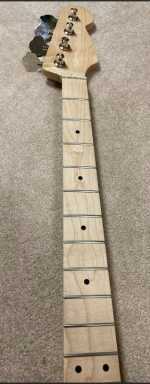
I'll tackle the body on my lunch break today, but the past few mornings I've put some time into the neck/fretboard. It all appeared to be unfinished with the exception of the fretboard itself. As mentioned in one of the early posts here, this was the nicest looking piece of the kit and I want to let it shine in all its glory. Unfinished, it's in pretty good shape from a smoothness perspective, but AWLAYS make 1000% sure you're working with raw wood. Many times, and even if you get raw wood from a hardware store, there's a slight film or coloring on the outside and it's a good idea to take it off with some sandpaper. I started lightly with 400 grit, then moved up to 800, 1000, then 1500 even on the fretboard. This thing feels like glass now!!! That's what I did over the US holiday weekend.

For the past few mornings this week, I've used Tru-Oil to finish it. You can also use boiled linseed oil for the same result, but I already had this from my first kit build. There are 2 methodologies to applying it from the research I've done: with your finger or with a paper towel. My first coat I used my finger and probably put on too heavy of a coat. With this stuff, less is more in terms of coat thickness. Same goes for painting a room or a piece of furniture. Lighter coats make it look better. The next day I applied it with a paper towel and got better results. With this stuff, its best to apply a coat then wait 24 hours or at least overnight to semi-cure. For every other coat I'm going to buff/knock it back with some 0000 steel wool. Today I buffed it out with the wool and applied a 3rd coat. I may stop at 5 or 6 coats, but it's really up to you how many you want. More coats = more shine and a thicker finish. I like the feel of the raw wood so 5 or 6 will be enough. Once I'm done with this process, let it sit somewhere and cure for a whole week. I hate waiting...

View attachment 51887

Steel wool v “sandpaper”— sandpaper will give you a surface where the pores of the wood are filled (eventually) with the cured oil, giving you a smooth, flat surface. Steel wool tends to also partially clean into the pores, so your finish continues to have a more open feel.

Not saying one is better than the other, but, with open grained woods there’s a difference, less from a few feet away than by touch.

I’ve never been as happy with paper towels as an applicator v cotton or linen rags. Especially old, washed many times rags. Paper towels often shed small flecks than can become part of the finish. I do use paper towels as a polishing medium sometimes, but that’s after the finish is completely hardened. After he first 6 or so coats of oil, I cut the oil slightly with mineral spirits, so you can apply much thinner coats. They set a good bit faster, too, so you can re-coat after 12 hours or so.

Your staining is looking great to me. There’s a big difference between looking at a guitar body, solo, and looking at a completed guitar.
 
Unless seen in person, I DOUBT the linseed rags did that... otherwise a LOT of impressionist art would have toasted museums world wide! Bet a few other things happened... but other chem soaked materials, do be careful... sick/dead pets may result, destroyed carpets/floor finishes.

The thin layers is the proper way, can always add more, royal hemorrhoid taking it back off 😉
 
Top coating.

This is the process that can make or break your overall look. I was very successful with my last kit build using wipe on poly. My problem is I never cleaned off the cap a few years ago and it fused together, so I threw it out. While I appreciate a high gloss, new car type finish I decided to go with a satin finish instead. Why? IMO, it's different and another way for my build to not look like it came off a production line. My options were limited in my area: either Lowes or Home Depot. The Home Depot one had really bad reviews for their satin finish product, so I went the Lowes route. For those who don't know, Lowes is a big box home center here in the US (Blue color) and Home Depot (orange).

1689100926818.png

To apply it, I used an old T shirt (make sure it's clean!) and ripped a piece off. If you're going to go with this method I would highly suggest you wear gloves. Your hands will get very sticky even after washing them multiple times. I should have tried mineral spirits on my hands, but was too lazy to pull it out, haha.

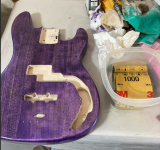
Similar to staining, the wood I was working with sucked up a LOT of product. It took me 4 coats to finally see the glossiness come through. I was getting worried at first since some of the color was coming off with each application. Not a lot, but enough to notice on my rag. I lightly sanded with 320 grit in between coats to remove the high peaks. Sanding between coats will save you time when you're ready to apply your final sand/buff whether you use car polish or otherwise. This is after 6 coats and I'm going to put on 2-3 more to make sure everything is sealed really nicely. Yes, that's my home gym in the background, lol.
1689101361495.png
 
With things drying and curing for the time being, it's time to focus on the electronics for my build.

For the pickups, I'm going with a DiMarzio DP126, which is nothing more than their standard P pickup and J pickup sold as a set. For the price, this seems to be the best "bread and butter" set of P-ups.

My kit came with a switch to go between the bridge, neck, or both. I want to replace this with a knob to have 2 volume and 1 tone knobs. I'll have to drill a hole in my brand new pickguard to accommodate, but whatever. The pots that came with the kit are splines. I've got a ton of Tayda pots that I need to clean up and for now I'll use these. I can always replace them down the road. I just don't have the cash this month for a set of pots.

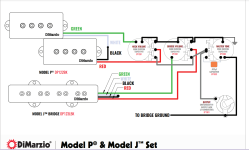
Here is the wiring diagram I'll try to replicate on my build. QUESTION FOR YOU ALL! The TONE control seems odd to me. I get that lug 3 (top) is not used here and that's fine. This is nothing more than a simple low pass filter if I'm not mistaken. As I turn it clockwise I should get brighter, but from a EE theory standpoint, this looks to be wired backwards, meaning the cap should be on lug 1, right? No mojo parts for me, since I've got a ton of box caps I can use here. Am I reading too hard into this and should just wire this blindly?

1689181170496.png
 
With things drying and curing for the time being, it's time to focus on the electronics for my build.

For the pickups, I'm going with a DiMarzio DP126, which is nothing more than their standard P pickup and J pickup sold as a set. For the price, this seems to be the best "bread and butter" set of P-ups.

My kit came with a switch to go between the bridge, neck, or both. I want to replace this with a knob to have 2 volume and 1 tone knobs. I'll have to drill a hole in my brand new pickguard to accommodate, but whatever. The pots that came with the kit are splines. I've got a ton of Tayda pots that I need to clean up and for now I'll use these. I can always replace them down the road. I just don't have the cash this month for a set of pots.

Here is the wiring diagram I'll try to replicate on my build. QUESTION FOR YOU ALL! The TONE control seems odd to me. I get that lug 3 (top) is not used here and that's fine. This is nothing more than a simple low pass filter if I'm not mistaken. As I turn it clockwise I should get brighter, but from a EE theory standpoint, this looks to be wired backwards, meaning the cap should be on lug 1, right? No mojo parts for me, since I've got a ton of box caps I can use here. Am I reading too hard into this and should just wire this blindly?

View attachment 52266
You're overthinking it. The wiring diagram is solid and will work. There's lots of different ways to skin the wiring cat. (Sorry cat lovers...)
This is one of the best NEW wiring books out there from Gerry Haze.
 
After 9 coats of wipe on poly, I let everything cure for about 2 days. 9 coats should be good, right? Keep reading...

1689269445379.png

The process I chose was to go the wet sanding route. Why wet sanding? There's a more in depth thread about sandpaper, but I'll sum up what I know. Wet sanding has 2 positives: water acts as a lubricant to reduce friction and in this case any warping of the polyurethane coat. Secondly, with the higher grit sandpaper out there (800+) it will not get clogged.

So, I let the paper soak in a container for about an hour or so until all the different grits I was going to use started curling up. To me, that's the sign it's ready. Some people out there say it works better when soaked overnight, but I'm impatient. I spritzed a little bit of water on the body and started with the 800 grit. No need to go too hard and let the paper do the work. All we're doing here is smoothing things out, not taking material off like with a 120 or 60 grit paper. With the 800 paper done I decided to wipe it down with a paper towel and start the process over with 1000 grit. For some reason or another stain was lifting off the body and into my paper towel! Gaaaaaahhhhhh!!!! Looking more closely at the body I saw raw wood coming through on some of the edges. This tells me I need to almost start over.

Sigh

Luckily, I still had the stain all mixed up with the dye in a closed container and stained the whole body again. More poly coats are needed, 6 at a minimum. I'll make sure to get the edges better this time. I think I can save this project.
 
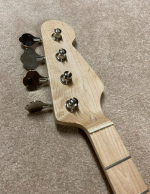
On a more positive note, I applied 5-6 coats of Tru-Oil on my neck/fretboard and let it cure for either 6 or 7 days (about a week, IDK). I finally put on the tuning pegs. On this kit there are sleeves that need to be hammered into the front side and the machine heads go through the back side. The sleeves were a little troublesome, but a hammer and some scrap wood to protect the sleeve fixed it right up. It looks discolored in the lighting, but it's just the angle of the pic.

1689270205826.png
1689270220627.png
 
Nice work! I think tru-oil is my favorite finish on necks. I use that same brand of wax to protect the tru oil finish once it’s cured
 
not relly supposed to need to hammer the sleeves in, light pressure with a C or squeeze lock clamp or the hole is to small. tru-oil or tung oil, works wonders and doesn't get sticky like poly. On the body poly is fine you only touch it long enough to pick up/put down.
 
On a more positive note, I applied 5-6 coats of Tru-Oil on my neck/fretboard and let it cure for either 6 or 7 days (about a week, IDK). I finally put on the tuning pegs. On this kit there are sleeves that need to be hammered into the front side and the machine heads go through the back side. The sleeves were a little troublesome, but a hammer and some scrap wood to protect the sleeve fixed it right up. It looks discolored in the lighting, but it's just the angle of the pic.

View attachment 52317
View attachment 52318
The fancy way to put in the tuning bushings instead of a hammer is a bolt that fits through the bushing and crank a nut on til it squeezes together
 
Back
Top