Help with CE-2 pedal

Matoni

Member
Hello,
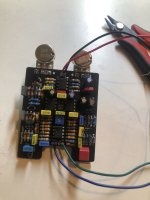
I need help with my Cepheid Chorus build. I am getting a signal coming through when I plug the pedal in, but there is no chorus sound. This is probably because of the R34 47K leak resistor seen at the very top of the schematic. There is no chorus sound, however. I have probed with an oscilloscope, so I know that there is a signal going into the MN3207 chip I am using, as well as voltage going in the correct pins, however, there is no signal coming out of pin 7 or 8. Please let me know what tests I can run to try and further diagnose the problem. I am using a corresponding MN3102 clock chip, but it may not be working. I have no clue how either the BBD or Clock chip work. Please let me know what I may have done wrong. I will post pictures if they are requested. Thanks so much in advance for your help.
 
Solution
OK I GOT IT!! Im so excited. using McKnib's methodology, I probed pin 7 to make sure it was connected to the diode... and it wasn't. I figured out that the trace between the 47pF capacitor and that diode got cut, probably when I took out my 47nF capacitor. Thanks for all your help guys. I really appreciate all the time and effort that went into helping me figure out what was wrong with this pedal. Next up is going to be the XC phase board, which hopefully I wont have any problems with. Ill let you great people know if I have any issues with that. Thank you again for all of your help and support.
Thanks for your quick reply. I got sent them by Ryan Z, another member of this forum. He had a thread somewhere saying he had extra sets of these chips that he was giving away. I assume they work because he sent them to me, meaning his pedal probably worked. Maybe they are counterfeit. Let me know if there is a more reliable source for these chips, I am happy to re-buy. Thank you so much for your help.
 
Post some pics of your build, I'd hate to send you off buying more ICs if there's some other simple problem to blame.

If you do determine they are the issue you can get the CoolAudio reproductions (V3207, V3102) from StompBoxParts or CabinTech. Both vendors are reliable sources.

StompBoxParts:
V3207D + V3102D Combo

CabinTech:
V3207D
V3102D
 
Last edited by a moderator:
Yes I did solder the jumpers the correct way. I tested this by using my multimeter and the voltage input going into the chips is correct. I will upload pictures as soon as I can. Thanks again for your time and help.
 
You might also want to adjust the BBD Bias trim pot.

There are "proper" steps for making the adjustment but you can get there by slowly turning up the trim pot until you hear chorusing, then micro-adjust for the cleanest signal without clipping.
 
Don't see anything out of place can't see R5 bands clearly not sure if the multipliers orange or brown

What's your transistor and IC voltages that might highlight something

I'm assuming your LFO functions ok if you've had it on a scope

You could obviously check the clock frequency with your scope to make sure it's working, check you get a square wave off the 3207 pins 2 and 6 etc the datasheets will give you information you may be able to use to verify whether they're working or not

This may help although I can't vouch for accuracy

 
Last edited:
Yes, I agree that the LFO probably functions correctly. This can be backed up by the fact that I plugged in the LFO LED and it blinks depending on how far the rate knob is up. All of the transistors and op-amps are reading at the correct voltage that they are supposed to be at, so I have no clue what the problem may be. I also tried taking out the BBD chip, and I got the exact same signal that I got with the chip, making me think it was a problem with the chip. I then swapped the chip out with another one sent to me from Ryan Z (he sent me 2 sets, thanks again to him) and I got the same signal as I did without the chip and with the previous BBD chip in. Let me know if there are any other tests I can run.
 
Use the frequency setting on you DMM or your scope to measure the frequency of the clock signal (pins 2 and 4 of the 3102). If your clock isn't working the delay chip won't either.
 
I just used the frequency setting on my multimeter, and bridging together pins 2 and 4, I got 60 hz. Is this what it is supposed to be? I also tried subbing in the other clock chip I was sent, and all I get is a very loud humming sound, with of course some of the signal coming in through the leak resistor. The signal may sound a little bit modulated, but it may just be gain (I can't tell over the howling sound I am getting)
Thanks again for your help. Let me know if you need any more pictures. (R5 is measuring at the correct 470Kish ohms range, so I don't think there is any problem with that.
 
To measure the frequency you will place the black probe of the DMM to ground, then measure with the red probe at pin 2 or 4.

Also, let me know the model number of you DMM. Some don't measure high enough frequency. Your scope will be able to, though, if this doesn't work.
 
Not sure, but I think this means that the one reading 0hz and getting no hum is a broken chip whereas the other one is the working chip, despite. the hum? I'm really not sure here this is my first analog modulation circuit using a BBD and clock, so let me know if my assumption is correct.
 
Not sure, but I think this means that the one reading 0hz and getting no hum is a broken chip whereas the other one is the working chip, despite. the hum? I'm really not sure here this is my first analog modulation circuit using a BBD and clock, so let me know if my assumption is correct.
No, sorry, you are only measuring pins 2 and 4 (separately) of the 3102 (the clock chip). Also, what is the model number on your DMM?
 
Yeah thats what I meant. The frequency between ground and pin 2 is 244 hz and the frequency between ground and pin 4 is 244 hz. Hopefully I am not doing anything wrong with the measurements. I have an SDM3045X multimeter.
 
Whoa, that looks like a legit MM. Specification says it measures up to 500kHz, so, should be fine for most things except an A/DA flanger.

244 Hz is way too low. It should be around 75-150kHz. This is good news, your problem is between the depth pot and the clock.

IMO, a bad or fake chip is rarely the problem. Some things to try first: 1. checking all the values (just with your eyes, you can't measure them once they are in circuit) of components connected between the Depth pot and the clock. 2. reflow the joints of those parts. 3. double check the voltages on the 3102. 4. use your scope to trace the LFO signal from the depth pot to pin 5 and 7 on the 3102. If all that checks out then, yep, bad clock.
 
  • Like
Reactions: fig
Back
Top