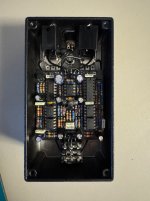
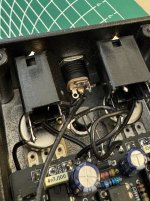
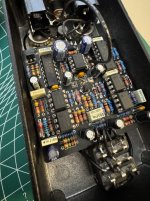
Question - with the extra power thing desoldered, does it make noise again? If you measure it while
it's making noise, are the voltage readings different?
source: I have no idea what I'm doing but I stayed at a holiday inn express last night
Thinking about it a little more, I think that seeing 9.5 on pin1 while you see 0 volts on pin 7 is
totally expected and doesn't indicate anything wrong with the circuit.
The non-inverting side of one amp and the inverting side of the other amp are supplied by
the exact same voltage (the same net).
The opposing inverting and non-inverting sides of those amps are fed by the outputs of IC4.1 and IC4.7.
An op-amp works by amplifying the voltage difference between their inverting and
non-inverting inputs to try to make them equal. This is why op-amps usually have a
feedback mechanism, where you connect the output to one of the inputs - so it amplifies
the signal but then the amplified voltage feeds back in to the input and once the sides
are equal it doesn't have to amplify as hard any more.
Those op-amps don't have a feedback loop so they have effectively infinite gain. That's why
they're bumping against their respective rails (one all the way positive, one all the way
negative).
The outputs of IC4.1 and IC4.7 could differ by just millivolts (well within the 1% resistor
tolerances) to give enough of a difference to peg IC5's outputs to the rails 'at rest',
but as soon as there's a signal through IC4 the voltages should swing.
My (non-expert) reading of the circuit is that these op-amps are basically turning the audio input
into a square wave. IC4's two halves are hooked to IC5 through diodes pointed in different
directions so each is only passing either the positive or negative part of the signal. This is
then boosted all the way to the rail by IC5, which then feeds it to the CDxxxx chip
because that's effectively a digital (on or off) input.
The CDxxxxx takes the square wave and cuts it in half (OCTAVES!!!) and then feeds it to
the other CDxxxxx which cuts it in half again (EVEN LOWER OCTAVE). So with no input
the "square wave" it generates is just "one side is on all the time".
You might not be able to catch it on a multimeter very well, you could try measuring in
AC mode, or if you have an O-scope you'd be able to see it once you have a signal on there.
Anyway - if you have an audio probe, you should go through the schematic and find where
the audio signal goes to die. A good place to start is the input and output pins of the op-amps,
which can at least narrow it down to the block of the circuit you're looking at, from there
you can binary search or whatever you like to narrow it down further. If you don't have an
audio probe, build an audio probe, and then go through the schematic and find where the
audio signal goes to die. (Seriously, I reach for the audio probe before the multimeter)