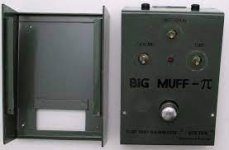
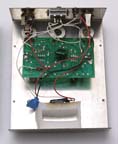
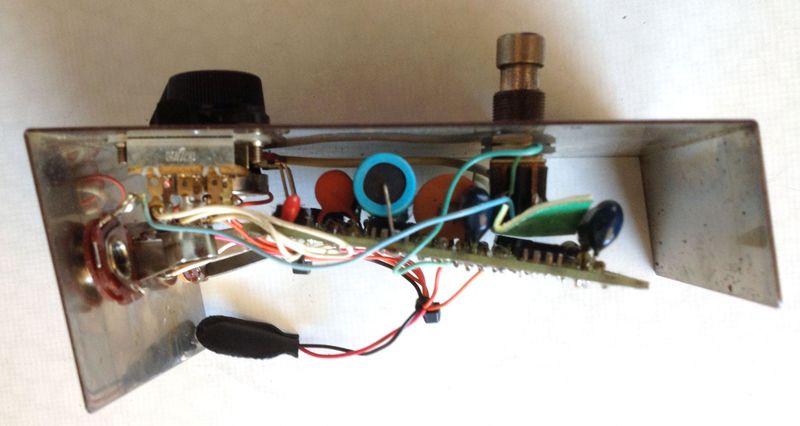
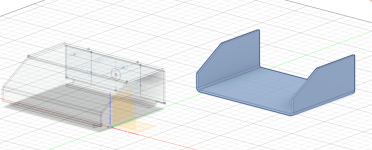
Sheet metal enclosures... inspire me

I just now realized that the angled top is going to be a challenge to letter with my usual system... I've been thinking about trying to etch some faceplates, so maybe this will be the place to try that...
I’m getting into screen printing. I’ve been compensating for this (in my head) the entire time 🤣 I have good ideas though! Definitely going to be etching a plate for sure! Any tips for that? I love your plates. I have used ferric chloride in the past but I have gotten less than ok results.
 
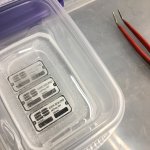
My etching procedure pretty much comes from this video:


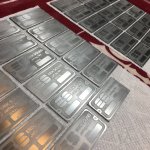
I’ve only done two sets so far, but getting consistent results has been a challenge. I etch three plates at a time for 5 minutes in a small volume of hypochlorous acid (two parts hydrogen peroxide, one part muriatic acid). I’ve started monitoring the acid temp with a non contact thermometer. The reaction generates a lot of heat, and the first few batches will jack the temp up 5-10 degrees F. If the temp goes over 100F the toner starts to release and I lose chunks of the image.

My design is part of the problem. The plates in the video are designed so that only the letters are etched, and very little aluminum is exposed, that would help reduce the reaction running away and generating too much heat. My name plate design is set up so the whole background gets etched, so I’m exposing a lot of aluminum in a small volume of acid.

I’ve also found that the acid loses effectiveness after about the fourth set of three plates. The temp stops going up, and even at longer etch times I don’t get the depth I want.

After I’m done I neutralize the acid with calcium carbonate, testing with swimming pool test strips until it’s about neutral, mix with a couple gallons of water and pour it down the drain. It’s my understanding you would NOT want to do this with any etchant you’ve used on copper as the soluble copper is highly poisonous to the ecosystem, but as far as I know aluminum doesn’t create the same problems.

For the Sproing, and a Hydra delay, I think I’m going to try just stealing and modifying an image of the ppcb faceplates that are available. Those are already set up with the lettering in negative, so they would just need to be reversed, and they’d be good to go for etch resists.

This was also my first experience with any kind of digital graphic design. A good friend made my ES logo for me, but the rest of the layout I did on an iPad with a free app called Vectornator. I was very impressed with that and would highly recommend it.

 

Attachments

  • 718DE8A4-1668-481B-A135-9325CA09DE4E.jpeg
    718DE8A4-1668-481B-A135-9325CA09DE4E.jpeg
    794 KB · Views: 21
  • 6BF8089E-E198-452E-AF12-33620F3365C0.jpeg
    6BF8089E-E198-452E-AF12-33620F3365C0.jpeg
    863 KB · Views: 21
I just now realized that the angled top is going to be a challenge to letter with my usual system...
What's your usual system?


I’m getting into screen printing. I’ve been compensating for this (in my head) the entire time 🤣 I have good ideas though! Definitely going to be etching a plate for sure! Any tips for that? I love your plates. I have used ferric chloride in the past but I have gotten less than ok results.
I'm considering screen printing but it's too much work for individual pieces. Especially when you live in an apartment. I've tried etching, but for me the final effect is not very predictable - of course, if you expect perfection every time.
 
What's your usual system?

I'm using a funky old drafting lettering system.

I posted some pictures of it here:

 
I'm considering screen printing but it's too much work for individual pieces. Especially when you live in an apartment. I've tried etching, but for me the final effect is not very predictable - of course, if you expect perfection every time.
I hear ya. I think part of my problem is I want an intricate design with a lot of detail and the way I have etched in the past was not very successful.

I’m kind of throwing a bit of everything into the pedal. I want to screen print the labels and etch a plate that will have the pedal name. A lot of work but I think it’ll pay off!
 
My etching procedure pretty much comes from this video:


I’ve only done two sets so far, but getting consistent results has been a challenge. I etch three plates at a time for 5 minutes in a small volume of hypochlorous acid (two parts hydrogen peroxide, one part muriatic acid). I’ve started monitoring the acid temp with a non contact thermometer. The reaction generates a lot of heat, and the first few batches will jack the temp up 5-10 degrees F. If the temp goes over 100F the toner starts to release and I lose chunks of the image.

My design is part of the problem. The plates in the video are designed so that only the letters are etched, and very little aluminum is exposed, that would help reduce the reaction running away and generating too much heat. My name plate design is set up so the whole background gets etched, so I’m exposing a lot of aluminum in a small volume of acid.

I’ve also found that the acid loses effectiveness after about the fourth set of three plates. The temp stops going up, and even at longer etch times I don’t get the depth I want.

After I’m done I neutralize the acid with calcium carbonate, testing with swimming pool test strips until it’s about neutral, mix with a couple gallons of water and pour it down the drain. It’s my understanding you would NOT want to do this with any etchant you’ve used on copper as the soluble copper is highly poisonous to the ecosystem, but as far as I know aluminum doesn’t create the same problems.

For the Sproing, and a Hydra delay, I think I’m going to try just stealing and modifying an image of the ppcb faceplates that are available. Those are already set up with the lettering in negative, so they would just need to be reversed, and they’d be good to go for etch resists.

This was also my first experience with any kind of digital graphic design. A good friend made my ES logo for me, but the rest of the layout I did on an iPad with a free app called Vectornator. I was very impressed with that and would highly recommend it.
Dude thank you so much for this! This is exactly what I need I will be using this as a guide!
 
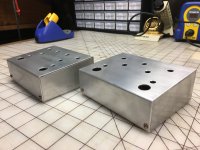
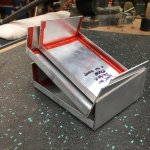
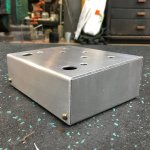
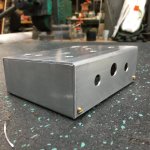
DIY enclosure update - it took me 4 tries to get a workable lower section, but once I hit a workable set of dimensions and procedures, I was able to make a second one without making any more scrap.

I don’t know how many of these I’ll end up doing. It’s a lot of work, and at the current price of aluminum, I think the material would actually cost me more than a powder coated 1590bb from tayda, even if I don’t make a bunch of scrap along the way. Maybe I’ll fall in love with them once they’ve got guts, but I definitely haven’t bought my last cast enclosure.

Countersunk flat head screws would look better/ more professional, but I had these little brass button heads, so I used them. Maybe I’ll swap them later.
 

Attachments

  • B16BAA53-7D66-466A-835C-20D3A9BF6457.jpeg
    B16BAA53-7D66-466A-835C-20D3A9BF6457.jpeg
    329.7 KB · Views: 31
  • E8AF140D-D414-4E42-A79C-D7A96A78084B.jpeg
    E8AF140D-D414-4E42-A79C-D7A96A78084B.jpeg
    640.5 KB · Views: 30
  • 59F02B10-CB40-4C31-809E-B4406BEE6B55.jpeg
    59F02B10-CB40-4C31-809E-B4406BEE6B55.jpeg
    522.4 KB · Views: 30
  • 3DAECB56-3590-445B-A0FB-D5FA79E82FE6.jpeg
    3DAECB56-3590-445B-A0FB-D5FA79E82FE6.jpeg
    518.2 KB · Views: 30
Dude these rock! Awesome job on these! My aluminum sheet just came in. What would you say is the trickiest part when doing the lower section?
 
Thanks! I mostly made dumb mistakes that could have been avoided if I slowed down and double checked things. All the errors likely would have been prevented if I had used the attached template method. The project definitely opened my eyes to the advantages of getting a CAD workflow up and running.

The tolerances are pretty tight to get something like this to look good. For each of these two encloseres I took some careful measurements from the first of the two pieces using calipers, and adjusted the dimensions of the second piece where needed to minimize any gaps.

I haven’t thought too hard about it, but there might be other designs that would be more forgiving. I like the angled top, but it would have been easier to start with a design where all the angles were 90 degrees.

Definitely let us know how it goes!
 
Dude this is reassuring! I’m very excited to start bending but this confirmed my process in how I want to do this. I want to get proficient first with Fusion 360. I feel having that element will minimize ALOT of errors. It’s all a learning curve but you got this man I would love to see more from you. BTW I really like those screws you used I think they fit the pedal nicely. Get some metallic red powder coat on that bad boy and those screws will shine 😉
 
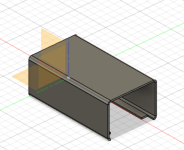
Ok this is what i have so far for the top part. The bottom will basically wrap around the sides. The sides will be under the top surface creating a "lip". Its kind of hard to explain but i can envision it in my head lol

I have a feeling when it comes time to bend the sheet metal, the corners are not going to be so round....
Enclosure Top.png
 
Last edited:
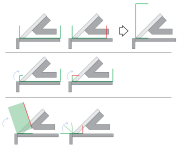
Make sure it can be bent on your bender. And plan the order of bending because it may turn out that you have to bend these short walls first. A piece of tin can or even cardboard is enough for testing.

Short visualisation of possible issues (on a box and pan sheet metal brake).
bb2.png
 
Ok this is what i have so far for the top part. The bottom will basically wrap around the sides. The sides will be under the top surface creating a "lip". Its kind of hard to explain but i can envision it in my head lol

I have a feeling when it comes time to bend the sheet metal, the corners are not going to be so round....
View attachment 46934

A suggestion, have the back and sides be the long length.

That way, when you build it, the top-jacks, PCB with pots and face are all one unit, once built. the lid is merely that, a lid (and sides) to the project.

Other wise you have to remove the jacks from the lid when you want to trouble-shoot or modify something, whatever — it's not a big deal to undo a few nuts on the jacks and DC-jack, but I prefer to stress wires as little as possible.


1682370741384.jpeg
V5_tone_Bypass_bmp_2084sm.jpg


cache_35171000.jpg


Of course, if for some unfathomable reason you like side jacks or it's 1590A-sized, carry on...
 
A suggestion, have the back and sides be the long length.

That way, when you build it, the top-jacks, PCB with pots and face are all one unit, once built. the lid is merely that, a lid (and sides) to the project.

Other wise you have to remove the jacks from the lid when you want to trouble-shoot or modify something, whatever — it's not a big deal to undo a few nuts on the jacks and DC-jack, but I prefer to stress wires as little as possible.


View attachment 46952
V5_tone_Bypass_bmp_2084sm.jpg


cache_35171000.jpg


Of course, if for some unfathomable reason you like side jacks or it's 1590A-sized, carry on...
I actually have a solution to that problem ;) I will keep this in mind though! Thank you for the suggestion they're always welcome!
 
Back
Top