Shrapnel: Prevent a Brother's Hara-kiri

genXslacker

New member
I've exhausted the limits of my knowledge and fortitude, and I'm begging for help now. I'll try to be brief.

I boxed and then attempted to rock. No joy. Bypass mode, however, worked perfectly.

I pulled the lid and noticed the D2 clipping LED was solid on... and bright at that. D3 was solid off. Brief inspection and DMMing. No problems obvious to me.

Unboxed and re-flowed all solder joints. Tried it again, before boxing this time, and everything appeared and sounded great. D2 and D3 were varying dimly on when passing signal.

Re-boxed and was right back to the condition where D2 is solid on, D3 is off, and it's only passing sound in bypass.

Unboxed again, but it didn't change anything.


An audio probe indicates signal going in on IC1 pin 3, but not coming out of pins 1 or 2.

Voltages:

VREF (added in edit to post)
at positive leg of C101: 4.28V

D100
A) 9.22
K) 8.92

IC1
1) 3.624
2) 0.486 - 0.542
3) 4.168
4) 0.0
5) 3.741
6) 3.742
7) 3.745
8) 8.92

BS170
D) 7.23
G) 2.492
S) 1.62

2N3904
E) 2.933
B) 3.354
C) 8.92

D1
A) 0.0
K) 2.495

I've swapped out ICs and BS170s. I can't remember if I've swapped out the 2N3904, but it seems pretty far removed schematically from the IC and the clipping diodes in the feedback circuit, and anyway, things did work briefly after I re-flowed the joints. I did check the 2N3904 on a DCA75, and it indicated that it's functional.

It's a tight squeeze into a 1590B, and I'm thinking I might be knocking something loose when I box it up. But does anyone have a guess on what it might be based on the brain dump above? IC1 Pin 2 voltage seems suspect to me, but I know just enough about dual opamps to embarrass myself.

The next thing I can think of is to de-solder the gain pot to verify its resistance out of circuit, but I hate de-soldering PCB-mounted pots and I'm hoping some kind soul will spare me that agony by pointing out something that I've overlooked.
 
Last edited:
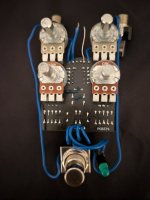
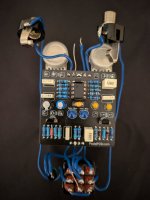
You need pics, my dude.

Both sides, including the off-board wiring. Also in box.

If it's working out of box, then most likely it's shorting on the enclosure, or there is a stray unwanted contact.

You have pot dust covers?
 
What kinda dc jack you rockin?

I notice you got a bare wire for the hot side and insulated on the ground side - nothing wrong with that, but it would be more conventional to do the opposite. Just want to make sure you’re not hooking up backwards.

Are those two 22n caps tantalum? Is the polarity right?
 
Again, it's not working out of the box. And it's not currently in a box.

The pots all have dust covers.
Ah, but it did work, you said. If it did, and it sounded good as you say, your circuit is okay, the fault is probably in a connection or a short.

For me, those generally happen at the 3pdt or at the jacks.

There is a bit of blobby soldering between the pots, there, but probably it's not the problem.

If you want to be sure and you can't find the issue just by poking things, run an audio probe from the jacks into the board along the schematic order.

No audio on pin 1 is a bit puzzling, though, as the IC looks to be getting power. Maybe something in the clipping loops into pin 2? Or an issue with vCC/vref going into pin 3?

In any case, it can't hurt to do a close visual inspection for broken joints and solder bridges and double check all values and especially orientations of polarized components against the schematic/layout
 
Last edited:
What kinda dc jack you rockin?

I notice you got a bare wire for the hot side and insulated on the ground side - nothing wrong with that, but it would be more conventional to do the opposite. Just want to make sure you’re not hooking up backwards.

Are those two 22n caps tantalum? Is the polarity right?

Thanks for looking. The DC jack was a standard-sized Stompbox Parts house-brand innie. The metal nut takes up less room than the plastic nut on Lumberg innies.

The bare 9V+ wire was insulated when boxed. I was too lazy to get up for wire strippers when I started troubleshooting and just slipped all the insulation off it to have an easy target to clip the 9V+ lead on.

Yeah, those two caps are tantalum. They were called for by the BOM in those spots and I had some on hand. I'm going to triple check their orientation when I get back to the board, but I'm 99.9% sure they're in the right way.
 
Ah, but it did work, you said. If it did, and it sounded good as you say, your circuit is okay, the fault is probably in a connection or a short.

For me, those generally happen at the 3pdt or at the jacks.

There is a bit of blobby soldering between the pots, there, but probably it's not the problem.

If you want to be sure and you can't find the issue just by poking things, run an audio probe from the jacks into the board along the schematic order.

No audio on pin 1 is a bit puzzling, though, as the IC looks to be getting power. Maybe something in the clipping loops into pin 2? Or an issue with vCC/vref going into pin 3?

In any case, it can't hurt to do a close visual inspection for broken joints and solder bridges and double check all values and especially orientations of polarized components against the schematic/layout

Yeah, a lot of the joints aren't show-quality anymore. Because I suspected I was wedging something loose while boxing, I added extra solder when re-flowing. I even added solder from the obverse side for most components. That's why the wire insulation is cooked in so many places close to the board. It was a very pretty build before I started re-working it. [sad face, tears, trembling-lip emoji] [Angel — Sarah McLachlan.mp3]

That was my process with the audio probe. There's signal until pin 3 of the IC, and then it vanishes. I don't think I probed it with the TL072 subbed in though. Maybe I'll try that next.

Maybe I'll fire up the SMD microscope and give it some super scrutiny. Like you say, it can't hurt. And I'm obviously missing something.

Anyway, thanks for checking it out and responding. I appreciate the mental elbow grease.
 
"It do be like that sometimes"
My guess is Bad IC chip, stray strand if wire touching something it shouldn't, internal trace with a dead end.... Your soldering looks pretty decent.. especially since you did a reflow and theres more solder than usual at a joint... I've seen noobs in here with really bad solder and working pedals..lol
The audio probe should tell you where to look first... but if you swap IC's and signal still doesn't come out other side you may have a bad trace to deal with.... Some of mine end up getting chucked in the maybe later pile and I move on..
 
Sounds like the issue is in or around the 1st half of the IC, since you have signal going into 3--off of R9? Couldn't see if R9 is 100k, btw.

You can also try jumpering between connections to see if a trace is dead.

What's puzzling is that apparently it worked. What would stop the signal at pin 3?

Question: what's the black goo on the solder side?
 
Sounds like the issue is in or around the 1st half of the IC, since you have signal going into 3--off of R9? Couldn't see if R9 is 100k, btw.

You can also try jumpering between connections to see if a trace is dead.

What's puzzling is that apparently it worked. What would stop the signal at pin 3?

Question: what's the black goo on the solder side?

R9: Brown, Black, Black, Orange, Brown and tests at 99.6k in circuit.

I tested all the traces around that negative feedback part of the circuit (at least I think I did), but I'll probably do so again.

Yeah, it worked... and well. It's frustrating.

It's actually green goo, though you'd never know it from the picture. It's UV-cure solder mask. A slip of the hand led to some exposed copper. I always cover those up, whether I think they could be a problem or not. I definitely tested and double-checked all affected traces at the time to make sure they were intact.
 
It seems that pin 2 of the IC, or something connected to it, is contacting ground. This would make it so one LED is constant on while the other is off. I would check underneath your pots and trim the leads that have been left long. Check out your IC socket with a meter for continuity and see if you can find a short to ground between pins 2 and 4

Lately I've been trimming leads before soldering and leaving what's left flush to the board in the manner of MadBean. At any rate, I did bend the pots back and check, and there's nothing that looks like it would make unintentional contact. There is, however, some flux I'm going to remove.

There's no continuity between IC1 pin 2 and the negative power rail, but I'm going to check the other components connected to it as you suggested.

Another clue that might have some bearing: When I pull the IC out of the circuit, the same D2 LED stays on solid on, but it's substantially dimmer.
 
Back
Top