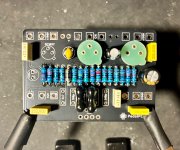
I’m having a hard time finding sockets for my Fuzz Aldrin build! BC109C transistors are TO-18 for the can. The couple of nice high quality ones are around $7-8 each One place (ThorLabs) has TO-18 Photo Diode sockets that look identical to a transistor. AI said pinout matters. How can pinout matter on a physical socket with holes that line up with a BC109? I thought you would solder the socket in place and the pinout would take care of itself. Am i going crazy??
If you’re really committed to the sockets you might need to shell out.
I was just looking at the data sheet for the ones @spi posted. I didn’t realize the real mill max ones have 4 spring fingers inside made of beryllium copper! At least you get something fancy for your 4 bucks.
AI is wrong all the time. If the socket fits, it fits.
I tried the Preci-Dip SIP sockets from Amplified and they feel like 10x better quality than ones I had from Tayda. Meaning I would probably trust them for 20 insertion/removal cycles instead of 2.
IMHO, transistor sockets in pedals is no bueno. It's a potential reliability problem. If you must use sockets to select transistors, which BTW is not necessary with the Aldrin, then after selecting transistors, either remove the sockets or solder the transistors into the sockets.
Well I won’t expect a thumbs up for this but for my lunar module>fuzz aldrin build I just used the one form stompboxparts and bent the legs in a little and checked for continuity. I only intended to for Q3, the germanium transistor as I thought it was recommended to germanium’s, but I didn’t expect Q3 to be in the middle so a silicon transistor gets one too.
I wouldn't expect all of the resistor values to be the same if Q3 is changed to Germanium, but I've been wrong before. Check the collector to base voltage on Q2 because it will be much lower than if Q3 is Si.
I wouldn't expect all of the resistor values to be the same if Q3 is changed to Germanium, but I've been wrong before. Check the collector to base voltage on Q2 because it will be much lower than if Q3 is Si.
The only time I use transistor sockets is for testing, and occasionally for Ge transistors. Even then I'll usually remove the socket once I have the Ge tranny I want and solder that tranny to the board. Sockets, particularly the inline snap-off things, are unreliable and have caused me plenty of problems in the past. Strangely enough IC sockets have never caused me an issue though!
- this will allow you to select the ideal transistors that sound good to you.
the same point/concept applies to selecting clipping diodes, opamps or whatever else for many other circuits that don't involve obsolete parts.
i.e. for many circuits that specify some obscure opamp, or one that no longer exists in thru-hole format (e.g. MC33178), with a breadboarded circuit, you can test and prove to yourself and your ears that the opamp of choice (likely) makes for a barely perceptible audible difference
(not all, but most cases, this has been my experience).
- same with JFETs. perhaps you can't find the right JFET part number, or it's not available anymore.
with a breadboarded circuit you can just try something else that has similar Idss & Vgs(off) specs, (and same pinout) and see how it sounds.
(had a recent experience where 2N5457 sounded even better than the obsolete 2N5484).
sometimes you don't even need to use a JFET (e.g. input buffers in boss circuits; some NPNs will work just the same).
- now, let's say you don't have a cache of transistors like @jwin615 and none of the transistors in your inventory are biasing up to the idle voltage that you're aiming for.
you're fucked right?
no. because you've breadboarded the circuit, you can try different (resistor) values to adjust the bias, and hear in real-time the effect this has on the sound.
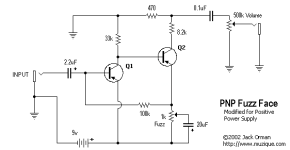
e.g. fuzz face. (a great circuit to explore the behaviour of Ge transistors etc.)
let's pretend you've breadboarded the circuit with these exact values, but you can't get Q2 collector to idle at 4.5V (or close enough).
- well, the good news is, you can replace the 8K2 resistor with a different value to adjust this bias voltage.
you don't have to just follow the schematic exactly as per the original.
- the best way to do this is with a trimpot. replace the 8K2 resistor with something like a 10K or 20K trimpot and adjust til you hit the target Q2c bias voltage, or for a particular sound that you like (i prefer 5V).
- you can then measure the resistance of that trimpot and then replace it with a resistor of the closest value. or leave the trimpot in, it's up to you. (for some Ge circuits, i like to leave a trimpot in here to account for seasonal/temperature effects on idle bias)
the fuzz aldrin isn't really a great example of this biasing conundrum since it involves Si transistors that don't rely on current leakage to bias properly as many vintage Ge transistor circuits do.
However, if you breadboarded the fuzz aldrin and didn't have any BC109 transistors, you could use literally any other NPN transistor of the same pinout, and then decide if they sound good enough for you. heck it could sound even better than the og specified transistors.
many builders/beginners don't have the patience to breadboard a circuit, probably due to apprehension and fear that it is hard and difficult to get a working circuit. (or other odd excuses that confound me...)
but it's not.
like many things in this hobby, it is all about attention to detail.
if you start small and work your way up to larger circuits, you will soon have the confidence and sharpened focus to take on larger circuits successfully.
just like playing guitar, it takes regular attempts / practice to gain success.
i have made fuck tonnes of breadboarding errors. i am not very smart.
sounds cliche, but i have learnt way more from fucking up and fixing breadboard errors than anything else in this hobby.
if there's any advice i can give for breadboarding:
1) PINOUT. always check the pinout. it's so easy to get this wrong.
2) there's no one correct way to do breadboarding.
if the circuit works, it works. it's not meant to be a final product. if you have to use a lot of jumpers to make something fit/connect/have continuity, then do it.
some folks bitch about breadboarding being a waste of time because they're inherently noisy or whatever other bs grievance they might have.
IME:
- i've found that the construction of the breadboard rig is important, paying close attention to grounding routes/continuity, and available shielding that the breadboard itself sits amongst.
- the position of filter caps along the power rails and proximity to active components (V+ pins) has way more of an effect on noise than the number of jumpers flying around. don't always assume that where you've positioned the filter cap(s) is a good one.
TL;DR,
you can either invest in yourself and try breadboarding, opening up a lot of opportunities to try different parts, mods, substitutes/alternatives, and accelerate your understanding, and then allow yourself to do the final build with the selected/tested/auditioned components correctly the first time.
OR
you can use additional, unnecessary, unsightly plastic and solder it to your PCB.
@owlexifry Great read man ! I must confess I one of those that “just don’t have time” to learn to breadboard. I started learning to breadboard when I first started building pedals probably 15 or so years ago and then took a long 14 year hiatus. I’ve just gotten back into it. I know I should learn. But like everything at my age now it’s a damn investment lol. That isn’t to say I won’t learn though.
I've used sockets for most transistors and ICs on my builds, and haven't encountered issues when using them. I don't put my pedals into rigorous enough use to knock anything loose. If I were building for others I'd probably solder them though.
Given the number of times I've inserted a transistor or IC incorrectly (often the transistors I've selected have different pinouts than what's on the board), I'm glad I've used sockets--saved my ass many times.
Why does every #$%^&* thing in the universe now have to have total polarisation?
This against that, us vs them, spacers vs settlers...
JUST USE THE RIGHT TOOL FOR THE JOB!
Sockets have their place, and I will continue to use them where they make sense and avoid them where necessary.
I am pro-breadboarding, though I'm not a pro at it — when it makes sense to breadboard a circuit, I will do so (multiple variables);
if it makes more sense to socket a single transistor on a PCB so that I can try different transistors, I will do so (more direct to finish).
Socketing entire PCBs is what got me into breadboarding.
DIYFYOP (find your own path), do whatever works for you.
ARM YOURSELF WITH AS MANY TOOLS IN YOUR ARSENAL AS YOU CAN — learn to read schematics, breadboard, desolder, resolder... make the circuit work and then decide if you like it enough to box it and put it on your pedalboard (or someone else's board/studio/stage/bedroom-floor...).
bro, calm down, i’m not your dad, im not @bluedmc777 ‘s dad either, my opinions aren’t an instruction.
if you wanna use sockets, fill your boots, do what makes you happy
i initially opted to stfu because i knew i’d see reactive emotional posts like this, but @bluedmc777 asked, so deal with it.
my advice is simply based on my personal experience of what i’ve found to be worthwhile. and that’s not gonna be for everyone.
but if you’re taking my advice as a personal dig or some righteous claim then idk, that might just be a you problem

 One place (ThorLabs) has TO-18 Photo Diode sockets that look identical to a transistor. AI said pinout matters. How can pinout matter on a physical socket with holes that line up with a BC109? I thought you would solder the socket in place and the pinout would take care of itself. Am i going crazy??