Wah Inductors. No hype. Just measurements.

That would be perfect for what I am looking for, any chance I can have it ?
Otherwise just a drawing would be great as well, I am used to making my own footprints in KiCad.
Thanks
Mick
 
Sorry for the Hijack here, I mean...you can go hi-tech or you can just go lo-tech sometimes

....I can't intellectualize by the numbers.

For me, it all came down to the tone pot.

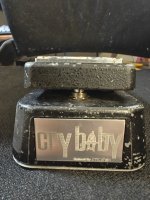
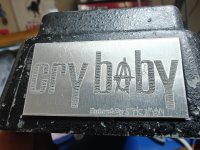
Years ago I modded my first Dunlop Crybaby following the 'stinkfoot' wah mods...dug through the parts drawer and gave it a shot.

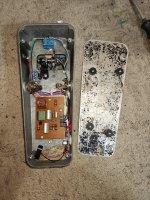
Upgraded to a 3PDT, and bypassed the buffer
(***One thing for sure, I now need to plug a JFET buffer after the Wah pedal in the chain, or it barely works.*** )

changed a few resistors and capacitors. That seemed to darken things, and tamed the shrill high end.

...Upgraded with the 'Red Fasel' inductor from the stock coil. That changed the voice!!

That made a pretty noticable difference in the sound, nice, a lot more 'authentic' tone? Ok maybe that's not the correct word here, as we know the Red and Yellow Reissue fasel induction coils are not the original, Induction me into the Rock and roll hall of shame then.

But something wasn't quite right yet....The Travel on the pedal just didn't seem to be right, something was still missing I don't know.

I played around with the 'travel' a bit and tamed the ear drilling highs, but there was something in the mids I wasn't getttin yet...Shrieking high dropping down to a pretty flat bottom end. Underwhelming.

The Crybaby came stock with a 100K pot, and during research I randomly read on the google somewhere that Hendrix had a 250K pot, honestly I looked everywhere and could NOT find a 250K tone pot for a wah, hmmmm that's very suspicious....I wondered for awhile maybe this is some kinda well hidden secret sauce or something?!?!? Only one way to find out.

Lo and behold I tried ordering a Wah tone pot from mojotone, It was not a 250K pot, but a 200K I think?


Right off the bat it Crackled worse than anything, no amount of de-oxit was working!

I took it apart and saw the graphite was totally Scored and damaged somehow!!!? Unbelievable, there was NO WAY I did that, it looked like a factory defect!!!!

The part was a dud!!! Wow.

I politely notified them and was met with a muted response. They did not reply to my message, and those Wah parts had just mysteriously vanished from their site next thing I know. HM ok...Fine. I just paid about $25 bucks for this part. Great...Grand.

Out of sheer 'I AM AHAB!!!!!!!' towering force of will to power....I went down to the old local ma and pa guitar store a few towns over, bought a generic 250K tone pot for a guitar for a whopping $6 dollars.

Did some serious reaming and straight up Jammed the Wah pedal gear on it, stuck it in..Bam!!!

Who needs a freakin' specialized Wah pedal tone pot..., let's see what we can do.


YARRRR THAR BE THE SECRET TONE YE BE WANTING MATIES!!!

No way, I'll be dipped....There it is.

That Raw and gnarly midrange that just tears at you ferociously. When you make that 'OOoOOOOoooo' Face. Jumping out at me!!!


It really really made all the difference!!! Honestly, that was the secret sauce right there. It's alive.

.....that my ears perk up!!! right here, that's....Eureka!!! There we go.

Now If I could only just do something about those horrendous 6 pin Quarter inch Jacks they're using in their modern Crybabies. UGH!!!

For me the induction coil was only half the battle tone chasing the elusive dragon....You might hate the sound of my wah pedal, I mean, different stokes different folks, sometimes a Stock Crybaby will do just fine, you know? I'm not saying I made it better or anything.

I could have probably just built a better wah from scratch and tossed the original guts in the trash where they will do more good.

Can you tell I had fun at least?

So what tone pots are you guys using in your wah pedals?
 
Last edited:
Oh shit! Joe found my thread!

Whatttt. I'm not worthy. I'm not worthy!
awesome thread


rossbalch said:
I picked up these pots and the associated bobbin https://nz.mouser.com/ProductDetail/871-B65661W0000R030


What's the best way to calculate how many turns you need for a given inductance?

Looks like you got larger ferrites than are standard. Still usable, mind you!

My experience with N30 as a ferrite grade is that winds of around 20-35 ohms work well for achieving around 500mH. 40AWG is a decent starting point.

Magnet wire is pretty predictable, you can guesstimate how much length you'll need and there are, ways to calculate how many winds that translates into. I'll see if I can dig up that info.
 
Last edited:
I have the inductance and ohms of a few inductors, if you want that info. I have an N30 gold text from a 1994 limited edition V847G, a Wilson Effects halo, a Dunlop yellow, and a couple black inductors from the 90's. I measured them with my EXTECH LCR meter.

As for measuring and logging your pots. If you can build a fixture to spin two or more pots at the same time, you can do the following.

You can use the Innovate Motorsports SSI4 to data log and/or view up to four pots in real-time. The SSI4 requires 12V to power it, and it has a 5V output you can use to power a linear pot. I wouldn't use its 5V power output for both pots because it would parallel them, so you'll need another regulated 5V supply for the other pot. The 12V supply, and the 5V supply share the same common ground. Likewise, the additional 5V supply must also share the same common ground, so the two pots will accurately reference the same ground. Basically, tie the negative of everything together.

It is designed for Automotive data logging, but you can use it for this purpose. Check the manual, but you can probably power it with a 9V battery, or a 9V adapter.

Anyway, the SSI4 has four 0-5V inputs. You connect the wiper and the negative lug of the linear pot to input 1, and the wiper and the negative lug of the second pot to the second input.

In the LogWorks software, each channel will have its gauge. So pot 1 will have its voltage displayed, and pot 2 will have its voltage displayed.

Use the voltage at the min extreme, and the max extreme for each pot, that is being displayed on the screen to set the 0% and 100% parameters for each pot, and give them a name. Linear for the linear pot, and Hot Potz 1 (etc...) for the other.

If the actual readings end up being something different at each extreme of the pot's rotation than 0V and 5V, and they probably will, like 0.00V, and 5.2V, then 0.0V would = 0%, and 5.2V would = 100%.

You input that info into the fields, and the software updates that gauge for you. You have to do this for each pot, turning each pot to its extremes to get the voltage for each pot, to set the parameters for its gauge.

It has been about 15 years since I did this, but this is how I remember it working. I did this for sensor data on an ATV to tune it. For example, the TPS was at 1.12V at 0% throttle, and the wide open throttle (WOT) was something like 4.65V. So I inputed 1.12V = 0%, and 4.65V = 100%. I called the gauge TPS with those parameters, and it worked excellent.

With this, you'll be able to compare the wah pot against the linear pot based on percentage. I think you can also plot gauges/channels against each other to compare the sweep of the pots on a graph.

You will know if you are turning them accuratly if they all start at 0% together, and end at 100% together. They'll all be different within that, but they should begin at 0%, and end at 100% at the same time.

Do you have plans on having a pot manufactured? If so, I hate high torque pots. I want the wah to move quickly, and freely. Inductors make their impact, but, IMO, the pot is the most critical part of the sound, and its feel shouldn't get in the way. Leave that to the axle/hinge pin tensioner.

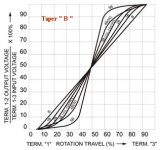
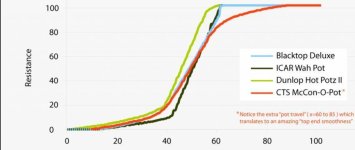
By the way, what are some 100k pots that actually have the correct Icar taper?
 
I guess I should elaborate on why I asked the question, what pots "actually have the correct ICAR taper?"

I have tried two different pots that claim to have the ICAR taper, and both are extremely different. One is great, the other is not. I have never used an old ICAR pot, but of these two that claim to have the ICAR taper, one nails the sounds we all know and love, and is very vocal and satisfying under foot. The other is more like a bass/treble on/off switch, with very little vocal mids.

A thought came to me after my post about data logging the pots. Since the pots are turned counter clockwise to brighten, and we think of them as increasing as the toe goes down, I think it would be better to make 5V = 0%, and 0V = 100%. Then, turn the pots down during the test, so LogWorks will show it as an increase.

Well, actually, after thinking about it even deeper, it would be best to set the voltage you get with the pot set at the ohm with the heel down as 0%, and the voltage you get with the pot set at the ohm with the toe down as 100%. This will increase resolution, so your eyes can see what your ears hear. Isn't that what we are most interested in?

If you perform this experiment with the SSI4 and LogWorks, since we have pots that crowd their best sound/wah sweep off center towards the treble end, and others that have their best sound/wah sweep better centered, I think it would be best to NOT test the full range of the pots. That wouldn't be a good comparison. Instead, I think it would be best to set each pot for its best sound in the wah, ohm the min and max, then set the pot up to sweep within that range during the test. Then, when you overlay the sweep, you'll get a much better comparison of their taper.

Also, after thinking about it, I don't think using a linear pot to compare against would be very helpful. Using a pot we all know would be the best baseline. I think the Hot Potz 2 would be the best option, since it has a broad linear feeling sweep under foot.

If using different wahs to setup each pot for its best sound before the test in LogWorks, each wah needs to have the same component values, inductors, and even the same bump stop lengths. Then when conducting the test with the SSI4 and LogWorks, set each pot up to turn only within its best sounding range, and you will have the best overlay comparison possible.

You could also compare the full rotation by making 5V = 0%, and 0V = 100%, just to compare the full track, but I think the best sounding range of the track is more useful for comparison.
 
Back
Top