BuddytheReow
Moderator
You could definitely squeeze one of mine on the bottom board if you're still tweakingYes, still on my breadboard. But I need to clear it off so I can build some of Buddy’s drive circuits.
View attachment 22091

You could definitely squeeze one of mine on the bottom board if you're still tweakingYes, still on my breadboard. But I need to clear it off so I can build some of Buddy’s drive circuits.
View attachment 22091


 Works pretty well as a fixed wah-type filter.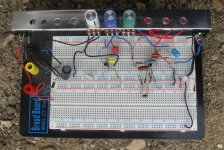
I may have tweaked it a little.
Keep tryin', Man. I have plenty of near-misses & out-'n'-out failures. I only show off the good stuff.I had a breakthrough.....but it fell through


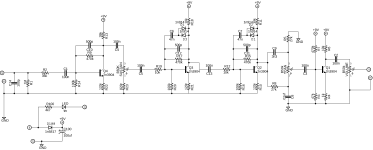
I wanted to name a a pedal calledHere's another one I cooked up between last night and this morning. The main sound I got last night and finished the TONE control this morning. This one is a heavy overdrive/fuzz circuit I'd like to call AIR NUTZ. To build this one the board you will need to bypass the third transistor stage. To make the TONE control (it's really a BRIGHT control, but I'll stick with Muffin terms, LOL) better I added a 820ohm resistor to ground after the TONE knob. I've designated this one R200.
View attachment 21564
View attachment 21565

Ok, so here's the deal. Breadboarding is too easy, I like to try to do it on the PCB itself and make a big ol mess. Here's what I got. It's a kind of elk fuzzish with more distortion and less fuzz, to my ears anyway. I couldn't stop playing it.
View attachment 22242
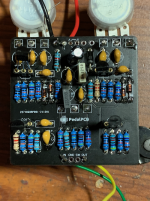

That's niiiiice! I like the tone cap values and the dual-clip action. What's that wire coming from the sustain pot?
Oh, that's a 100k resistor on a 100k pot. I forgot to clip it off. I'm really digging the sounds I'm getting. I just got some PCBs for this in today, right after I made the final changes to this. Seems about right.That's niiiiice! I like the tone cap values and the dual-clip action. What's that wire coming from the sustain pot?

Right, but the 100k resistor on a 100k pot will more or less reduce the part of the rotation that doesn’t do much. It would hurt the sustain pot to keep it at 100k.That won't sound quite the same as a 50K pot. I will sound the same at 0 and 10, but the volume will drop more around noon with a 100K pot than with a 50K pot. The tone sweep will be slightly different too.
When you get a chance, can you measure and report the collector voltages?

The main reason is I have a lot of sub-1K resistor values on hand so it's convenient.Why do you like the drain current to be so high?