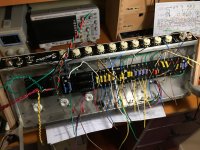
This is on my bucket list, but I'd love to cross it off soon. Problem is, I don't know where to begin. Should I go the kit route or source all the parts myself? I also have no idea what flavor I want, though id like it to be a good pedal platform. Buddythereow Can anyone point me in the right direction for some good night time reading or youtube?
I went the kit route for my amp and tube reverb. My theory was that the kit parts are known to work together. If I sourced or designed the wrong parts and the amp did not work, it would have been harder to troubleshoot. That is a weak excuse, but it was my theory at the time.
For kits, I liked Weber amps and Mojotone. Weber amps seems to have better prices and the cabinets are customizable.
Uncle Doug (YouTube) has some good information on safety when working with high voltage (rock'n'roll). Also goes through some amp designs explaining how all the different parts work together. Well worth a look
When I was first getting into amp building I did a Mojotone kit followed by a Ceriatone kit. Ceriatone is getting pricier than they used to be, but I like their kits better. Quality parts, well-planned layouts, good documentation. I won't say impossible to mess up, but they make it very easy to do it right.
The guys on the 18WATT forum are very displeased with Mojo for selling kits and offering zero support, then everyone asks questions at the 18w forum. Their earlier 18w kits literally had troubleshooting 'alternate' locations for their capacitors "just in case" you got run-away oscillation. Which everyone did.
TubeDepot used to offer support and said so on the front page. They were inexpensive. This no longer appears true.
Hoffman amp has detailed parts lists with prices and the EL34 forum for support which Hoffman is known to answer.
Weber used to say These aren't erector sets kiddies, you're on your own and can sometimes have some pretty ratty components.
Used to be small kit makers that offer support. I think the world had gotten too big for that kind of service.
It's not really that hard to start with a layout, glean the components list from that and start putting it together. I did that after my first amp which was a SDG 5e3.
Metropolis used to be the best Marshall kit maker around, he's gone into full time larger facility production and has handed his kits over to Valvestorm, which offer Metro's kit instructions. This is some really good stuff, but it's all marshall.
The link below is how to build a Marshall 50w plexi model 1987. If you read this from front to cover, you should be able to get the idea and feel for how to build an amp. A lot of this stuff is very specific to building reproductions that are exactly the same as original Marshall amps. I really feel this is the best 'how to' on amp building I've ever read. I have a bunch of Metro's layouts if you're interested.
After building the first 5e3, I found some Hiwatt DR504 layouts and schematics on Mark Huss site https://mhuss.com/ and rolled my own DR504's. I built quite a few of these. I've never bought Ceriatone, but I've downloaded a crap load of their layouts, and used those to make my own layouts, which I make in actual size so I can fabricate as many of the components as possible like turret/eyelet boards and drill my own chassis.
I highly recommend a Mojotone kit. They have quality parts that are conveniently separated and labeled, excellent support, and some of their most popular kits (like the 5E3 or the Deluxe Reverb) have hundreds of pages worth of documentation available.
If you want to save money, get your cab from GuitarCabinetsDirect.com. They used to do Mojotone’s cabs until a few years ago when Mojotone started building them in house. Other advantages to using GCD are that they don’t charge extra for custom cosmetics and they generally have a faster turnaround than Mojo!
Building a tube reverb unit is one of my wet dreams (get it?). Seems costly and the potential to screw up an expensive build is real in my case.
Anyway, for those who are interested in Mojotone kits I found this video by this guy who seems to know what he's talking about, though I have no way of knowing if he's legit.
I don't use kits very often these days but the Mojo kits are mostly decent. Weber kits not so much. I miss the Metroamp kits - everything was top-notch. Valvestorm are ok but need to be prodded from time to time. The stuff they sell is excellent though.
I usually get a layout diagram and work through all the parts needed that way. I often use Antique Electronics (tubesandmore.com) because the y have most parts I like and are well priced. I often buy chassis and tag/turretboards from Mojo then everything else from Antique. Things like 1W resistors I'll buy at a local store. If I'm building a Marshall style amp then Valvestorm are the go.
Once you know the basics you don't really need instructions. But it is important to know how best to wire filaments and how to rout the wiring. Things like keeping plate wiring away from grid wiring are not obvious but once you know you know. And we are here if you need help!
Building a tube reverb unit is one of my wet dreams (get it?). Seems costly and the potential to screw up an expensive build is real in my case.
Anyway, for those who are interested in Mojotone kits I found this video by this guy who seems to know what he's talking about, though I have no way of knowing if he's legit.
I think what I really want is a deluxe reverb, but I probably need to walk before I can run. Should I start simple with, say, a 5F1? I'm checking out Rob Robinette right now
I think what I really want is a deluxe reverb, but I probably need to walk before I can run. Should I start simple with, say, a 5F1? I'm checking out Rob Robinette right now
I agree with @Harry Klippton . No sense in buying something you're immediately going to outgrow.. StewMac's kit is sourced from Mojotone and has instructions that detail down to the length of wires to cut:
Build it stock first and make sure it works as intended. If you want to tweak/mod it after that, it's super easy. As mentioned above, Rob Robinette has a wealth of info on the circuit, as well as useful mods:
I'm starting with Rob Robinette Micro Bassman because it's a first for me too ant it gives me less things to mess up and diagnose after (high voltages, wire location, etc ... ).Plus I think it will be powerful enough for house practice. But I know I may want to go full size bassman later, in any case I could use some parts from the Micro build. I tried bending my own chassis... ended up buying yesterday.
A few years back, when I decided to build an amp, the two ”finalists” were Trinity and David Allen. I ended up with Allen, especially since I wanted a Fenderish design. The hardest part was deciding which kit to build. He offers two levels of kits—one that has complete instructions (illustrated, 40+ pages, etc.; and the other, bags of parts, the schematic and a wiring image. Parts quality was very good. Really nice stainless steel chassis. David offered additional phone support, and the potential to send him your non-functioning kit to be made good (there was a cost involved for the latter, I’m pretty sure.)
David retired about a year ago, and there are new owners that are talking about bringing back some of the older kits that were discontinued even. But I have no experience with them.
What I ended up with absolutely surpassed my expectations. I went with the Encore, as a 2x10 combo. Easily the best Fender style amp I’ve ever plugged into. If I don’t have anything plugged into it, I can’t tell it’s turned on in my guitar room. Lovely bias trem, reverb with a tone control, a good master volume, and a raw control that fades the tone stack out, getting from blackface through blonde, into tweed. The ability to bias for either 6L6 or 6V6, (and with bias test points right on the back panel!).
i save a few hundred building the kit, but that wasn’t my primary objective; I’ve built stereo tube equipment (well, none in the past 30 years, except for a dynaco 70 I’m currently rebuilding with van Alstine mods)—but had never worked on a tube guitar amp beyond replacing caps.
Don’t go into this expecting to build something that will recoup its costs if you need to sell it; pretty much like a well built parts guitar—you may have the equivalent of a $3500 boutique amp (David’s prices were low compared to most boutique builders), but don’t expect to sell it for half that.
Sorry, TL;DR worthy… But do it! Anyone that loves pedal building really should build an amp!