
You are using an out of date browser. It may not display this or other websites correctly.
You should upgrade or use an alternative browser.
You should upgrade or use an alternative browser.
What’s on *YOUR* workbench?
- Thread starter Bricksnbeatles
- Start date

Locrian99
Well-known member
Big fan of the tayda hanmered powddr
Coats.
almondcity
Well-known member
KiCad. Super easyThat’s awesome! I’ve thought about trying it, do you use diptrace or KiCad?
You may notice I forgot to have them remove the order number so I just went over it with a sharpie lmao

synthesiserror
Well-known member
Wow, they put it in a terrible spot.You may notice I forgot to have them remove the order number so I just went over it with a sharpie lmao

DeadAirMD
Well-known member
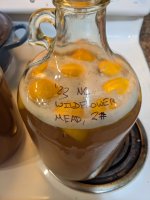
Man, I haven't had Mead in too long. Years ago, a security officer I was friends with at an old job, made some incredible Mead with honey him and his dad made. I remember being shocked at how much they needed to use. I'm salivating just looking at that growler.A couple gallons of mead using my dad's honey

MBFX
Well-known member
Man, I haven't had Mead in too long. Years ago, a security officer I was friends with at an old job, made some incredible Mead with honey him and his dad made. I remember being shocked at how much they needed to use. I'm salivating just looking at that growler.
Quite a bit is required! Roughly 2#/gal for dry, 3#/gal for sweet
What’s #/gal for those of us outside thr us?Quite a bit is required! Roughly 2#/gal for dry, 3#/gal for sweet

jessenator
Well-known member
US pounds per gallon—the ratio of honey in pounds, so whatever those conversions are to:
Kg per litre
I imagine
Kg per litre
I imagine
1 # = 1lb = 0.45kgUS pounds per gallon—the ratio of honey in pounds, so whatever those conversions are to:
Kg per litre
I imagine
1 gallon (us liquid) = 0.83 gallon (imperial) = 3.79l
So basically a lot of honey

MBFX
Well-known member
Yes, in proper metric units you are correct.According to my math that’s 120 g/liter or 180 for sweet.
Unfortunately, enology is an absolutely fucked science that uses absolutely fucked measurement conventions. Vessels are measured in imperial, bottles in metric, tank and pump hose fittings in imperial unless you have European tanks (exceptions apply), dry ingredients such as yeast and sulfur are measured in grams but grapes in tons....

GizzWizzKing
Well-known member
Thanks for sharing this! I haven't made mead since highschool! I got into beer brewing during COVID which was great. But since then I have developed some less fun reactions to gluten so adios to the beer. I think I will take another stab at the honey wine.Quite a bit is required! Roughly 2#/gal for dry, 3#/gal for sweet

DGWVI
Well-known member
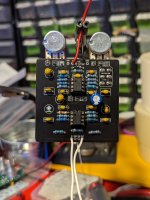
I'd forgotten I had ordered a few of these Cleric / Warlow boards

This thing fucking rips! Toggle in the middle, tone full CCW, Sustain and Volume dimed
Waiting on some enclosures, some more LF353s, and the Kewpie board to get here, but I wanna do a shootout. Maybe a combo build. Maybe parallel
This thing fucking rips! Toggle in the middle, tone full CCW, Sustain and Volume dimed
Waiting on some enclosures, some more LF353s, and the Kewpie board to get here, but I wanna do a shootout. Maybe a combo build. Maybe parallel

Bricksnbeatles
Member known well
Looks rad! I have this board, and recently found it in my box of pcbs that I need to build– As far as the FAC/Depth knob goes, what cap values did you opt to use, and how noticeable is effect of that control? Seen a lot of people on the GCI pcb FB group saying that the rotary switch doesn't make a noticeable difference thru its rotationThe Apostle is boxed up, drilling was fine except for the rotary switch hole which I forgot needs to be larger than a normal pot hole, but that was an easy fix.
Also a bit of a goof, the dual gang pots (which the Musikding kit did not include - it included single gang pots instead, but I did get a voucher for my troubles so it's fine) I ordered were accidentally linear and not logarithmic, so apparently the normal "noon" position for treble and bass is now somewhere around 20% of the rotation. I thought 50% is the same in both and just the rest of the taper was different (for whatever reason), but obviously I was way off mark.
It still works and sounds fine, but it's a bit noisy (just background hum - doesn't change if I touch anything so I don't think it's a grounding issue, but I'll double check that the input and output are making a good connection at some point) and also very loud and high gain (fun comparison to the Viceroy which I've been troubleshooting for a while which has way too little gain and volume). I'm pretty sure everything is correct, and I biased the JFET's at 17V (originally 16V but rebiased them to try and get more headroom and less gain) as they should be AFAIK. Maybe it's just a very high gain circuit? I feel like there's no reason to put gain and volume over noon, or at least if you include the boost knob in the equation.
It also has a switch between Orange and Matamp tone stacks, I don't know which one is which, but one seems to be more balanced with the edges rounded off. Both are interesting flavours.
Edit: Attached photo, featuring the God of War font @music6000 pointed out to me some time ago.
The toggle switch is sadly a bit skewed, I should see if I have a washer that could work there.

Fama
Well-known member
I had the Musikding kit so I just used some from that. There are 6 of them, I think they go from 1n to 68n, but I'm not sure what exactly they are. If I had to guess and try to vaguely remember, I think they doubled every step, more or less.Looks rad! I have this board, and recently found it in my box of pcbs that I need to build– As far as the FAC/Depth knob goes, what cap values did you opt to use, and how noticeable is effect of that control? Seen a lot of people on the GCI pcb FB group saying that the rotary switch doesn't make a noticeable difference thru its rotation
But to be honest, it is very subtle. I can definitely notice a difference between the smallest and biggest value if I dial in a weird tone with no bass, but otherwise it's pretty hard to notice any difference. A two position switch between the two values would do the same trick.
The EF120 Overdrive is more noticeable IMO, and it seems to go from nothing through 2.2n, 4.7n, 10n, 22n to 100n. Maybe that's a better range, or could be other differences in the circuit that make it easier to notice. You could probably snip out a couple of the intermediate values and not notice anything.
Edit: The wrong pots I used might color my impression a little, but I do think this is not a very high quality PCB or instructions, from the BOM error, through the cluttered layout and to the depth switch being so subtle. If someone was asking me whether to go with the EF120 or this one, I'd probably say EF120 - the tone stack switch is cool, and I'm still not sure how exactly Drive and Gain differ in the EF120, but I still prefer it. Obviously since you already have one of the PCB's, it's worth building that one.
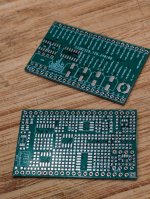
U10 looks pretty straight forward!!!Why did I have to do this to myself? Really, really not looking forward to stuffing this.
View attachment 66318
Fama
Well-known member
Did you look into the SMD soldering services? That seems like something where it might make sense, although obviously it would cost more and if you're still experimenting it might not be worthwhile. But the examples I've seen have been very reasonably priced.Why did I have to do this to myself? Really, really not looking forward to stuffing this.
View attachment 66318

JTEX
Well-known member
Yep, that's the chorus chip. I'm still bummed they don't make it in SMD.U10 looks pretty straight forward!!!
JTEX
Well-known member
I've used JLC assembly in the past, they fitted most passives, which is like 90% of it. But this one's a new revision, I'll have to stuff one by hand to make sure it works. That's a whole day's work...Did you look into the SMD soldering services?