
chongmagic
Well-known member
Traded a pedal for this today, sounds much better than I thought it would. Great cleans! Gets hot as hell though.

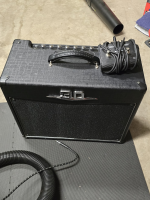


I think that's an issue due to where the tubes are in the cabinet and chassis - it's been a while with those. Make sure to have air moving in the back of the chassis and you'll probably be good. Watch the tubes so they don't glow red!Traded a pedal for this today, sounds much better than I thought it would. Great cleans! Gets hot as hell though.
I had one of the 18?20? Watt models (older/tan covering), and it was a decent little amp. I essentially turned it into a modded JCM800 and then eventually sold it. Was honestly my favorite grab and go amps I ever had and wish I never sold itTraded a pedal for this today, sounds much better than I thought it would. Great cleans! Gets hot as hell though.
View attachment 72253

Very good point about the iron!Overheating can have a number of sources. The ventilation is important but not as important as the weight of the transformer. The more plates, the heavier the heat sink, the less concentrated the heat becomes and the ventilation can have a chance to keep the cabinet cool. When you see those "fat stack" transformers, that's why they're fat. They don't have more copper, just more iron.
If your tubes were red-plating you'd hear it. Blurba blurba kinda wavy sounds in your guitar tone. Ask me how I know!!!!!
There were plenty of very early Fender models that ran very hot too! In the 50's no one had any idea what guitars were about to become in the world of music. Organs were much hotter at the time!!! So the idea that people would drive a nice clean sounding guitar amp into overdrive wasn't yet conceived of. Transformers were built accordingly.Very good point about the iron!
makes Me wonder if the overheating is related to ’intended” use (ie where the clean channel is still clean, and the drive channel is turned down by the master etc), or by those of us who appreciate the sound of a cranked amp, and like to run them wide open?
the lightweight “modern” iron is one of the reasons I cringe when folks slap attenuators on some of these lowered price point master volume/preamp gain type amps. Without folks realizing the extra heat generated by cranking the output section of an amp designed to run the output cool (ie: light duty transformers), I just see folks slowly cooking their output transformer, and by using a attenuator, they don’t get the natural “ear fatigue” that would encourage them to turn down/off, they keep it up longer per session.
note:I’m not saying attenuators are bad, they just make it easier to do things that are bad for the modern lightweight transformer.
I’m thinking more of the folks that get an amp like a Soldano or 5150 etc, which is designed to be all preamp gain and don’t push the output… yet folks will attenuate (again it’s not the attenuator causing the problem , it’s pushing the amp louder than it should be that is)There were plenty of very early Fender models that ran very hot too! In the 50's no one had any idea what guitars were about to become in the world of music. Organs were much hotter at the time!!! So the idea that people would drive a nice clean sounding guitar amp into overdrive wasn't yet conceived of. Transformers were built accordingly.
Leo knew he could make more money with less expensive amps and guitars, so it was very important to make them as inexpensively as possible. I heard him say that in slightly different words when I got to meet him in my early teens, but it was VERY important to him that as many people as wanted to afford an electric, could afford an electric.
And by that I mean I could see it in his eyes when he said that, from a standpoint of improving peoples lives not just the bottom line. It wasn't BS. But I digress.
I hadn't actually thought of transformer abuse by using an attenuator! The attenuator, either passive or reactive, needs to stay cool with a good heat sink just like the transformer.
So you probably wouldn't want to use one with say a Princeton reverb with fixed bias which uses the same PT as the much lower watt champ with only one tube and cathode bias.......
I knew several musicians that early in their career drove POS cars so they could afford that 2203 Superlead 100...! And then there was Larry who just had his rich girlfriend buy one for him.I’m thinking more of the folks that get an amp like a Soldano or 5150 etc, which is designed to be all preamp gain and don’t push the output… yet folks will attenuate (again it’s not the attenuator causing the problem , it’s pushing the amp louder than it should be that is)
Ironically the amps that sound the best with overdriven power amps (Tweed Fender and Marshall plexi etc), either were built with off the shelf (overbuilt) generic iron, or when they had their own iron wound, it was wound on heavier iron cores/thicker wire etc as at the time, over 90% of the “big amps” (over 50w), were destined to a life of being a rental— the everyday joe musician couldn’t afford the big amps. Often these companies (Like Orange etc), were “house brands” who were the ones renting- so their spec was to handle the abuse of rentals (“drive it like you stole it”), which is why these amps can be driven hard for decades with no wear on the iron.
And again I want to clarify- I’m not saying the attenuators cause the problems… they just make it easier as they take out the “ear fatigue” safety net of just cranking the amp.
we all wanted a 2203/2204! They were definitely finally in a realm where lucky everyday joes could afford them. Arguably not the same iron that was in the Plexi though!I knew several musicians that early in their career drove POS cars so they could afford that 2203 Superlead 100...! And then there was Larry who just had his rich girlfriend buy one for him.


