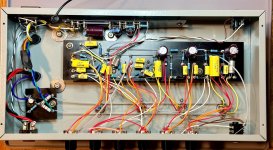
High Voltage Hijinks

Imma reply to myself :ROFLMAO:

I fixed my Deliverance. After two hours of probing, validating DC voltages, resistances and continuity, I decided to simply check AC voltages with a signal. Turns out, the amps works with not issues! I must have had a lose connection somewhere, or something when the amp is really hot? I cannot reproduce it though. So I re-secured all the Faston connectors and it works fine. I redid the bias to make sure, and lowered it a bit while playing. Turns out I really like it at 55%. Much less harsh while still remaining gritty. So there is that.
Just be aware that running your bias too low can damage tubes just as much as running them too hot. Although you won't melt glass, lol. 70% is used for maximum life span.

Did you ever get the oscillation fixed?

There's old books on building tube amps, can't remember the names but wire dressing is a term. Avoiding closely parallel run wires and making sure that wires that must cross do so at a 90 degree angle. This is one of the reasons I use solid core, so wires don't move. Also using wires that are as short as possible. I measure each length and cut the wire just long enough to strip. This helps to control parasitic oscillation.

I've been building amps for over 20 years, and have built so many 5e3's I lost count. I like to use teflon wire since it is so thin while still having a very high dielectric.

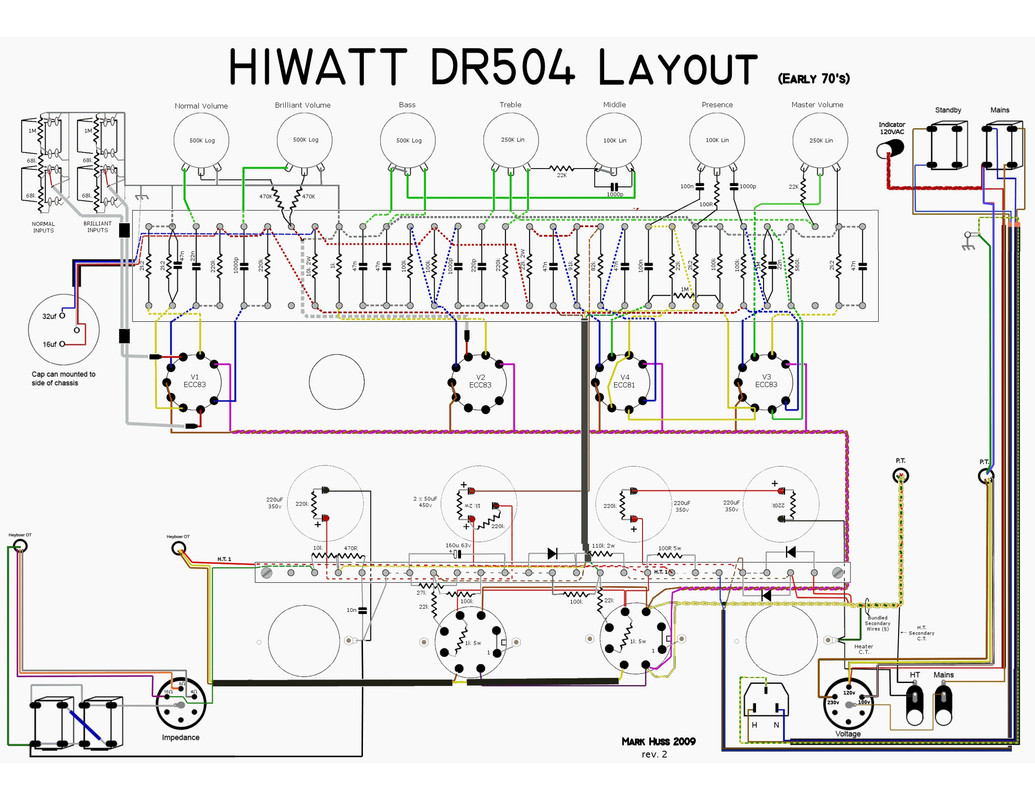
I built six Hiwatt DR504's 17 years ago, not from a kit. A whole lot of sourcing, lol. Sold three to pay for the three I kept. 2 were monoblocks for my JBL JRX125's for vocals and the other for guitar.

I used this layout by Mark Huss when I built them:
(these images are hosted on postimg, and these are hot links. If you click on them it will take you to that site where you can download a full resolution image if you want. I use 210x210 pixels per inch so you can really get good in focus close ups of the details)

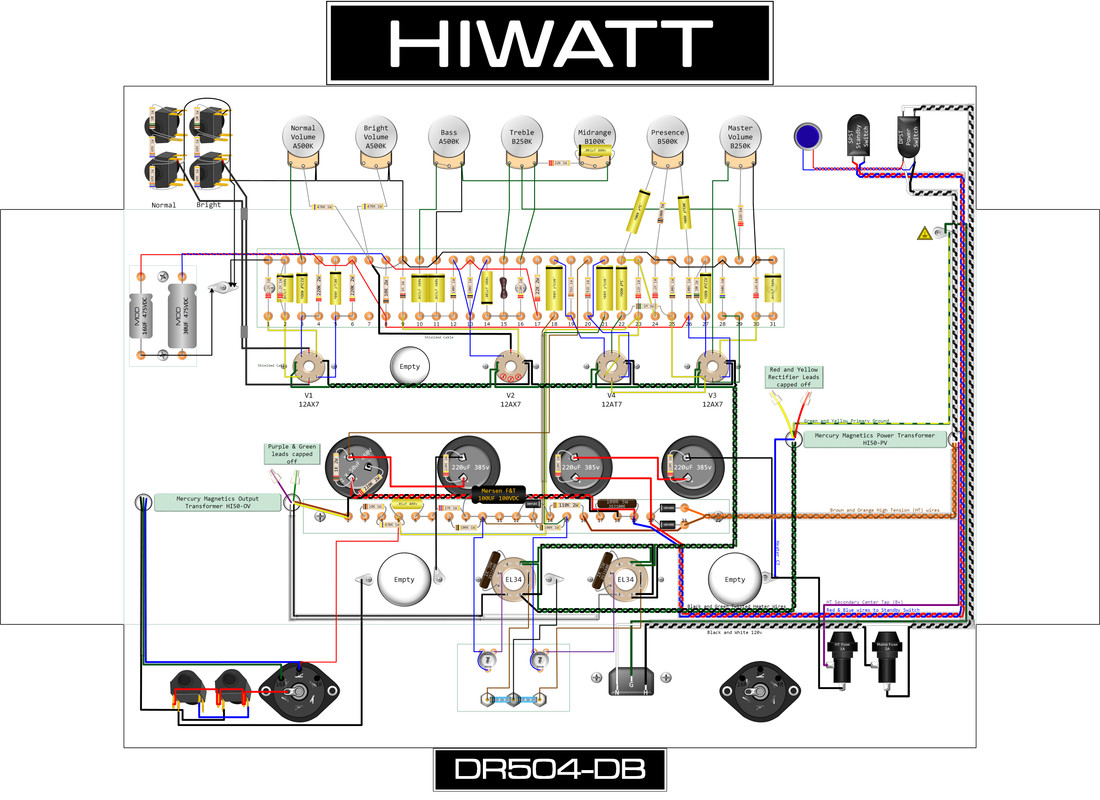
And just yesterday I finished ( I think ) this layout of a DR504 with dual adjustable bias. I traced over a real Hiwatt faceplate at 1000x to make the logo at the top. All of the components I drew using Visio. Particularly happy with the way the 3d jacks came out!

If you look at the layout from mhuss you can see a 22k resistor leading to pin 5 for the bias. My layout just uses a 50k trim pot mounted to the back panel along with test points so biasing with non matched tubes is easy peasy. If the tubes are in spec then the trim pot would just be dialed to 22k and you're there.


And the logo:



This is number 3. I pulled it out of storage so I could get exact measurements for all the components. My layout is 100% to scale down to the 1/16th of an inch. Since Dave Reeves was English all the measurements are *easy* to measure with a ruler.
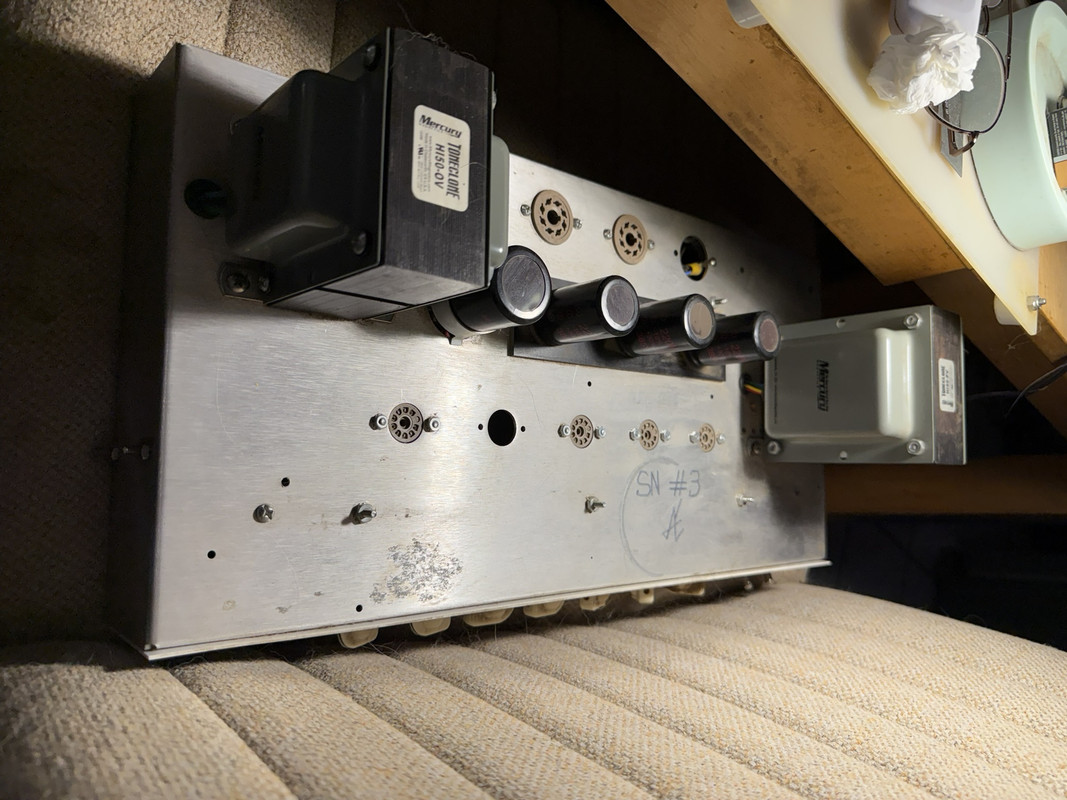
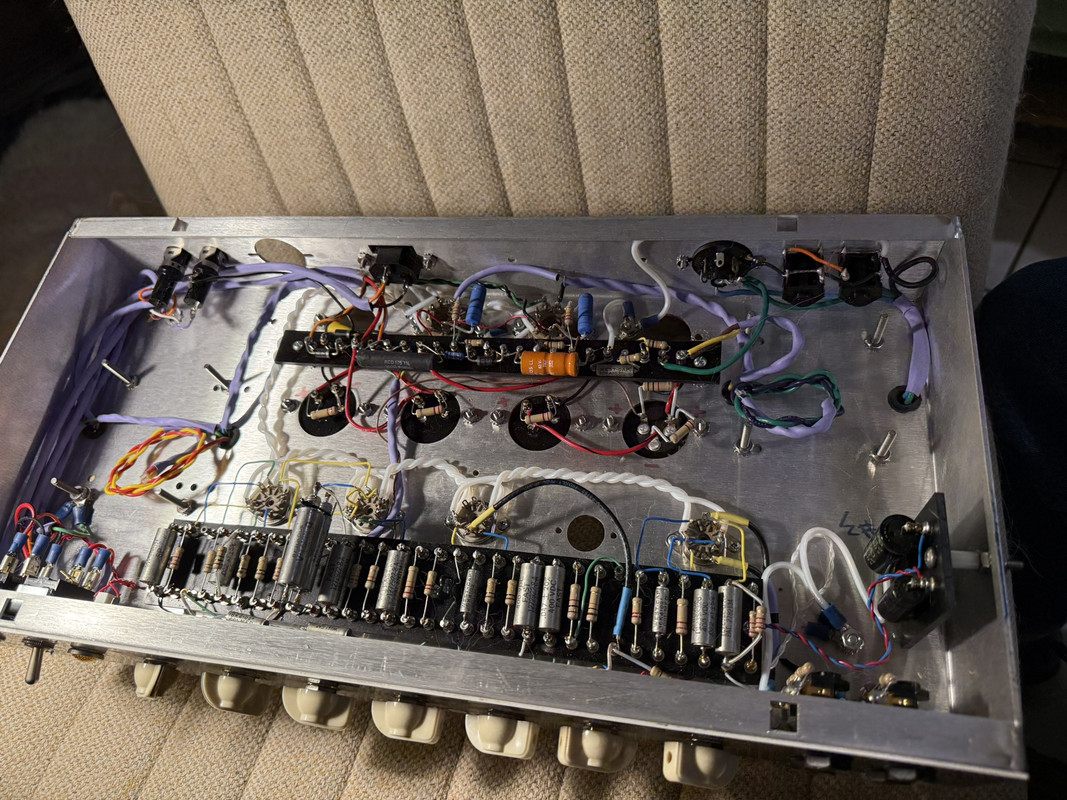
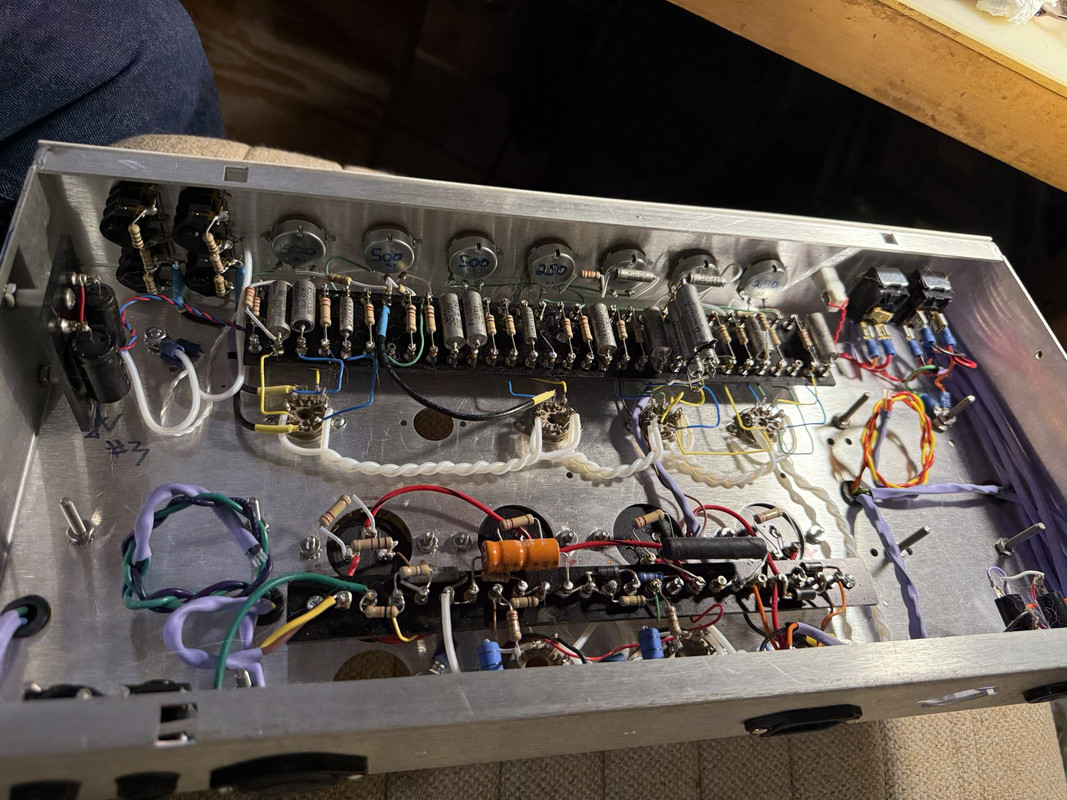
 
Hey that's looking great! I love when PTP looks tidy. I have seen pictures of things that sent shivers down my spine...

Just be aware that running your bias too low can damage tubes just as much as running them too hot. Although you won't melt glass, lol. 70% is used for maximum life span.

Did you ever get the oscillation fixed?
The bias is running at 55%. I don't think it's too low, but it's cold for sure. I just... like it? One thing I realized though is that, compared to the original Deliverance 60, mine has its B rail a bit higher at idle (10V?). I didn't think it was a big deal, but then I realized that the original DL has a EI PT and I run a (custom wound, fairly high specs) toroidal PT. So my voltage sag is probably way less. Considering how the entire thing already runs with hot 12ax7 (and a freaking hot cathodyne), I would estimate my preamp B rail to be over 20V higher than what it "should" be when playing. This probably doesn't help with harshness, and doesn't help with anything else that might pop up (the oscillations/resonance(?) that show up at what should be 120dB if I didn't have an attenuator lol). My bad, that will teach me for trying to go fancy pancy toroidy ;) I will add a could of droppers to my next mouser order and try some stuff - separate KT88 screens and plates by 1V more and drop the preamp B rail by 15-16V.
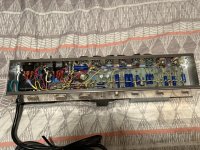
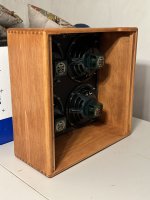
You are also perfectly on point with lead dressing. I'm trying to work on it (although I like the tidiness of PCBs, I still have some wires to dress ;)). Next build should be better, I am less scared of twisting tight, and for the pots I will use shielded 3 conductor wires. And all EI transformers.
 
Hey that's looking great! I love when PTP looks tidy. I have seen pictures of things that sent shivers down my spine...


The bias is running at 55%. I don't think it's too low, but it's cold for sure. I just... like it? One thing I realized though is that, compared to the original Deliverance 60, mine has its B rail a bit higher at idle (10V?). I didn't think it was a big deal, but then I realized that the original DL has a EI PT and I run a (custom wound, fairly high specs) toroidal PT. So my voltage sag is probably way less. Considering how the entire thing already runs with hot 12ax7 (and a freaking hot cathodyne), I would estimate my preamp B rail to be over 20V higher than what it "should" be when playing. This probably doesn't help with harshness, and doesn't help with anything else that might pop up (the oscillations/resonance(?) that show up at what should be 120dB if I didn't have an attenuator lol). My bad, that will teach me for trying to go fancy pancy toroidy ;) I will add a could of droppers to my next mouser order and try some stuff - separate KT88 screens and plates by 1V more and drop the preamp B rail by 15-16V.
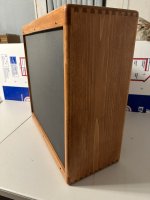
You are also perfectly on point with lead dressing. I'm trying to work on it (although I like the tidiness of PCBs, I still have some wires to dress ;)). Next build should be better, I am less scared of twisting tight, and for the pots I will use shielded 3 conductor wires. And all EI transformers.
I've seen others go the toroidal route and have odd problems. I just build stuff, I'm not into design. Retired IT director/programmer I'm 69.

There's actually a PTP group/forum that eschews CIRCUIT BOARDS. OMG! Talk about your 1939 nightmare! I have a wet tile saw that I use for cutting the G10 and then I just use elmers glue to attach the layouts I make to the board and drill the holes for the turrets. I also use the press for swagging in the turrets or eyelets.

I like to use PTP since it will last a few hundred years at least. I've seen lifted traces from just about every manufacturer on The Gear Page where I hang out on the tech section https://www.thegearpage.net/board/index.php?forums/amps-cabs-tech-corner-amplifier-cab-speakers.11/

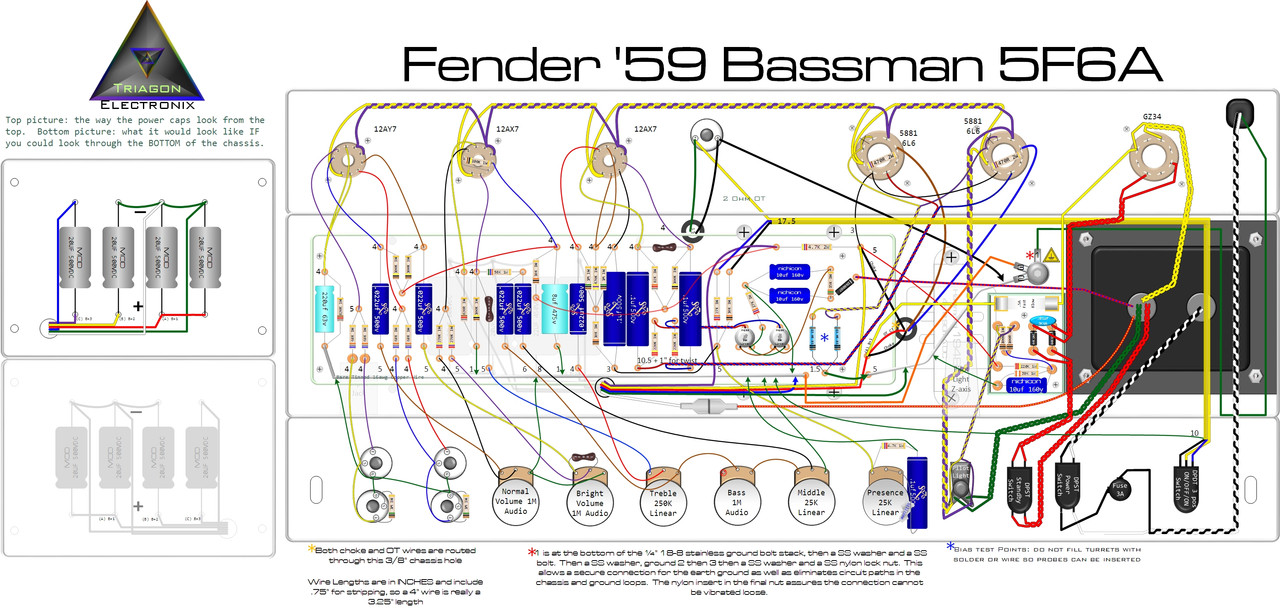
I'm currently working on a 59 Bassman, which is like building a ship in a bottle!!!! Just have to wire the rectifier (the only untidy wires left) and it's time to test!

Just rectifier left to do 1.JPEG

Just rectifier left to do 2.JPEG
I used satin finish poly with gunstock stain. Came out exactly the way I wanted.

IMG_2933.JPEG


IMG_2929.JPEG

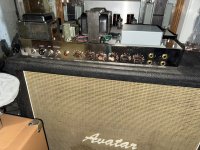
I just stored it on top of my avatar in front of my #5 Hiwatt while I was using my workspace to get the dimensions off the Hiwatt #3. They have these really cool gold finish 'dress nuts' at CE Dist. Coupled with the bronze finish knobs, I love this look!!!!

I used the ground switch for a three way NFB. Have a raised ground for the artificial heater center tap, internal fuse for the HT and a dual bias mod I got from Rob Robinette's site. I rearranged it significantly to make the usage more intuitive. There's on board test points just next to the trim pots. Easy Peasy! And I have backup diodes in front of the rectifier so that if the tube shorts I won't get A/C flowing across polarized caps (boom).

On the avatar.JPEG

Hotlink:
 
Last edited:
70% is used for maximum life span
Shouldn’t this state ”70% is used as max idle bias value for keeping under load operation within safe side”?

Wasn’t even been born in tube era, but on what I’ve read so far the 70% isn’t ideal point, but just a maximum not to exceed and the actual ideal idle bias point varies from tube to tube, batch to batch. And most of all the individual tube's performance &/or test characterics determine what’s the ideal idle point for prefered operation and it could be idle bias point @ 45%, 52.5%, 65% or the 70% (or slightly more!). And within tube circuits overall tolerance could be consired wide and forgiving so there’s no absolute reason to know what idle bias % is, but it’s crucial to know that idle bias point is not exceeding the 70%.

What you think?
 
Shouldn’t this state ”70% is used as max idle bias value for keeping under load operation within safe side”?

Wasn’t even been born in tube era, but on what I’ve read so far the 70% isn’t ideal point, but just a maximum not to exceed and the actual ideal idle bias point varies from tube to tube, batch to batch. And most of all the individual tube's performance &/or test characterics determine what’s the ideal idle point for prefered operation and it could be idle bias point @ 45%, 52.5%, 65% or the 70% (or slightly more!). And within tube circuits overall tolerance could be consired wide and forgiving so there’s no absolute reason to know what idle bias % is, but it’s crucial to know that idle bias point is not exceeding the 70%.

What you think?
Back in the day tubes that weren’t in spec were discarded that’s why many designs don’t have an adjustable bias!

The generally accepted longest tube life figure used at that period in history was 70%.
 
Major work is done on the Laney AOR preamp. No real issues, I wired the bass pot backwards but I was able to rock out on first plugin.

IMG_8802.jpeg
IMG_8803.jpeg
IMG_8801.jpeg

I kinda hate mini switches. I may switch back to the larger Carling toggles for anything after these next three preamps.

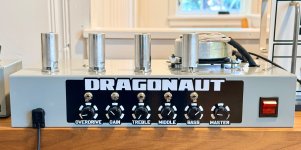
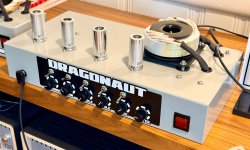
Anyway, this preamp covers the 6 knob master volume AOR Matt Pike used in Sleep but also the extra Advanced Overdrive Response gain stage on some models. With both Overdrive and Gain toggles down it’s the low gain input of the 6 knob, flipping the Gain toggle up brings in the gain stage of the higher sensitivity mode. The Overdrive toggle brings in yet another gain stage at the very front along with the pot to control it. It gets noisy with all the gain stages on and dimed (just like the original amp) but with a gate pedal in front it’s very quiet.

The tone stack is standard-ish FMV with switches above each to bring in a boost. I dig it. With the preamp in the lowest gain mode it’s a great pedal platform. A more vintage midrange-y sound compared to the HiFi of the GT/OR120 preamp.

The post TS recovery stage has some local negative feedback which you don’t see often in amps of this era. I tacked the X88R driver-cf at the end (which I’ll likely do for all standalone preamps). Tons of volume on tap to smash a power amp.

I may be starting a new job soon so I think I’ll lay down the soldering iron for a moment and get the next two preamps and Model T layouts done, chassis drilled, art work applied. I’m likely going to have the front panel for the Model T engraved somewhere. 21x3” is little large to do with precision for my vinyl cutting skills.
 
Last edited:
Shouldn’t this state ”70% is used as max idle bias value for keeping under load operation within safe side”?

Wasn’t even been born in tube era, but on what I’ve read so far the 70% isn’t ideal point, but just a maximum not to exceed and the actual ideal idle bias point varies from tube to tube, batch to batch. And most of all the individual tube's performance &/or test characterics determine what’s the ideal idle point for prefered operation and it could be idle bias point @ 45%, 52.5%, 65% or the 70% (or slightly more!). And within tube circuits overall tolerance could be consired wide and forgiving so there’s no absolute reason to know what idle bias % is, but it’s crucial to know that idle bias point is not exceeding the 70%.

What you think?
Too low bias will fry the tubes.

The developers of audio were extremely good mathematicians.

In 1978 I had the highest SAT score in the country.

As such I took applied trigonometry and used quadratic equations which I developed to create min/max correlation analysis graphs for a large variety of physics issues.

These graphs were actually made by hand without a calculator, using slide rules and graph paper.

We’re talking ancient math technique.

The 70% was arrived at through an analysis of tube death versus efficacy.

Two graphed curves crossed and that intersection of the two equations indicated the longest life with acceptable power and function.
 
@Asdrael does not actually need any help biasing his amp lol. But for posterity…

(I’m not sure what his test scores are but) Aiken has a good article here on biasing:


Rob Robinette is great resource too of course:


(Interestingly he mentions Merlin Blencoe says up to 85% dissipation at idle is OK for fixed bias AB!)

Biasing cold will not shorten tube life. If it sounds good, even better.
 
I resisted responding earlier, ’cos this whole conversation went downhill when bragging came in. Imma dumbity dumbee underachiever without ShATings, but I’d really like to hear a proper argument about this excessive tube wear happened by cold bias thingie. I’d be fine with selfmade description of the phenomenon with why and how it happens. Also a research paper quote would serve well on this one-sided-debate.

@RetiredUnit1 please come down to the unintelligent level of us peasants and make us understand!
 
Putting this back on track -

Been in tight contact with Thermionic lab (EU) to wind me some transformers and I will go with them. Not the cheapest for the PT (they make you basically pay for the core and will do anything you want for the windings as long as the core supports it) but choke and OPT are very well priced and specs are great (cheaper than Hammond with better specs for the range I am targeting). For anyone in the EU, worth getting in touch with them.

Anyone has any decent source of "large" (22-18AWG) PTFE wires rated 600V+ in Europe? I am only finding massive 30 or 100m rolls and it feels overkill for a 10cm heater run. I guess I am forced towards PVC.

Also I updated my PCB to include MOAR LEDs. Should have a light show now.
 
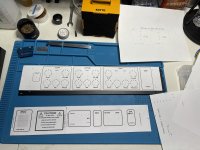
I ordered the face plate for my Model T build this morning from Front Panel Express. Here's the mock up I did before I used their program:

model T Panel v2.jpg

It's two pieces of anodized aluminum 21x3", the black over the natural. Fucking expensive, I won't be doing that much (or ever again). I need to order a decent CNC already lol.

As I like to do, I tired to tip my hat to the original design but make it my own.

I was playing the VH4 preamp this morning and I came to the conclusion I should have just made channel 3, skipped channel 2. Not that channel 2 is bad it's just not distinctive like 3 is. Aside from the X88R, I'll likely just build single channel preamps from here out. Like I am going to just build the Wizard MTL lead channel.

Anyway, I am working on the Soldano X88R preamp layout today. I am hoping to finish this layout and the MTL layout, cut-drill-turret the boards, and drill both chassis before the weekend. Apply the art on the weekend.
 
Back
Top