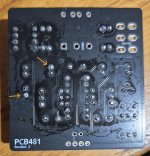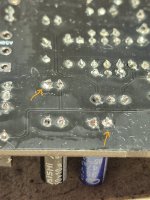
Solder won't flow nicely on some PCBs

Matopotato

Active member
I just soldered the components to Karaoke and Celsius boards for making a Boss CE-1 with the preamp clone (-ish).
I strikes me that the Karaoke PCB from Lectric-FX was quite easy to solder the components to. I find the same for Aion FX PCBs as well.
I use a station with about 380 deg C ("716 F"), a 2 or 3 mm hoof point (0.08-0.11 ") and lead free solder.
Then I was doing the Celsius pre amp board.
And some solder points just won't heat up as the others. This seems to happen more often to points going to ground which made me think that there is more copper involved, thus more heat/time needed.
I swapped to a 1mm point and upped to 412 C and later 450 C ("842F") and still some point refuse to flow the solder.
The solder pads on pedal PCBs as slightly but visibly smaller/narrower so I try to wiggle the iron tip and leg to allow for the hole being visible.
I also used liquid flux.

Anyone else experienced anything similar?
Any hints on what I am doing wrong?
Because I do not think there is anything actually wrong with PBCs from pedalpcb in this regard, else there would have been tons of posts already.

20260224_172330.jpg 20260224_172637.jpg
 
I forgot to mention that all soldered points do check out in connectivity tests between its leg and the points it goes to in the schematic, so electrically it is probably ok.
 
It looks like your iron is struggling to maintain heat on the pads that are connected to the ground plane.

The ground pads have thermal reliefs to help with that, but still require a bit more heat than the others. Lead free solder is probably contributing to that.

It's odd though, because it looks like some of the other ground pads didn't have that same issue.
 
I have had some pcbs that seemed to take more heat to get them to flow.

I do a mental count of the preheat time before I add solder, then flip the board after the first few joints to check the flow through. If I'm not getting as much as I like I add some preheat time. Ground pads seem to take a little more heat. Also large components like electro caps sometimes seem to suck up some heat.

Sometimes I'll try feeding the solder a little slower too - the theory there is that hitting the joint with too much cold solder too fast might cool the top side of the joint before it can flow through to the other side.
 
I'd say your iron and your solder have a lot to do with what your seeing.......Especially dealing with non leaded..Both of them play a pretty big role... if you have a really good iron then I'd say the solder is the culprit..... When I was using a budget station and crap brand solder I really struggled...just moving to kester 63/37 leaded make a huge improvement in my soldering... Then I bought the Hakko 951... Now if I have a bad solder joint it's my dam skills and not my tools.. :ROFLMAO:
 
It looks like your iron is struggling to maintain heat on the pads that are connected to the ground plane.

The ground pads have thermal reliefs to help with that, but still require a bit more heat than the others. Lead free solder is probably contributing to that.

It's odd though, because it looks like some of the other ground pads didn't have that same issue.
Thanks Robert!
Some ground pads worked out fine, but I can tell there is a difference between them and non ground pads. The marked ones is where I struggled most. Although one is equally strange a non-ground pad.
What does the thermal relief mean/how does it effect the soldering?
I have leaded but it is a bit thicker than what I like to use. I can use that for the ground ones in the future.
I thought turning up the heat would help, but unleaded is still a problem?
 
I have had some pcbs that seemed to take more heat to get them to flow.

I do a mental count of the preheat time before I add solder, then flip the board after the first few joints to check the flow through. If I'm not getting as much as I like I add some preheat time. Ground pads seem to take a little more heat. Also large components like electro caps sometimes seem to suck up some heat.

Sometimes I'll try feeding the solder a little slower too - the theory there is that hitting the joint with too much cold solder too fast might cool the top side of the joint before it can flow through to the other side.
Thanks, good points!
Also diodes like 1N5817 and 1N400x with thick legs usually want "more".
 
I'd say your iron and your solder have a lot to do with what your seeing.......Especially dealing with non leaded..Both of them play a pretty big role... if you have a really good iron then I'd say the solder is the culprit..... When I was using a budget station and crap brand solder I really struggled...just moving to kester 63/37 leaded make a huge improvement in my soldering... Then I bought the Hakko 951... Now if I have a bad solder joint it's my dam skills and not my tools.. :ROFLMAO:
Thanks!
Well, leaded solder is not easy to buy unless you run your own business (solder related) in Sweden or most of Europe...
I have some that is double as thick (1mm) as my usual that I could try using when ground pads are in the mix.
My station is a 100 Usd level. Ish. So probably not the fanciest one. But it works well on other boards and situations and I swap tips as need be, so I wouldn't blame it for everything.
My skills are def not pro, but I feel I manage reasonably ok.
 
Last edited:
What does the thermal relief mean/how does it effect the soldering?

Most of the projects here have a ground plane on the top and/or bottom of the PCB. Imagine the empty area of the board flooded with a solid copper layer.

This acts like a heat-sink and absorbs a lot of the heat from your iron, pulling it away from the solder pad you intend to heat.

To counter that, any pads that are connected to the ground plane are connected by small / thin "spokes", rather than a solid connection. This makes it easier to heat the intended area and not everything else surrounding it.

1771956046458.png

 
Most of the projects here have a ground plane on the top and/or bottom of the PCB. Imagine the empty area of the board flooded with a solid copper layer.

This acts like a heat-sink and absorbs a lot of the heat from your iron, pulling it away from the solder pad you intend to heat.

To counter that, any pads that are connected to the ground plane are connected by small / thin "spokes", rather than a solid connection. This makes it easier to heat the intended area and not everything else surrounding it.

View attachment 112174

Have you always made the pedalpcb pcb ones that way? Or are there older releases out there without the ground plane?
 
Maybe a little oxidation is why it occurs on some pads and not others. Try using a flux pen. That helps even with hard to solder potentiometer casings.
 
Maybe a little oxidation is why it occurs on some pads and not others. Try using a flux pen. That helps even with hard to solder potentiometer casings.
Thanks,
I could prewash in Isopropynol as well, although it feels that over time I can narrow it down to the initial description.
 
Thanks Robert!
Some ground pads worked out fine, but I can tell there is a difference between them and non ground pads. The marked ones is where I struggled most. Although one is equally strange a non-ground pad.
What does the thermal relief mean/how does it effect the soldering?
I have leaded but it is a bit thicker than what I like to use. I can use that for the ground ones in the future.
I thought turning up the heat would help, but unleaded is still a problem?
I have this problem sometimes too, usually when I first start soldering. Once the board warms up a bit the problem goes away.
 
Back
Top