A simple Relay Bypass

For some reason, they are totally quiet.
It's probably safe to assume that when you're switching contacts at half the current (36mA vs. 72mA) with the high-sensitivity type (denoted by the "S" in the part number) it's going to result in less noise.

Edited to say that I have had zero switching noise that gets into the audio path using cheap low-profile relays, at least so far.
 
It was a wah coil that was picking up the noise, and I have an application pending using a coil.
The ones I have are termed DS2E-DC5V, lacking the "S" or "M" suffix which the current production (?) units have.
I found a reference that claims that they are equivalent to the "S" type, which I believe is true because of the lower current, as you say. I found several hundred of them brand new waiting to be thrown away in the near future, so I might as well make good use out of them.
I don't know if they are screened, but as you say, they are dead quiet, where the OMRONs weren't.(y)
 
I don't know if they are screened, but as you say, they are dead quiet, where the OMRONs weren't.
I haven't used the high-sensitivity type yet, but I do have an unfinished bypass design (based on one of Chuck's designs) where a high sensitivity type (or lower current type) is called for. The reason a low current relay is needed on that design isn't because of current spikes bleeding into the audio circuit though, it's to reduce the system's overall current draw to fall within the acceptable operating range of an SMD voltage regulator.

I'd take a guess (and this is not verified) that the larger relays may provide better isolation against current spike emissions simply because the housing is larger. I'd assume that the internal mechanisms (coils/contacts) are similar between the larger relays and the miniaturized versions. Following this train of thought, it's possible that the material used to pot the relays internals is more substantial and therefore provides better insulation on the larger relay.
 
Relay coils are solenoids and throw a wide magnetic field. Many Wah inductors are pot cores, which should provide good shielding. No shield is 100% effective. Distance is the best thing to minimize magnetic pickup. Orientation can be helpful too because the magnetic field from a relay is directional. If the inductor has an E-I core (Xicon or Triad transformers) or RM core (SBP ME-6 wah inductor) then there is much less shielding. Basically, if you can see the winding, it's vulnerable to magnetic pickup. Unless it's a toroid. Toroids have the winding on the outside, but the magnetic field is highly contained by the internal core. I hand-wound a toroid inductor for my CryBaby many years ago. My brother has it now.
 
Sorry if this is a dumb question, but I'm curious how this works without a 5v regulator... for a 4.5v/5v relay I always assumed that coil voltage rating was around the max voltage it'd want to see...
 
Look at post #110 in this thread. RX1 is a ballast resistor that limits the relay's coil voltage & current. I describe in the thread above how to determine the value of RX1 based on info in the relay datasheet and the power supply voltage. The rated or nominal coil voltage is the mfgr's recommended operating condition. Some datasheets specify a maximum coil voltage. The thing that will damage a relay coil is heat. Power is dissipated in the relay coil's resistance. More current -> more power -> more heat. The Kemet EA2 relay's maximum allowable coil voltage is 150% of the nominal coil voltage at ambient temperatures up to 40C. Above 40C, it derates down to 100% at 85C.
 
I've been looking into using a relay for soft switching reverb/delay signals. I've looked at the variations on PPCB however I have some questions. Ultimately, I would like to implement my own circuit on the PCB itself.

Mainly, what is the NE555 doing in the circuit? Particularly in the non-latching examples. I get that it provides drive but so do most transistors.

I see the flyback diode but what about the other diode in series with the coil?

Furthermore, when I modelled a 2n3904 with the coil impedance tolerance of a TQ2-L-5V (IK latching..) in spice, I had a large tolerance in the voltage, current and power across the coil? Is this a big concern in the field?

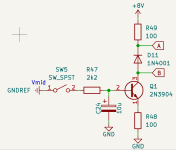
So far I have the circuit attached for driving a non-latching coil with a non-latching SPST switch. Between A and B would be the coil. Is this reasonable? My thinking was to add R48 & 49 to reduce the sensitivity to coil impedance. R47 and C24 set a time constant. 8V is just Vcc after a schottky drop.

1761662223644.png
 
inspired by this thread, i've been designing a board that contains:
-in & out jacks
-DC jack
-relay switching
-LED
-power conditioning
-input buffer
-option between buffered or true bypass
-VREF -- which, since i'll have a spare op amp from the input buffer, may as well be buffered. TL072s are 18c each at JLCPCB.

i have a couple of questions:

1) is there any reason not to put a 9V regulator before the switching circuit if you want to still have the option of using an 18V supply? would it require any other accommodations?
2) i noticed that this circuit has a protection diode, a voltage divider, and what looks to me like a power conditioning capacitor. is that because it's expected to be attached directly to an unconditioned 9V supply? since i intend to have a protection diode, power conditioning and buffered VREF on the board, could i use those, or should there be separate ones for the switching and the effect itself?
3) for modulation effects, i like to have the LED be modulated by the LFO too. is that possible with this circuit?

thanks!
 
3) for modulation effects, i like to have the LED be modulated by the LFO too. is that possible with this circuit?

thanks!
it looks like the 555 is switching the ground for the LED, so it shouldn't affect anything negatively to just switch the current source from Vdd to the LFO, right?
 
Last edited:
1) is there any reason not to put a 9V regulator before the switching circuit if you want to still have the option of using an 18V supply? would it require any other accommodations?
2) i noticed that this circuit has a protection diode, a voltage divider, and what looks to me like a power conditioning capacitor. is that because it's expected to be attached directly to an unconditioned 9V supply? since i intend to have a protection diode, power conditioning and buffered VREF on the board, could i use those, or should there be separate ones for the switching and the effect itself?
3) for modulation effects, i like to have the LED be modulated by the LFO too. is that possible with this circuit?
@Chuck D. Bones still wondering about those first two questions. I think I figured out the third.
 
1. If we install a 9V reg and want the option to run on 9V, then it must be an LDO (low-drop-out) reg. A 78L09 will not make anything close to 9V if it's powered by 9V.

2. If you're referring to the schematic in post #1, then yes it is designed to be connected to the power input jack. The current draw jumps when the relay is energized or de-energized. I think it's a good idea to provide some isolation between the relay driver's power rail and the audio power rail. It might be overkill, but that's better than hearing even a little pop when the relay is cycled. The relay board does not have or need a Vref.

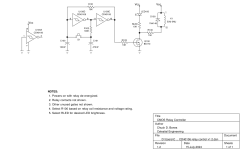
BTW, we have a better relay driver circuit that uses a CMOS IC and a BS170 to drive the relay. The 555 has very little margin for driving a 5V relay.
 
where can i find that?

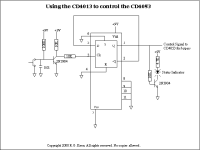
You could use a CD4013 for example like so:

1774529227505.png

Q output then goes to the gate of a MOSFET. Source to ground, drain to - power pin of the relay. When Q goes high, the MOSFET will turn on and act like a switch to ground turning on the relay. You just need to be sure the threshold voltage of your MOSFET is well below your high logic level, otherwise it may not fully turn on.

There are more modern logic ICs than the 4013, but what's nice about that one is that it can be run on 9V, so no voltage regulator necessary. Also, these are still available in through-hole if you care about that.

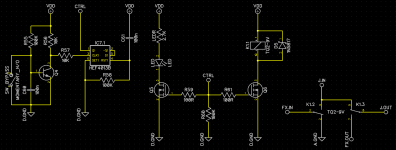
Here's another example:

1774542047315.png

I'm using the set and reset pins of the 4013 to make sure the Q output is always low on power up. R59 and R61 provide some isolation between the gates and should prevent ringing during switching. R60 provides a path to ground so the gates can discharge quickly when power is cut. These aren't totally necessary and could be omitted though.
 
Last edited:
what are the advantages of this over the 555 relay circuit?
Those MOSFET gate drivers can source much more current than the 555, although this may not matter much. The TQ2-9V for example draws just 15.5 mA when energized.
Other than that, this whole circuit should draw overall less current than a 555 circuit, and to me it's just a cleaner approach.

I think this may have been the circuit Chuck was talking about by the way: https://forum.pedalpcb.com/threads/a-simple-relay-bypass.16474/page-6#post-257911
 
Back
Top