
You are using an out of date browser. It may not display this or other websites correctly.
You should upgrade or use an alternative browser.
You should upgrade or use an alternative browser.
ChatGTP and Pedal Electronics
- Thread starter Cybercow
- Start date

Cybercow
Well-known member
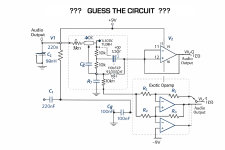
I first spent about 90 minutes with ChatGPT in discussion about the circuit I wanted it to draw a schematic for. It was very detailed and rather accurate in all the text exchanges. It even provided detailed stripboard layout descriptions with proper component IDs & grid point placements and it was spot on. But when it came to rendering a schematic image, well . . . . . . . . . you can see.Are you trying to tell me that ChatGPT is just sticking pictures together and doesn't actually have any intelligence!?
I'm flabbergasted.

Fama
Well-known member
From what I understand, the best way to accomplish that right now would probably be to ask it to code you a program that outputs the schematic as an image. But of course it depends a lot on the models used, and I'm not sure if it's really worthwhile right now.I first spent about 90 minutes with ChatGPT in discussion about the circuit I wanted it to draw a schematic for. It was very detailed and rather accurate in all the text exchanges. It even provided detailed stripboard layout descriptions with proper component IDs & grid point placements and it was spot on. But when it came to rendering a schematic image, well . . . . . . . . . you can see.

Yep.From what I understand, the best way to accomplish that right now would probably be to ask it to code you a program that outputs the schematic as an image.
Trying to do this in chatGPT is only useful for laughing at how bad it will be. However, if you use a tool like a Claude Project loaded with context via filesystem or git repository, and use Opus 4.5/4.6, you can get it to generate working KiCad projects with schematics. This works well because those models are among the best at generating code. Under the hood KiCad is driven by configuration written in S-expressions, which is code.
Visually they usually end up a bit ugly, but that can be fixed easily in KiCad.
Fama
Well-known member
FWIW a big point they (he interviews someone for the second half of the video) made was that AI is really good at coding, much better than at other stuff, so it might work better to ask it to code a script or program to do task X instead of asking it to do task X directly.

Band of Dans
Well-known member
One thing I try to keep in mind wrt the “it’s good at coding” part: the “agentic” models are making a *ton* of separate queries behind the scenes to create the “context” they work from. Each of those queries is pretty dang expensive and the cost isn’t really going down in an appreciable way. To me, this sounds like brute-forcing an approach that’s already kinda the poster child for brute-forcing your way out of a problem. Maybe there will be an order-of-magnitude efficiency gain soon, but it’s hard to say! The point, for me anyway, is that none of this feels like a stable or reliable system I’d be comfortable depending on, especially the agentic stuff. It’s getting better at coding prompts because it’s making a shit-ton of invisible prompts behind the scenes. Is that sustainable? Idk, maybe. Once they build data centers on the moon.
I’ve read some folks estimate that a *single* agent session can cost more than the entire monthly fee for a pro Claude account. Anyone else remember when an uber was almost free and all the cars were nice and the drivers made good money? This AI era feels like a much worse version of that, but this time we’re all the “economic shock absorbers,” not just taxi drivers.
I’ve read some folks estimate that a *single* agent session can cost more than the entire monthly fee for a pro Claude account. Anyone else remember when an uber was almost free and all the cars were nice and the drivers made good money? This AI era feels like a much worse version of that, but this time we’re all the “economic shock absorbers,” not just taxi drivers.

ICTRock
Well-known member
"it only cost me $10K to design YATS with Claude"From what I understand, the best way to accomplish that right now would probably be to ask it to code you a program that outputs the schematic as an image. But of course it depends a lot on the models used, and I'm not sure if it's really worthwhile right now.
feels like future clickbait content for How To Geek

pricklyrobot
Well-known member

Certainly, it should be able to help me de-bug my Mind Control MT-2, no?
I hear Bill Gates’ voice in my head telling me to shit my pants, but the tone isn’t quite right…


bluedmc777
Well-known member
Exotic Opamp!!! Would that be an early 80s JRC4458D?
Fama
Well-known member
That's a good point - this www.technologyreview.com/2025/05/20/1116327/ai-energy-usage-climate-footprint-big-tech/ is the best article I found on actual AI energy use numbers, and while singular text queries (and surprisingly image generation too - well not too surprising since you can run it fine locally too, I guess) are not very heavy, agent based queries definitely are.One thing I try to keep in mind wrt the “it’s good at coding” part: the “agentic” models are making a *ton* of separate queries behind the scenes to create the “context” they work from. Each of those queries is pretty dang expensive and the cost isn’t really going down in an appreciable way. To me, this sounds like brute-forcing an approach that’s already kinda the poster child for brute-forcing your way out of a problem. Maybe there will be an order-of-magnitude efficiency gain soon, but it’s hard to say! The point, for me anyway, is that none of this feels like a stable or reliable system I’d be comfortable depending on, especially the agentic stuff. It’s getting better at coding prompts because it’s making a shit-ton of invisible prompts behind the scenes. Is that sustainable? Idk, maybe. Once they build data centers on the moon.
I’ve read some folks estimate that a *single* agent session can cost more than the entire monthly fee for a pro Claude account. Anyone else remember when an uber was almost free and all the cars were nice and the drivers made good money? This AI era feels like a much worse version of that, but this time we’re all the “economic shock absorbers,” not just taxi drivers.
A single query isn't going to cost more than $20 (which is the monthly fee) though, no way. A single session, maybe, if you spent 8 hours working on a coding problem.
I definitely agree with you that AI companies are in the "let's build a business disregarding making a profit and worry about it later on" phase, which was also covered in the Hank Green video. The order-of-magnitude efficiency gains would probably come from using smaller, more dedicated models which only cover a specific function, but do it quite well despite the small size. At least that's the theory - and I'm not sure how well they'll hit that goal. It will probably be worthwhile to use for coders who can increase their output a lot by using tools like this. For everything? I don't think so, at least not very fast. The bubble will pop eventually.
Band of Dans
Well-known member
Yeah the costs are all basically guesses at this point. Most of the best estimates I’ve seen also completely omit ongoing training expenses as well. BUT it seems pretty clear they’re all losing money on power users just based on published API pricing.
100% agree. The monolithic general-purpose models just seem wildly out of proportion to the applications people want to use them for, at least in the spaces where there’s actually a chance to do something that legitimately improves lives. Whenever folks crow about how great LLMs are for summarizing meetings and emails I just think, “uh, maybe your company should reduce the number of emails and meetings?” Blasphemy, I know.The order-of-magnitude efficiency gains would probably come from using smaller, more dedicated models which only cover a specific function, but do it quite well despite the small size. At least that's the theory - and I'm not sure how well they'll hit that goal. It will probably be worthwhile to use for coders who can increase their output a lot by using tools like this. For everything? I don't think so, at least not very fast. The bubble will pop eventually.
Similar threads


- Replies
- 6
- Views
- 456


- Replies
- 16
- Views
- 2K