DuoPhase build troubles: squealing, high end roll off, signal degradation, unwanted parallel audio and LFO

patgarz

New member
Hello,

This is my first time making a post but I’ve been perusing for a few weeks so hello all.

This is my first pedalPCB build but I’ve done a zepellin labs quaverato before and also I solder all my patch cables so I feel comfortable with an iron (although I did have trouble with the jacks and switches which I soldered post installation for cable management reasons). I also double checked all resistor, cap and transistor values prior to installation. Forget if I also tested the diodes, but I’m inclined to say I did. All parts from tayda.

My issue is the build turns on, the LFO’s seem to work by reading the oscillating led but I get a high pitched squealing that is way louder than the signal (which is currently also weaker than direct in, despite the bypass). I think the weak signal might be a ground issue on one of the jacks but I’m not sure, I confirmed continuity from ground to all sleeves and various points around the PCB.

So far for diagnosis I’ve tried, reflowing everything (some points even twice). Adding shielding to the back of the pots via electrical tape. Confirming ground continuity. And lastly (per some GPT walkthroughs that may or may not actually be helpful), I was voltage metering the individual IC’s to ground.

The IC’s gave me weird values that GPT said were off but I don’t have a great grasp of what I should be expecting. From the browsing I did it, GPT was expecting reasonable outputs/values. I got Pin 1, 2, 3, 5, 6 and 7 to be zero or near zero. And I got pin 4 to be -8.2V while pin 8 is 8.7V. GPT said this was due to a mid rail reference not working properly? Dont even know what that means or what it would entail but like I said I reflowed all the pads.

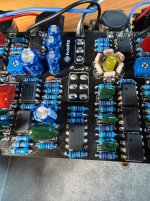
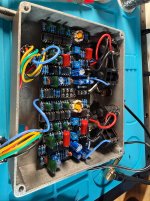
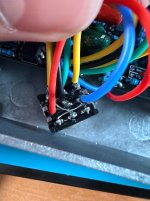
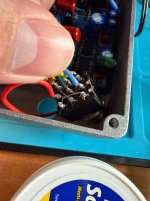
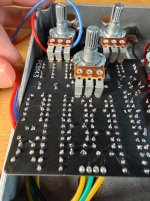
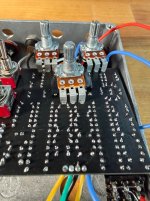
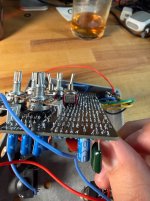
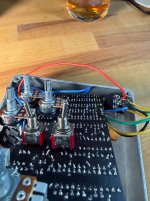
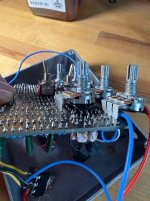
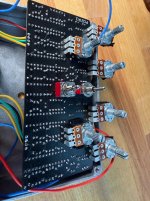
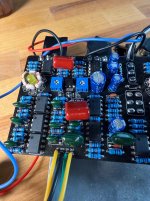
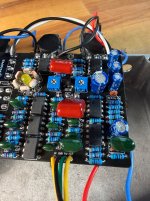
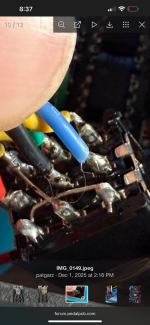
Attached a few pictures for reference in case I fudged something.

Thanks in advance! I am excited to get this figured out and get some whooshes going
 

Attachments

  • IMG_0163.jpeg
    IMG_0163.jpeg
    1.1 MB · Views: 20
  • IMG_0147.jpeg
    IMG_0147.jpeg
    1 MB · Views: 19
  • IMG_0148.jpeg
    IMG_0148.jpeg
    630.1 KB · Views: 15
  • IMG_0149.jpeg
    IMG_0149.jpeg
    698.9 KB · Views: 14
  • IMG_0154.jpeg
    IMG_0154.jpeg
    902.5 KB · Views: 16
  • IMG_0155.jpeg
    IMG_0155.jpeg
    950.2 KB · Views: 15
  • IMG_0156.jpeg
    IMG_0156.jpeg
    728.8 KB · Views: 17
  • IMG_0157.jpeg
    IMG_0157.jpeg
    808.8 KB · Views: 17
  • IMG_0158.jpeg
    IMG_0158.jpeg
    775.8 KB · Views: 15
  • IMG_0159.jpeg
    IMG_0159.jpeg
    1 MB · Views: 16
  • IMG_0161.jpeg
    IMG_0161.jpeg
    1 MB · Views: 18
  • IMG_0162.jpeg
    IMG_0162.jpeg
    1 MB · Views: 21
Considering the number of sharp solder joints/points, my experience tells me that a single layer of electrical tape alone may not be good enough to isolate the the chassis' of those two pots. The solder joints/points can poke right thru electrical tape.

And to be fair, IMO - ChatGTP is not a reliable source (yet) for dependable electronics advice.
 
hm that’s a good point, will bend the pots out of the way and see if that changes anything.

Also yeah totally agree on GPT, I’ve had mixed results on troubleshooting with it. On the quaverato I built it actually pinpointed the problem pretty quickly though, despite the manufacturer insisting it was wrong and that the issue I was asking about wasn’t the issue. So anyway I take what it says with a grain of salt and am looking for second opinions
 
What Cybercow said. The tits (actual technical term) are too long.
Ok! So the tits were probably shorting. I added some thick paper between the pots and the PCB and now the LFO is not high pitched/squealing anymore. Unfortunately though the LFO phase clock sound is still dominating. Doing some more debugging to see if any of the IC voltages changed or if I can figure something else out that might point to an issue
 
Ok! So the tits were probably shorting. I added some thick paper between the pots and the PCB and now the LFO is not high pitched/squealing anymore. Unfortunately though the LFO phase clock sound is still dominating. Doing some more debugging to see if any of the IC voltages changed or if I can figure something else out that might point to an issue
What IC did you use for IC6? TL072 or TL062? The 72 causes ticking, the 62 does not.
 
What IC did you use for IC6? TL072 or TL062? The 72 causes ticking, the 62 does not.
Ah fook, yeah I’m using TL072 per the spec sheet. I saw on the reviews of the PCB that the bias control can get the ticking to go away though.

But im guessing the LFO leaking into the audio signal isn’t from that either
 
These should be able to run quiet with tl072s. Since yours aren't in sockets and there are a ton of them, I wouldn't jump straight to trying different opamps.

Try moving your wiring around. There are areas of the board that generate that LFO noise. If your in / out wires are running right up against those areas, you'll get that noise in your signal.
 
Hm, don’t have any on hand unfortunately. Just checked the IC’s and still getting weird values on them. Pin 4 is -8.1V and pin 8 is full 8.7V. Any chance you have an idea of what values I should be expecting? 4.5V is my understanding?
 
These should be able to run quiet with tl072s. Since yours aren't in sockets and there are a ton of them, I wouldn't jump straight to trying different opamps.

Try moving your wiring around. There are areas of the board that generate that LFO noise. If your in / out wires are running right up against those areas, you'll get that noise in your signal.
I tried moving the cables in between the PCB and the enclosure on the pot side, but no difference as far as I can tell as when the cables were behind on the component side
 
I tried moving the cables in between the PCB and the enclosure on the pot side, but no difference as far as I can tell as when the cables were behind on the component side
Above or below the pcb might not make that much difference if the wire run is close to the same part of the board.

There have definitely been threads about this, not sure how much searching you’ve done through old troubleshooting threads on the Duophase but you might find some good tips there.

Also - no idea if this is an issue or not, but I don’t see that type of jack used in pedals usually, and looking at it I’m wondering if that type doesn’t make ground contact with the enclosure and whether that could contribute to noise issues.
 
yeah I’ve done some reading and people basically just say moving the cables away. I’ve tried some combinations but I’ll try a few more.

And I never thought about the jack connection being a point of contact with enclosure but that’s a good point. I’ll maybe hardwire something to the enclosure then to see if that helps.
 
Eureka! I added a wire from one of my jacks to the enclosure via copper tape. The signal loss is still present and one side is still overwhelmingly LFO dominated. But the other side is giving me some whooshes so progress!

I’m going to double check my grounds for the fourth time (argh) and see if I can find another missing connection.

Has anyone else experienced signal loss from these, I’d say my signal through the pedal (even bypassed) is about 25% softer than direct in
 
IMG_1593.png
Its probably a hair or something but is that between your ground lug and the jack connection.

You shouldnt have any signal loss in bypass, its true bypass. Only thing i could see causing that is a bad joint causing some signal loss, ive experienced it but it was more than 25%, refreshing switch joints fixed it.
 
View attachment 107066
Its probably a hair or something but is that between your ground lug and the jack connection.

You shouldnt have any signal loss in bypass, its true bypass. Only thing i could see causing that is a bad joint causing some signal loss, ive experienced it but it was more than 25%, refreshing switch joints fixed it.
Yup that’s definitely a cat hair, it gets everywhere lol. But yeah good shout I think my worst solders are on the switch and jack port so that’s likely the cause of my signal loss. Will re do and report back regarding that issue
 
re: the weird IC voltages, that looks like it is correct for this circuit.

Ideally, the signal in to an op-amp sits right in between the positive and negative voltage rails.

The op-amp can be fed with a bi-polar supply, that is, a voltage that is positive and negative
relative to ground. (e.g. as you're seeing, approx +9v / -9v.). This lets the signal be +/- relative
to ground, with no DC offset voltage. However, this requires somewhat complicated support ICs
(like the TC1044SCPA charge pump in this design) to provide the negative voltage, or they'd use AC
voltage with transformers to get the positive and negative rails.

A lot of designs, rather than using +9v / -9v with a signal at ground ( 0v ), will use +9v / ground ( 0v ),
with the signal at 4.5V. This might be why chatGPT / AI search is recommending different signal
pin voltages. The downside of a design like this is that you have to add the DC bias to the signal
before the op-amp and then remove it afterwards, but the added complexity of this (for the most
part) way cheaper than the added parts/cost of a charge pump.

The difference between the signal voltage and the supply voltages is what people call the 'headroom' --
the op-amp can't amplify the signal any more than the supply voltage(s) so if the signal is amplified
to the point where it hits one of the rails, the signal gets clipped. (Some circuits do this on purpose!)
For the most part with guitar effects, the signal is really never more than 1-2 volts, so the ~4.5 volts of
headroom is plenty - but some effects do need the higher voltages, or are just easier to design
with a bipolar design.
 
Back
Top