High Voltage Hijinks

Damn guys. 630V WIMA Radial 1µ are 3cm long. Gonna be fun building with lunchbox amp with those ;)
What are you building that requires a 630V 1µF? The only time I've ever used 1µF in tube preamps has been as cathode bypass caps, and there is no reason to use 630V caps for those, nor is there any reason they even need to be film caps. Electrolytics are fine for cathode bypass caps.
 
Yeah I was being overly dramatic. With what I am looking at (@Hal Harvey I hate you :ROFLMAO: ) I should be mostly fine with 630V for the B line and around the PI. For the cathode I will likely stay at 50-63-100V, but I prefer film there because I am allergic to polarity. I will use some known amps as a reference and try to read up more on Triode basics.

Also I guess I'll have to figure out how to select a proper output transformer but I am not there yet.
 
What transformer are you using that’s has 14v instead of 6.3v?
If/when I get around to build this, it will have a custom toroidal for the PT. My latest amp has one, and it is surprisingly cheap, even with quite a few secondaries. Since I plan on using DC for heaters and Omron relays, it makes sense for me.
 
For the cathode I will likely stay at 50-63-100V, but I prefer film there because I am allergic to polarity.
If electrolytics for cathode bypass were good enough for Leo Fender, they're good enough for me. I won't use them anywhere in the signal path, but cathode bypass is fine.
 
If/when I get around to build this, it will have a custom toroidal for the PT. My latest amp has one, and it is surprisingly cheap, even with quite a few secondaries. Since I plan on using DC for heaters and Omron relays, it makes sense for me.
I’m in this exact same situation I need a toroidal 270v 14v running 5 tubes I got a quote from troid and it was more than I thought. Where did you get the quote from?
 
I’m in this exact same situation I need a toroidal 270v 14v running 5 tubes I got a quote from troid and it was more than I thought. Where did you get the quote from?
Mueller Rondo. Then again, I am in Germany so that makes sense to me. I'd love to help you with this if you are abroad but unless you are EU, I am not sure it would make sense... I think I was quoted 100€ for a 141VA, with copper shielding.
 
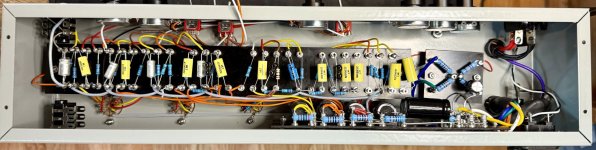
Getting there on this...

Photo Aug 13 2025, 7 14 16 PM.jpg

Really only the tone stack and output left.

Yesterday after the power section was all wired up I did a little no tubes testing on a variac at 12V, and on the light bulb limiter with a 25W bulb. All the voltages looked as expected with no real load.

@Asdrael I was thinking about your "for sure going to happen" build. I know you were thinking channels 1 and 3/4. You would have a triode left over. You could set it up like the Mesa Mark V 35. It has two channels, one was like clean/fat/crunch and the other was the high gain options, each channel had it's own FMV tone stack. You could do two channels, 1 Clean/Crunch, and channel 2 More/Much More. It would be a shame to build a full amp and be so close to having access to the full array of sounds of a VH4 haha.

Mean while I am thinking I will do the Laney AOR next. I am going to cover the 6 knob master volume version that Matt Pike used in Sleep with switchable AOR (basically front end of the amp overdrive gain stage). The extra AOR stuff was not really defeatable in the amps that had it so the 6 knob MV version is more popular (for doomers).
 
Last edited:
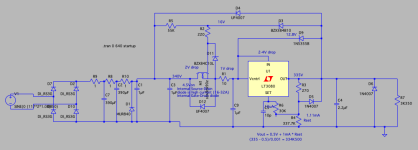
I thought I'd share my implementation of the Maida regulator with a LT3080 which may be useful to people doing low noise signal work. It's possible to switch to a LT3042 too if you want less current capacity and even more PSRR. If you don't want the RCRC then remove C1 and everything before. R7 in this is my load. I use a 12.8V TVS in D9, and 16V Schottky diodes for D11 and D9. I also have a lower voltage on R5 (10K) and R2 I have as 1K IIRC. Ignore the diode bridge, I'm using a bridge rectifier. Final mod is that I run 0.3V between SET and OUT rather than 0.5V (this seems to be an odd comment on the data sheet.) I make the Rset a fixed resistor and a trim pot and that allows the pot to vary the output voltage to find the sweet regulation spot (the power here varies +10% to -6%)

Vital points:
* the mosfet M1 will see the full HV voltage as DC as the device starts up. So ensure that the mosfet can handle it.
* R5 that provides the drop across the mosfet. I have about 4V IIRC which means it's only generating about 0.5W on the heatsink. This also works with R1 sense to provide that drop over a programmed max current using the sense resistor R1.
* the C4 needs at least 2u2
* C5 can be increased to 1uF, it smooths but reduces response time to regulation. I used a small Wima FKP1 film cap.

I've seen versions of this with a diode across D9 to the gate. I've found this interacts with the gate/source capacitance and LDO startup to create an oscillator hence I've removed it.

Screenshot 2025-07-29 at 08.21.56.png

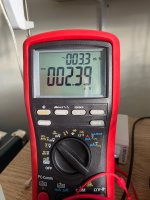
This is currently providing a near silent noisefloor for my tube compressor and runs at 340+ Volts. The 3080 will go up to 1.1A but I'm pulling around 65mA. The RCRC outputs about 1Vpp ripple, the LT3080 then drops that to below 10mV.. I use a cap and then put the multimeter on mV mode. Top display is AC hence ripple at 3.3mV, at 350V that's -100dB.
IMG_4884 2.jpg

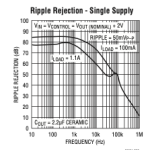
The PSRR of the LT3080 drops off as it approaches 1MHz and then you're onto inductors but if you're processing guitar signal using tubes before the a high gain amp input. This works really well.
Screenshot 2025-07-25 at 10.47.31.png

It works by the mosfet creating a little 'bubble' under the input voltage. The LDO sits in that bubble so only sees the few volts, except the resistance to the output that creates a reference divider that pulls 1.11mA and from the SET pin pulls 10uA at the correct voltage.
So as the input voltage ripples, the bubble bobs up and down vs the SET reference voltages. Allowing the LT3080 to address the voltage changes and smoothing out the ripple.
 
Last edited:
Getting there on this...

View attachment 101158

Really only the tone stack and output left.

Yesterday after the power section was all wired up I did a little no tubes testing on a variac at 12V, and on the light bulb limiter with a 25W bulb. All the voltages looked as expected with no real load.
That looks good and fairly compact really. A good candidate for a PCB too if size is a concern.

@Asdrael I was thinking about your "for sure going to happen" build. I know you were thinking channels 1 and 3/4. You would have a triode left over. You could set it up like the Mesa Mark V 35. It has two channels, one was like clean/fat/crunch and the other was the high gain options, each channel had it's own FMV tone stack. You could do two channels, 1 Clean/Crunch, and channel 2 More/Much More. It would be a shame to build a full amp and be so close to having access to the full array of sounds of a VH4 haha.
I am done getting the rough schematic in Fusion for the VH4, I am putting values and part numbers on everything now. Then I will decide what I take out and what stays in for a small footprint. So far, and after some youtube and review investigations, I will likely go for a Ch1 (VH4 or slightly more gain) + Ch3 (VH4) only so VH2 style in the preamp. So that removes a 12ax7 and makes switching much easier (no MIDI). Poweramp will be a single pair of KT77. The question is what the fuck do I do with the loop, as it is tube driven. So part of the sound, but that's one tube extra to fit in a compact design...
 
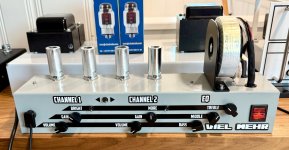
It lives!

Photo Aug 14 2025, 9 17 36 AM.jpg

Everything works as expected except I have some oscillations at the top of the gain for channel 1, and channel 2 with "more" engaged oscillates almost right away. But channel 2 without "more" has no oscillations at all. I did skip the treble bleed cap to ground at the input. That is the first thing I'll try. If that doesn't fix it I'll break out the signal gen and oscilloscope. I used zero shielded wiring and a have a couple of longer runs, I don't think it'll be too hard to track down.

It's loud as fuck, easily saturating my GT120 power amp. The Soldano X88R preamp does a 97% cut at the end, I thought that might be excessive, I'll likely get close to that before I call it done. I kind of want to see how the Sunn Model T power amp fairs before I commit though.

The preamp itself is pretty quiet, I don't hear any hum, but it will amp noise coming into it like any high gain preamp. With a Fortin Zuul+ between my guitar and amp it's quiet as can be at idle.

How does it sound? I have never played a real VH4. Also I would not consider myself to be a high gain dude. I'm into doom and heavy classic rock, with taste of spaghetti western. Like if Keith Richards worshipped the dark gods, had no talent, but also lost all ability to play from a bad car accident. Anyway...

Channel 1 (VH4 channel 2) is very crunchy like a plexi. Great for dirty mid gain sounds.

Channel 2 (VH4 channel 3) sounds great throughout it's entire gain range, a giant sweet spot I guess, the same character through the range just more until the gain knob stops turning. It has great, even unexpected, string to string definition for chords. To my ears, this is the 'at the sunset of grunge', great rock guitar sound.

Channel 2 with "More" engaged (VH4 Channel 4) is just too much. It's like chocolate cake with chocolate frosting with chocolate ice cream on the side with some fudge on top of it all, and a chocolate shake to wash it all down. It loses the nuance. I do have the oscillation, but it seems to go away when I play, but I'll hold out judgement until that is fixed.

Likely it'll sit in VH4 Channel 3 mode and rarely change.

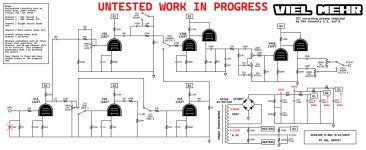
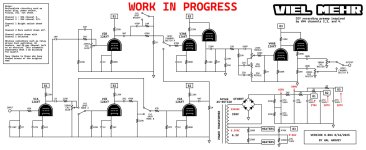
Here's my updated schematic:
Viel Mehr Schematic.jpg

The biggest changes are the 100KA master volume pots, how the gain pots are wired (3 and 2 tied like an variable resistor), and how the bass pot is wired. I also have the treble bleed at the input crossed out for now because I don't have that in there.

I added the model I used for the power transformer, and annotated my voltages in red. My B+ supplies are very close to modern VH4s (they run just above 360V at those points). However I want them to be higher, I plan on updating my PSU Designer II model with the real data and then figuring out what the first dropping resistor needs to be lowered to get me closer to 390Vish on the supplies (what the early VH4s ran at allegedly). That would also get my elevated ground reference for the heaters higher. Closer to 70V will be good for the two cathode followers.

I am done getting the rough schematic in Fusion for the VH4, I am putting values and part numbers on everything now. Then I will decide what I take out and what stays in for a small footprint. So far, and after some youtube and review investigations, I will likely go for a Ch1 (VH4 or slightly more gain) + Ch3 (VH4) only so VH2 style in the preamp. So that removes a 12ax7 and makes switching much easier (no MIDI). Poweramp will be a single pair of KT77. The question is what the fuck do I do with the loop, as it is tube driven. So part of the sound, but that's one tube extra to fit in a compact design...

I concur with those decisions given my above experience.

The FX Loop is a harder nut to crack. I'm sure it contributes to the sound like the SLO FX Loop does. That is why I use the same setup as it's driver-cathode follower pair at the end of my preamp, post tone stack. I was going to tack on the X88R driver-cathode follower on all these preamps but in this case it seemed better to just stick with what's in the VH4. Adjusting the voltage divider right before the send to sum whatever the last triode pair does might be the best solution.

So you are at 3 preamp tubes, PI tube, and then power tube pair?

 
Last edited:
That looks good and fairly compact really. A good candidate for a PCB too if size is a concern.


I am done getting the rough schematic in Fusion for the VH4, I am putting values and part numbers on everything now. Then I will decide what I take out and what stays in for a small footprint. So far, and after some youtube and review investigations, I will likely go for a Ch1 (VH4 or slightly more gain) + Ch3 (VH4) only so VH2 style in the preamp. So that removes a 12ax7 and makes switching much easier (no MIDI). Poweramp will be a single pair of KT77. The question is what the fuck do I do with the loop, as it is tube driven. So part of the sound, but that's one tube extra to fit in a compact design...

You could maybe sub an LND150 for the tubes if it's part of the loop, it depends how significantly the loop is overdriven, I suspect not a lot.
 
Oscilations are phase reinforcement at 180degrees.

As your amp has no global feedback loop, then it has to be either:
* ripple/harmonics.
* power supply not providing enough current
* power rail 'ripple' being lack of filtering capability so a large signal on the back end tubes finding their way to the front end.
* ground reference moving. Local by-pass caps aren't typically a problem but if there's a long non-star architecture then you will find noise on the ground as the impedance increases with the length of the ground.

It's best if the return for a stage goes straight to the associated cap, creating a smallest loop for RFI: https://valvewizard.co.uk/Grounding.html
 
It lives!

View attachment 101189

Everything works as expected except I have some oscillations at the top of the gain for channel 1, and channel 2 with "more" engaged oscillates almost right away. But channel 2 without "more" has no oscillations at all. I did skip the treble bleed cap to ground at the input. That is the first thing I'll try. If that doesn't fix it I'll break out the signal gen and oscilloscope. I used zero shielded wiring and a have a couple of longer runs, I don't think it'll be too hard to track down.

It's loud as fuck, easily saturating my GT120 power amp. The Soldano X88R preamp does a 97% cut at the end, I thought that might be excessive, I'll likely get close to that before I call it done. I kind of want to see how the Sunn Model T power amp fairs before I commit though.

The preamp itself is pretty quiet, I don't hear any hum, but it will amp noise coming into it like any high gain preamp. With a Fortin Zuul+ between my guitar and amp it's quiet as can be at idle.

How does it sound? I have never played a real VH4. Also I would not consider myself to be a high gain dude. I'm into doom and heavy classic rock, with taste of spaghetti western. Like if Keith Richards worshipped the dark gods, had no talent, but also lost all ability to play from a bad car accident. Anyway...

Channel 1 (VH4 channel 2) is very crunchy like a plexi. Great for dirty mid gain sounds.

Channel 2 (VH4 channel 3) sounds great throughout it's entire gain range, a giant sweet spot I guess, the same character through the range just more until the gain knob stops turning. It has great, even unexpected, string to string definition for chords. To my ears, this is the 'at the sunset of grunge', great rock guitar sound.

Channel 2 with "More" engaged (VH4 Channel 4) is just too much. It's like chocolate cake with chocolate frosting with chocolate ice cream on the side with some fudge on top of it all, and a chocolate shake to wash it all down. It loses the nuance. I do have the oscillation, but it seems to go away when I play, but I'll hold out judgement until that is fixed.

Likely it'll sit in VH4 Channel 3 mode and rarely change.

Here's my updated schematic:
View attachment 101190

The biggest changes are the 100KA master volume pots, how the gain pots are wired (3 and 2 tied like an variable resistor), and how the bass pot is wired. I also have the treble bleed at the input crossed out for now because I don't have that in there.

I added the model I used for the power transformer, and annotated my voltages in red. My B+ supplies are very close to modern VH4s (they run just above 360V at those points). However I want them to be higher, I plan on updating my PSU Designer II model with the real data and then figuring out what the first dropping resistor needs to be lowered to get me closer to 390Vish on the supplies (what the early VH4s ran at allegedly). That would also get my elevated ground reference for the heaters higher. Closer to 70V will be good for the two cathode followers.


I concur with those decisions given my above experience.

The FX Loop is a harder nut to crack. I'm sure it contributes to the sound like the SLO FX Loop does. That is why I use the same setup as it's driver-cathode follower pair at the end of my preamp, post tone stack. I was going to tack on the X88R driver-cathode follower on all these preamps but in this case it seemed better to just stick with what's in the VH4. Adjusting the voltage divider right before the send to sum whatever the last triode pair does might be the best solution.

So you are at 3 preamp tubes, PI tube, and then power tube pair?
Looks great really. What kind of oscillations you got? Hopefully you can track them down. If I were you I would put shielded wires at least in places carrying signal level - input and output. Careful with ground looks obviously.

For my part, I will have to settle with a 5 preamp tubes setup (3 preamp, 1 loop, 1 PI). I think that will get me closer to what I want and provide a nice loop. The only issue is going to be that if I want to use DC heaters on the pre, I might have heat issues on a LM317. I have to see if I go this route with a possibly beefy heatsink (my 4 preamp tube LM317 doesn't seem to go above 55° so maybe I will be fine? need to calculate this) or put a tube on AC. A couple of relays will have to be on it but with a 2 channel setup it shouldn't be anything major. I will keep working on the "full" VH4 schematic until I am ready to cut down to two channels. I have a lot to learn on the way, especially in the power section still...
 
Oscilations are phase reinforcement at 180degrees.

As your amp has no global feedback loop, then it has to be either:
* ripple/harmonics.
* power supply not providing enough current
* power rail 'ripple' being lack of filtering capability so a large signal on the back end tubes finding their way to the front end.
* ground reference moving. Local by-pass caps aren't typically a problem but if there's a long non-star architecture then you will find noise on the ground as the impedance increases with the length of the ground.

It's best if the return for a stage goes straight to the associated cap, creating a smallest loop for RFI: https://valvewizard.co.uk/Grounding.html

Thanks for the input Nick. I am a Valve Wizard enjoyer too. I am excited for his new book coming out even if I'll have most of it already in the one he discontinued.

My ground strategy follows most of his suggestions. Single robust chassis ground connection. Ground returns are as close to the associated filter cap as possible with a single path to ground. Power supply is fairly robust in regards to filtering. There are three supply nodes and the the stages that share them were chosen to reduce regenerative coupling. This schematic shows the power supply filtering and node sharing. It's interesting to note that the real VH4 amp has a single supply node for all the stages.

Looks great really. What kind of oscillations you got? Hopefully you can track them down. If I were you I would put shielded wires at least in places carrying signal level - input and output. Careful with ground looks obviously.

For my part, I will have to settle with a 5 preamp tubes setup (3 preamp, 1 loop, 1 PI). I think that will get me closer to what I want and provide a nice loop. The only issue is going to be that if I want to use DC heaters on the pre, I might have heat issues on a LM317. I have to see if I go this route with a possibly beefy heatsink (my 4 preamp tube LM317 doesn't seem to go above 55° so maybe I will be fine? need to calculate this) or put a tube on AC. A couple of relays will have to be on it but with a 2 channel setup it shouldn't be anything major. I will keep working on the "full" VH4 schematic until I am ready to cut down to two channels. I have a lot to learn on the way, especially in the power section still...

Typical high gain style oscillations. I have a roll of a hundred feet of mil spec shielded Teflon 22 gauge wire I will break out if need be but I want to take out the scope and signal generator to track down the real problem before I start trying things. It's interesting that channel 2 without the "more" switch engaged has no oscillation at all even at max gain. My run from the channel switch to the output crosses turret board in the middle where channel 1 and channel 2 "more" live, so maybe it'll be as easy as shielding that wire.

5 is perfect. That will allow you to clone channel 1 and 3 plus loop perfectly, why compromise.

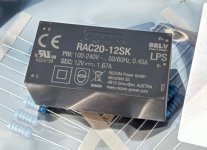
Have you considered one of these bad boys for DC heaters and relays:
Photo Aug 15 2025, 7 43 17 AM.jpg

I picked that up for an upcoming Dumble ODS build where I am using vintage spec transformers. Then your PT handles just B+ and power tube heaters. Here's a video where Jason from Headfirst Amps talks about it:


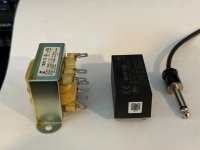
It's really pretty tiny, here it is next to the Hammond transformer it's replacing and 1/4" plug for scale:

Photo Aug 15 2025, 8 29 51 AM.jpg

I think your current plan is the best way as long as you are able to properly heatsink the LM317, but the Recom is the (very) easy button.
 
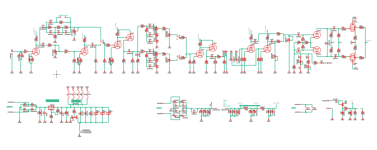
Well. Schematic seems done. 1755548980224.png

With Ch1 and Ch3 only, even when keeping 2 tone stacks, I am only using 3 relays. I will keep a "mechanical" bright switch. It's not too bad really, but I am not sure I will use a 12H (!) choke. Will probably scale it down a bit, it is massively overkill.

For what it's worth: all the bypass caps are 50V electrolytic, basically all the other caps are WIMA PP 5 or 10% depending on their availability and size. 1kV for anything beside the tonestack, which is rated at 630V.

Time to do a layout I guess.
 
Exciting!

My current preamp looks like this:
Viel Mehr Schematic.jpg

I lowered my first B+ dropping resistor to get voltage closer to the first VH4s. I think I'm between the originals and current. I'll probably leave it alone.

I turned the output cathode resistor into a voltage divider to tame the output. It now seems to be in the same universe as what my GT120 preamp is pumping out (like with a boost).

I rerouted my output wiring and channel 1 is completely free of oscillations. Channel 2 with "more" still needs some love though. I haven't had a chance to break out the scope (and shielded wire).
 
Probably as good a thread as any to ask but since I am away on holidays I can only do some head scratching on my project and can’t really come out with a definitive answer: for a push pull KT77 pair and a B+ of 470V, what output transformer would you go for? I am thinking 4300 primary impedance with around 60W based on approximations ( (470^2)/(2x25) )but I read that lower impedance can make an amp sound tighter, but KT77 like higher impedance in general…

Conversely, any suggestions for output transformer manufacturers, particularly in Europe? Hammond seems to have gotten more expensive here in the last few months and I doubt a 1650NA for over 200€ makes sense now.
 
Probably as good a thread as any to ask but since I am away on holidays I can only do some head scratching on my project and can’t really come out with a definitive answer: for a push pull KT77 pair and a B+ of 470V, what output transformer would you go for? I am thinking 4300 primary impedance with around 60W based on approximations ( (470^2)/(2x25) )but I read that lower impedance can make an amp sound tighter, but KT77 like higher impedance in general…

Conversely, any suggestions for output transformer manufacturers, particularly in Europe? Hammond seems to have gotten more expensive here in the last few months and I doubt a 1650NA for over 200€ makes sense now.

JJ markets the KT77 as a drop in replacement for the EL34. Classic Marshall primary would be 3.4K but the range of what will work and still sound good is pretty broad. I think Trainwrecks are at 6.6K for a pair of EL34s. As you go up less power, more headroom, and the low pass filter created is centered lower. KT77s should have more bass than a EL34 too so maybe a little lower for tighter bass is the better choice? That said I'd guess the speaker-cab would have a bigger impact than the difference between 3.4K and 4.3K.

I am curious about the transformer situation in Europe. The US is spoiled by choices (Mercury, Pacific, Heyboer, etc).

Rosamp has a Hiwatt DR504 (3.8K primary) set for 228 euros. Maybe they would sell you just the OT?
 
Back
Top