Nein Fuzz 3rd Attempt/Failure

Depattern

New member
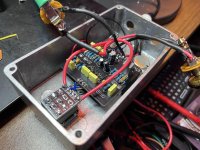
this is probably a lost cause since im not skilled enough to properly troubleshoot. I have a multimeter but aside from basic voltage and continuity testing, i dont really know what im doing but i wanted to give it a shot after buying the pcb and jfets 3 separate times.

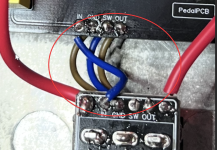
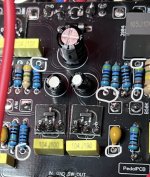
i thought i accounted for the dumb obvious mistakes in my first two builds (soldering the wrong component or pad, then severely botching the desoldering - im really bad at desoldering), and i felt like i did everything according to the instructions i had here. im 95% sure i didnt use any incorrect components like 470k vs 470r, and r2 is 47k. everything is oriented properly. q2 is only soldered like that because i was trying to get ai to help me and it wanted to me swap that jfet for another one due to the weird drain voltages:

d68646a8-0436-47d0-87a2-eb6f717bdfe3.jpg
but i think the orientation is correct (d,s,g from left to right when facing the top of the pcb). and the pins are soldered on the top and bottom. I know my soldering is shotty but the continuity tests ive done dont show any obvious issues


this is what i have so far:
  • Q1 D: 8.06V
  • Q2 D: 8.93V
  • Q3 D: 1.248V
  • Q4 collector: 3.9V
  • Supply: 9.41V
  • All carrier orientations verified (potentially)
  • All resistors measured correctly (mostly)
powers on, led comes on with the switch but no audio when engaged. i get my clean guitar signal when switch is bypassed. sometimes i hear a tiny bit of scratchiness when turning the vol in pot (much moreso in my last build attempt), but really almost completely silent. one thing im kind of unsure of is the in/out jack soldering, which should be the most basic aspect of a build like this, but i guess that since im getting the clean bypassed signal its ok? i dont even know if thats true or helpful. i was thinking maybe its something simple like the ground points arent all connected, or the jfets arent making proper contact, but i've had the same issue when i soldered the smd jfets (non-pre-soldered) directly to the pcb pretty successfully.

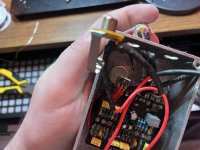
I don't know if this is enough info for direct troubleshooting but im wondering if anything glaring sticks out, maybe even the poor soldering? although i have reflowed almost every single point that was even slightly dull but there are some bigger blobs remaining which ive attempted to re-do a few times. the jacks and power connections especially are bad due to the twisted awg wire, but those dont seem to be the issue as far as i can tell(?)

i used film caps for the first 2, then i bought a bulk box film cap pack for this one. i had some others on order from stompbox parts but they didnt arrive in time for this one. thats what the yellow 100n (104 100v) and 10n (103 100v) are

maybe someone as unskilled shouldn't be attempting this but i would really love to give this pedal a shot and i feel that it would be so much more satisfying that just buying another pre-built fuzz, even though i may unfortunately end up with no choice. it seems like a really rewarding pedal to build: the kind of overdriven tones, the unruly gnarly timbres, the chaotic biasing.

so really, any general troubleshooting or any ideas at all that maybe you would try yourself if you werent sure why a pedal build isnt working would be very helpful. claude ai usually does not steer me wrong but its been sending me down some mind numbing rabbit holes that arent helping with these builds at all
b6090539-9496-4c9e-b8ff-e74ce97e57bd.jpg c980c832-7981-4af1-96d3-116ac5cdb64d.jpg 6b883e45-29bf-4e33-89a1-0df2e9dca1d7.jpg e8a23c0e-4e46-49a7-b17f-f6bc200352a8.jpg

kind of a sentimental thing, as i had the genius idea of dedicating it to my dog who passed recently. so feels extra depressing to leave it broken
 
Good call but I tried swapping them, no luck

Maybe I should try again though

I figured the ai thing would upset people. I was surprised because it’s very helpful with technical things when it comes to software, but makes sense that it has zero context or valuable insight for electronics troubleshooting
(In my defense, it seemed like a better idea than bothering people in forums for advice as a complete beginner)

Thanks for the advice
 
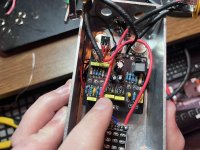
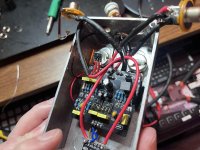
I'm just looking at a glance while making dinner, but nothing obvious is jumping out at me. Are your lower 2 pots insulated?

Also if you still have the first 2 botched builds, those are a perfect playground for practicing your desoldering. It can only get better, and it's practice that's gonna make the most difference
I put a piece of electrical tape over the lower pots so they wouldn’t short the pcb
Maybe not fully covered though, kind of rushed that part as I was leaving work this morning, trying to get the knobs secured before I packed everything up

Good point though, I will double check that.

I will definitely practice desoldering on those. I don’t know what I’m missing, should probably watch some more YouTube tutorials but I am learning that I should have been using a flux one this whole time, which was a very stupid oversight

Thanks for the encouragement. It’s promising at least that nothing glaring sticks out I guess
 
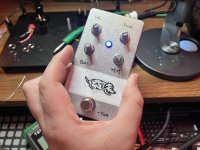
You lost points for taking advice from AI, but then you drew a cool dog, so I'm back to rooting for you.

One easy thing that could cause only bypass to work is plugging in to the output (extra easy mistake when the jacks aren't mounted yet).

Now that you mention this, since I’m not familiar with electronics/schematics at all really, I wasn’t sure which was which initially. I think I landed on (facing front of pedal) top right is in and left is out? I didn’t see any indication of that anywhere in the build guide but I’m sure it’s obvious to most everyone who takes on a project like this
 
Ok first of all, don't get discouraged. This is a perfect learning opportunity and we've all borked some stuff. Guitar signal present in bypass usually indicates a problem on the main board (or with the wiring) if you've got your in and out jacks backwards, you'll still get your guitar signal in bypass

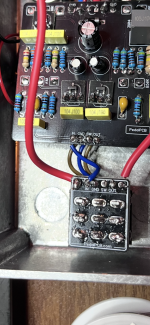
it's hard to see the wires between the footswitch board and the main PCB to know if they're connected the right way. it looks like your in and out jacks are wired the right way, and yes, from the face of the pedal, in should be on the right, and out on the left.

Your soldering on the footswitch board in particular is rough. You could try reflowing those. It's ok to fill those pads with solder and you want a nice shiny smooth tent on each one, not a bulb.

Since you seem willing to put some effort in, and you're getting an education here, now might be a good time to make and learn how to use an audio probe. That lets you send a test signal through the circuit and hear where it runs into trouble
 
Ok first of all, don't get discouraged. This is a perfect learning opportunity and we've all borked some stuff. Guitar signal present in bypass usually indicates a problem on the main board (or with the wiring) if you've got your in and out jacks backwards, you'll still get your guitar signal in bypass

it's hard to see the wires between the footswitch board and the main PCB to know if they're connected the right way. it looks like your in and out jacks are wired the right way, and yes, from the face of the pedal, in should be on the right, and out on the left.

Your soldering on the footswitch board in particular is rough. You could try reflowing those. It's ok to fill those pads with solder and you want a nice shiny smooth tent on each one, not a bulb.

Since you seem willing to put some effort in, and you're getting an education here, now might be a good time to make and learn how to use an audio probe. That lets you send a test signal through the circuit and hear where it runs into trouble
Oh, that’s interesting. I will try that for sure. I’ll have to look into it, I don’t think I was aware of that method. Sounds very helpful, thanks so much

Agreed on the footswitch, I always have trouble with large metal parts. Would you use a flux pen on something like that or is that just for pads?

I am getting continuity between all of the 3PDT breakout board and the pcb contacts at the bottom, if that’s what you mean. And I believe the jumpers are accounted for in that breakout because I get continuity between 6 &1 and 3 & 9
IMG_6809.png
(it looks like “gnd” and “in” here are bridged but they aren’t that close currently, this is a previous photo as I’m not at my desk currently)
 
Just was going to reiterate Harry's advice to add audio probing to your troubleshooting repertoire --this helps pinpoint where your signal is getting messed up. If you search this forum you'll find advice on how to build them--it's really only a capacitor and some leads.
 
IMG_6809.jpeg

I circled a few places in white that I think you might want to reflow the solder on. There are others that look similar, I just circled these quickly to show what I'm talking about. They don't look like they are making good contact. It could just be the photo, but that's what I'm seeing.
 
View attachment 113300

I circled a few places in white that I think you might want to reflow the solder on. There are others that look similar, I just circled these quickly to show what I'm talking about. They don't look like they are making good contact. It could just be the photo, but that's what I'm seeing.
I soldered these from the bottom, but that’s true. I noticed that in a few and even soldered a few from the top because of that but wasn’t sure if it was necessary or not. I will definitely go over the ones I can reach from the top
 
i dont want you guys to think im ignoring the advice or abandoning this, but i won't have a chance to work on this until tomorrow morning, at which point im going to try every suggestion in here, and start by building an audio probe

thank you everyone for the suggestions, i appreciate it more than you know. it's going to rule if i can get this thing working
 
The way I view AI is that it's only helpful if you already have a background of experience in the subject matter you're asking of it. I use AI to help me write sentences with good words so I don't sound like a dumbass, but really only if there's one word I just can't think of and the thesaurus isn't helping me. It's really just a way to get the brain juices flowing again.

Actually it's great at therapy type things as well. I was using it to help with a resume and it was prompting me to lean on my managerial experience, which I'm reticent to mention because one of my current employees is a complete dipshit who establishes his sense of self worth on his skill base, which means he refuses to learn anything I teach him, which is unfortunate because he's terrible. I'm just kinda over it and I'd rather spend my time working on my own tasks. But AI helped me to learn that it's okay to put effort into trying to teach him, but I shouldn't feel responsible for the outcome if he decides not to grow.

Anyway, all that aside, that style audio jack is terrible and prone to failure if you overtighten them even in the slightest. If you cooked the board from desoldering then you need to get out the multimeter and follow along the traces in the PCB between solder pads and make sure you still have continuity. If you don't then you need to repair it. There's a few ways you can do that if necessary.

For desoldering, get a roll of MG Superwick 426, it's the best desoldering braid. That and some Q tips and isopropyl alcohol will get your board cleaned up nicely. It's really much easier to troubleshoot if it's clean and you can see everything.
 
The way I view AI is that it's only helpful if you already have a background of experience in the subject matter you're asking of it. I use AI to help me write sentences with good words so I don't sound like a dumbass, but really only if there's one word I just can't think of and the thesaurus isn't helping me. It's really just a way to get the brain juices flowing again.

Actually it's great at therapy type things as well. I was using it to help with a resume and it was prompting me to lean on my managerial experience, which I'm reticent to mention because one of my current employees is a complete dipshit who establishes his sense of self worth on his skill base, which means he refuses to learn anything I teach him, which is unfortunate because he's terrible. I'm just kinda over it and I'd rather spend my time working on my own tasks. But AI helped me to learn that it's okay to put effort into trying to teach him, but I shouldn't feel responsible for the outcome if he decides not to grow.

Anyway, all that aside, that style audio jack is terrible and prone to failure if you overtighten them even in the slightest. If you cooked the board from desoldering then you need to get out the multimeter and follow along the traces in the PCB between solder pads and make sure you still have continuity. If you don't then you need to repair it. There's a few ways you can do that if necessary.

For desoldering, get a roll of MG Superwick 426, it's the best desoldering braid. That and some Q tips and isopropyl alcohol will get your board cleaned up nicely. It's really much easier to troubleshoot if it's clean and you can see everything.
I do hate these jacks. Do you have a type you prefer? I think the only spares I have are the enclosed trs type or tiny 3.5mm raspberry pi style jacks

And yes I agree on ai, but I do also ask it for help with really any problem I encounter that I can’t fix myself and Claude in particular has helped me massively. But it’s true that I got way to ambitious with asking it for help here, although it did suggest I build an audio probe the same day I posted this initial question. And it helps me track my component inventory for specific builds so i know what to order, or builds me quick carts for tayda/mouser orders and whatnot. Typically basic questions like compatibility stuff. But there are always blind spots so you have to challenge and scrutinize and push it to help you. It’s just a tool, and it can’t always help you if it’s your only source of information. I’m learning how to make it work for me. and i do agree with the therapy/advice thing. it's helped me a lot there as well

I have built some nice vst plugins and monome norns scripts with it though, which I am very happy with. And the reason I even attempted this build was because I had Claude ai help me conceptualize and follow walk me through my arion tubulator mod (germanium, silicon, led clipping stages in parallel via 2 way switches), which was successful on the first try.

But I also get the criticism, so I’m not trying to advocate for it really. I understand very well why I can’t rely on it for something specialized, physical, and nuanced like this and I have already gotten so much better advice here than I got from it in this context. And I totally get why people hate it. I don’t love the idea of using it for creative purposes

Back on topic;

On the audio probe note: should I use a 220uf 630v axial polyester film cap? Most YouTubers are using these or 400v but they’re also using them for amp testing a lot of the time
 
Last edited:
Back
Top