
MichaelW
Well-known member
Ok, so I don't play surf music and I don't own any flannel or plaid shirts. I'm really not into grunge or alt. (Yes, I'm old and boring).
I play some fake jazz and fake blues. Mostly I noodle and read this forum.
So why did I need this guitar? Well.....because I always wanted a vintage-ish JM.
The only tune I can actually call to mind that uses a jazzmaster is Jeff Skunk Baxter playing the melodic refrain in Steely Dan's "Any Major Dude".
Nevertheless., being the gear slut that I am, I can never pass up a good deal. A number of the Squeir Classic Vibe models have gone on sale recently.
Including this one from Chicago Music Exchange. This is one of the FSR runs they do in conjunction with Andertons in the UK and I've been eyeing it for a quite a while.
So when I got an additional coupon code from Capital One Shopping for CME, PLUS an additional $50 knocked off for a very small finish chip on the back of the guitar I just couldn't resist. I think this came out to be around $330 shipped.
I'm a big fan of the Squeir Classic Vibe line. They are all solid guitars. Well made, and have vintage style appointments and pickups. The vintage style appointments and pickups really is what attracts me the most. I lean that way anyway, and the more modern styled JM's never made a whole lot of sense to me.
Having said that, these guitars typically need some work to get them playing optimally and to my rather picky standards.
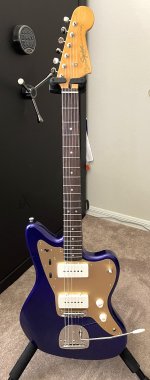
Out of the box shot here....sure is pretty! The gold anodized pickguard has an old school 60's JM vibe. (But not the purple....I don't think Fender ever did any purple JMs).

The frets were a mess and the nut was only marginally cut. It also came with .009's. So first up was a full fret level and crown.
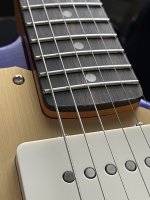
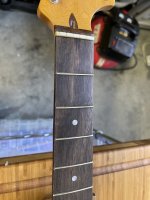
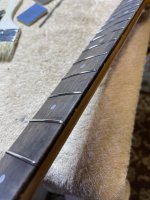
The fingerboard edges came slightly rolled, which is nice. But it needed a bit more attention so I started there. Lots of finish to deal with.

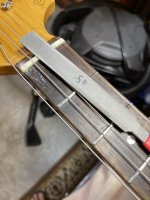
The end result before sanding, feels great! The trick is to roll the fingerboard and NOT the fret ends. This is why I use a razor blade and not a sanding block. You really want the fret ends to maintain their geometry so your E strings aren't always slipping off the ends.
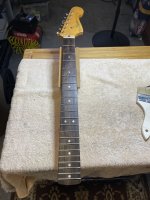
Marking off the frets here with a sharpie for leveling. If this were a maple neck, I'd mask the whole fingerboard off with painters tape. But with rosewood I can get away with just using the metal fret dressing masks.
Investing in a good quality beam leveler is a must. Don't over do it, a few strokes with just the weight of the leveler to "kiss" the tops of the frets and knock down the high spots or high frets. Make sure the neck is DEAD STRAIGHT before doing this.
Frets are leveled......

Now re-marking the tops of the leveled frets with a sharpie to start the crowning process.
I always start crowning down at the body end of the neck. That way if I mess up it's easily fixable. Having a couple of lower frets at 20-21 will have little impact in the overall playability. If I mess up down at 1-5 then I'd need to re-level the whole board, which of course uses up the life of the frets. A good crowning file is a must. This is one tool you don't want to skimp on. Get a good one.
Once crowned, I move to dressing the individual fret ends. Again, you don't want to change the geometry of the fret end. Just knock off the sharp edges.
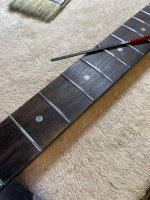
These little fret dressing files are extremely versatile and I use them for all kinds of chores. They're rounded and smoothed on the edges and don't damage the fingerboard.
Continued in the next post......
I play some fake jazz and fake blues. Mostly I noodle and read this forum.
So why did I need this guitar? Well.....because I always wanted a vintage-ish JM.
The only tune I can actually call to mind that uses a jazzmaster is Jeff Skunk Baxter playing the melodic refrain in Steely Dan's "Any Major Dude".
Nevertheless., being the gear slut that I am, I can never pass up a good deal. A number of the Squeir Classic Vibe models have gone on sale recently.
Including this one from Chicago Music Exchange. This is one of the FSR runs they do in conjunction with Andertons in the UK and I've been eyeing it for a quite a while.
So when I got an additional coupon code from Capital One Shopping for CME, PLUS an additional $50 knocked off for a very small finish chip on the back of the guitar I just couldn't resist. I think this came out to be around $330 shipped.
I'm a big fan of the Squeir Classic Vibe line. They are all solid guitars. Well made, and have vintage style appointments and pickups. The vintage style appointments and pickups really is what attracts me the most. I lean that way anyway, and the more modern styled JM's never made a whole lot of sense to me.
Having said that, these guitars typically need some work to get them playing optimally and to my rather picky standards.
Out of the box shot here....sure is pretty! The gold anodized pickguard has an old school 60's JM vibe. (But not the purple....I don't think Fender ever did any purple JMs).
The frets were a mess and the nut was only marginally cut. It also came with .009's. So first up was a full fret level and crown.
The fingerboard edges came slightly rolled, which is nice. But it needed a bit more attention so I started there. Lots of finish to deal with.
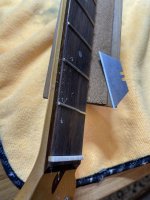
The end result before sanding, feels great! The trick is to roll the fingerboard and NOT the fret ends. This is why I use a razor blade and not a sanding block. You really want the fret ends to maintain their geometry so your E strings aren't always slipping off the ends.
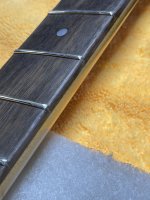
Marking off the frets here with a sharpie for leveling. If this were a maple neck, I'd mask the whole fingerboard off with painters tape. But with rosewood I can get away with just using the metal fret dressing masks.
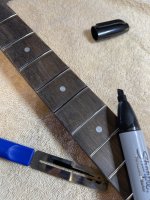
Investing in a good quality beam leveler is a must. Don't over do it, a few strokes with just the weight of the leveler to "kiss" the tops of the frets and knock down the high spots or high frets. Make sure the neck is DEAD STRAIGHT before doing this.
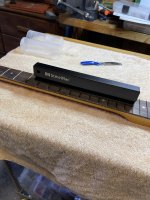
Frets are leveled......
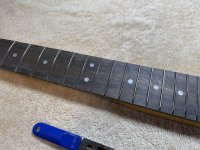
Now re-marking the tops of the leveled frets with a sharpie to start the crowning process.
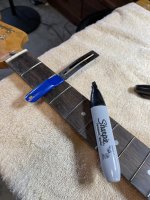
I always start crowning down at the body end of the neck. That way if I mess up it's easily fixable. Having a couple of lower frets at 20-21 will have little impact in the overall playability. If I mess up down at 1-5 then I'd need to re-level the whole board, which of course uses up the life of the frets. A good crowning file is a must. This is one tool you don't want to skimp on. Get a good one.
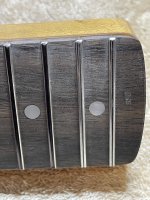
Once crowned, I move to dressing the individual fret ends. Again, you don't want to change the geometry of the fret end. Just knock off the sharp edges.
These little fret dressing files are extremely versatile and I use them for all kinds of chores. They're rounded and smoothed on the edges and don't damage the fingerboard.
Continued in the next post......
Attachments
Last edited:

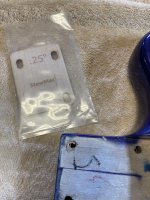
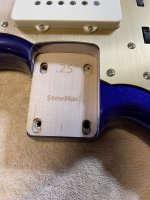
 It needed some adjusting for string action at the nut.