Pedal that most disappointed you vs. pedal that most surprised you?

Lots of good talk about single pot tone shaping. My personal opinion is that depal designers try to take a pedal and make it too versatile. You can add too many controls. I think taking the time to find tune a pedal for a certain sound or end result and having only the essential controls makes for a better sound and end user experience. By trying to make the pedal inclusive to all players, rigs and music styles you end up alienating pretty much everyone in the process. You either like the sound of the pedal or you don't. There is nothing worse than playing a pedal and you have to spend a ton of time dialing it in and never getting the sound you want (I'm looking at you vfe👀👀)
Yes! When I see a pedal with too many knobs my thoughts are the builder was like "I don't know how to design this, so you do it". They should curate the tone to do something special. There's enough pedals that we don't need ones that do everything.
 
Lots of good talk about single pot tone shaping. My personal opinion is that depal designers try to take a pedal and make it too versatile. You can add too many controls. I think taking the time to fine tune a pedal for a certain sound or end result and having only the essential controls makes for a better sound and end user experience. By trying to make the pedal inclusive to all players, rigs and music styles you end up alienating pretty much everyone in the process. You either like the sound of the pedal or you don't. There is nothing worse than playing a pedal and you have to spend a ton of time dialing it in and never getting the sound you want (I'm looking at you vfe👀👀)
I take a different approach on mine... I will use a few toggles to add tone/gain shaping options... might be a three knob pedal, but I'll figure out what can add a touch more/less gain and what will give me a cut/boost in bass/treble...

Whenever I would gig live, I would often get "stuck" playing certain guitars all night... because switching to a Strat from my Gretsch or Tele would yield too much of a sound variation... I hate changing my settings on gear, because I've spent hours dialing in during our rehearsals or recording. You can quickly lose your place and not get back to it...

I like to incorporate a couple toggles to my drives, so if you are playing single coils and grab a humbucker guitar, you flip one toggle on a pedal and you're good to go... or if one of your guitars is hotter/weaker than the other, flip a switch and you have a way to easily compensate with a flip of the switch.

Back in the day I'd use a Marshall with a Green Rhino for my drive/lead tone... I bought a Line 6 DM4 that I would have multiple T.S variations programmed so my drive sound would be more or less the same if I had to switch guitars for any reason
 
Lots of good talk about single pot tone shaping. My personal opinion is that depal designers try to take a pedal and make it too versatile. You can add too many controls. I think taking the time to fine tune a pedal for a certain sound or end result and having only the essential controls makes for a better sound and end user experience. By trying to make the pedal inclusive to all players, rigs and music styles you end up alienating pretty much everyone in the process. You either like the sound of the pedal or you don't. There is nothing worse than playing a pedal and you have to spend a ton of time dialing it in and never getting the sound you want (I'm looking at you vfe👀👀)
I'd say it depends. Single tone controls can really limit the types of rigs the pedal sounds good on, especially when moving into high gain distortion territory. I don't see it as "I have no idea what it should sound like", except if it's useless control with esoteric names.

For bluesy drive stuff and most fuzz I am happy with a single tone control or maybe another that changes the pedal's character in some way. Never thought a Klon needs more controls than it has for example (still curious to try a Tumnus Deluxe at some point though), but muffs can greatly benefit from a mids control or even just a toggle switch.

Specific example: the DRV has a (for me) horribly useless tone control that always ends up either too bright or too muted sounding for me and it's one of the cases where I'd prefer either something like the Crunchbox with Tone and Presence or a 2 or 3 band Baxandall instead so you can actually set up the tone instead of finding the tiny sweets pot where it's sort of ok when you set your amp a specific way, which may in turn not work with other pedals.

My pet peeve is when the builders add internal trim pots and dip switches for EQ or clipping options. Either make it external if it's important or leave it at a fixed value/configuration. Be confident about it goddammit.
 
I will definitely build the blue shift eventually. I have a few other builds with expensive chips I need finish up before I undertake another pricey build. Maybe I will treat myself for christmas. The wiring on the blueshift still intimidates me a little haha
the wiring really isn't that bad. use solid core and you'll be fine :)

I have a day job so I have to pass on this one.
View attachment 55300
same, so i ended up building it over a few weekends.
 
I can see how having a switch to go between SC pickups and HB sounds could be useful. It would take some tweaking to get just right I would think. I tend to agree with the sentiment that too many controls can be a pain. It's true also that too many knobs can often mean no good sounds - look at the Marshall TSL amps, or any Mesa Boogie. The equivalent in pedals might be Friedman or Bogner. I can't get a sound from these things no matter how much fiddling I do with their controls. (notice I avoided saying knobs...)

Most of the time when I build a pedal which has various switches I try all the settings and then hardwire it how I like if the pedal is useful to me. I guess the manufacturers are trying to appeal to as broad a base as possible but usually I find one setting I can use and the rest are useless. Exceptions would be the switches on the Pandora, Broadcast and Foxxy Fuzz. And I even added a switch to the Snozzberry! But that is very rare for me.

I tend to think that with fuzz and OD one good sound is about all you can expect. The adjustment is just to tailor it to the guitar and amp.
 
  • Like
Reactions: spi
I'd say it depends. Single tone controls can really limit the types of rigs the pedal sounds good on, especially when moving into high gain distortion territory. I don't see it as "I have no idea what it should sound like", except if it's useless control with esoteric names.

For bluesy drive stuff and most fuzz I am happy with a single tone control or maybe another that changes the pedal's character in some way. Never thought a Klon needs more controls than it has for example (still curious to try a Tumnus Deluxe at some point though), but muffs can greatly benefit from a mids control or even just a toggle switch.

Specific example: the DRV has a (for me) horribly useless tone control that always ends up either too bright or too muted sounding for me and it's one of the cases where I'd prefer either something like the Crunchbox with Tone and Presence or a 2 or 3 band Baxandall instead so you can actually set up the tone instead of finding the tiny sweets pot where it's sort of ok when you set your amp a specific way, which may in turn not work with other pedals.

My pet peeve is when the builders add internal trim pots and dip switches for EQ or clipping options. Either make it external if it's important or leave it at a fixed value/configuration. Be confident about it goddammit.
I definitely agree with the DRV, and in general. I have a Barbershop, and while it's nice if I dial down the tone knob on my guitar, if it had a tone control (instead of the sag control which doesn't do much on mine - not sure if I made a mistake or it's just very subtle, adds a sort of raggedness to it that's not very interesting IMO) instead I would use it more because then I didn't need to twiddle with my guitar's controls when using that one.

I also take some offense with the idea that pedals with a lot of controls means the designer said "I don't know how to dial this in, you do it". When it's just as easy to reverse that. If you prefer pedals with very few controls, does that mean that you don't know how to dial it in and prefer the designer to do it for you? That's fine of course, everyone is entitled to their taste. But maybe some of the simple circuits you didn't like would have been better if they had more controls and you could dial them in to get a good tone? I know learning things like how multiple EQ controls interact can be a pain, but once you've done it a few times it gets easier.

Frankly I think I like the pedals I have with more controls better than some of the ones with less controls. Because at least I can get them to a good sound. King of the Morning was a disappointment, but tbh that's more because both sides of it didn't have enough control over the tonality so I didn't find what I was looking for in their limited range. Pot and Kettle for example is a similar circuit, but with great controls, so I could dial it in better.

The approach where you hardwire certain controls to positions that suit your personal taste is a good idea though, you get the best of both worlds like that. I just leave the knob alone, but of course I then have extra unnecessary pots most of the time.

All in all, I think there is no wrong or right way to design a pedal. Different things suit different people. But taking a "pedals with lots of controls are stupid and their designers are stupid" is in my opinion, stupid. Just because it isn't for you, it can be great for other people.

 
The big thing with rangemasters and other germanium fuzz pedals it putting them before EVERYTHING. I built one and bought a Blammo! Zap Master... both were so high pitched, ice pick sounding ... and almost felt like they were gonna blow my speakers... I contacted Dan from Blammo! and he personally walked me through biasing the transistor... it was slightly off but not much...
He offered a full replacement or refund and his apologies, but I decided to try it by itself first... Turns out the buffer in my boss TU-2 Tuner was making the Germanium in the pedal go haywire... It was much improved after I put it the very first in my chain... It is REALLY sensitive to your guitar's volume and tone controls and you can really dial it in... especially on an amp with a bit more low-end and grit... It's a very cool tone tool, but not something I'd make space on my board for... I'm in the same boat with Fuzz pedals... never really liked any except an octavia style octave fuzz
I totally agree with you!
All germanium mounted pedals (or almost) should be right after the guitar and do not always like to be mixed together.
This greatly complicates the composition of a Pedalboard to assign the right place to each pedal!
The very first master range I built was infected with the other pedals, I was sad to have built a pedal that doesn’t sound beautiful.
Then I tried the ranger master alone in my Ace Colt (Jcm800) with my Les Paul (emg 57/66 active pickups) and it was already better, without being perfect.
The revelation was with simple passive pickups or mini humbuckers.
And it makes sense because as you say, germanium doesn’t like buffer and active emg have a buffer.
Thank you very much for your help!
 
The big thing with rangemasters and other germanium fuzz pedals it putting them before EVERYTHING. I built one and bought a Blammo! Zap Master... both were so high pitched, ice pick sounding ... and almost felt like they were gonna blow my speakers... I contacted Dan from Blammo! and he personally walked me through biasing the transistor... it was slightly off but not much...
He offered a full replacement or refund and his apologies, but I decided to try it by itself first... Turns out the buffer in my boss TU-2 Tuner was making the Germanium in the pedal go haywire... It was much improved after I put it the very first in my chain... It is REALLY sensitive to your guitar's volume and tone controls and you can really dial it in... especially on an amp with a bit more low-end and grit... It's a very cool tone tool, but not something I'd make space on my board for... I'm in the same boat with Fuzz pedals... never really liked any except an octavia style octave fuzz
I struggled with my Rangemaster clone (AionFX Radian) at first because I didn't get why it doesnt sound right when placed after any buffer. After a bit of LT spice modelling I found the answer: the Rangemaster circuit has no low pass filter. In fact, the Rangemaster is really just a high pass filter and a Ge boost. The problem with this is that the circuit's peak gain is maintained all the way up the spectrum - no rolloff- and that can make things sound harsh. However, as the circuit has very low input impedance it's behavior is greatly affected by the pickups to the extent that if you turn down the guitar just one notch you can hear all the harshness go away as the rolloff of the guitar circuit is now your low pass filter (up in the handful of kHz). A buffer in between the guitar and pedal reduces that effect of the guitar volume control on the circuit.
 
I struggled with my Rangemaster clone (AionFX Radian) at first because I didn't get why it doesnt sound right when placed after any buffer. After a bit of LT spice modelling I found the answer: the Rangemaster circuit has no low pass filter. In fact, the Rangemaster is really just a high pass filter and a Ge boost. The problem with this is that the circuit's peak gain is maintained all the way up the spectrum - no rolloff- and that can make things sound harsh. However, as the circuit has very low input impedance it's behavior is greatly affected by the pickups to the extent that if you turn down the guitar just one notch you can hear all the harshness go away as the rolloff of the guitar circuit is now your low pass filter (up in the handful of kHz). A buffer in between the guitar and pedal reduces that effect of the guitar volume control on the circuit.
That's my impression about most "sounds harsh after a buffer" pedal, although I don't know for sure if there are other elements at play. Would you say "they are tuned to be too bright and harsh, but they also load the pickups which then tames that harshness" is somewhere in the ballpark of accurate?
 
I definitely agree with the DRV, and in general. I have a Barbershop, and while it's nice if I dial down the tone knob on my guitar, if it had a tone control (instead of the sag control which doesn't do much on mine - not sure if I made a mistake or it's just very subtle, adds a sort of raggedness to it that's not very interesting IMO) instead I would use it more because then I didn't need to twiddle with my guitar's controls when using that one.

I also take some offense with the idea that pedals with a lot of controls means the designer said "I don't know how to dial this in, you do it". When it's just as easy to reverse that. If you prefer pedals with very few controls, does that mean that you don't know how to dial it in and prefer the designer to do it for you? That's fine of course, everyone is entitled to their taste. But maybe some of the simple circuits you didn't like would have been better if they had more controls and you could dial them in to get a good tone? I know learning things like how multiple EQ controls interact can be a pain, but once you've done it a few times it gets easier.

Frankly I think I like the pedals I have with more controls better than some of the ones with less controls. Because at least I can get them to a good sound. King of the Morning was a disappointment, but tbh that's more because both sides of it didn't have enough control over the tonality so I didn't find what I was looking for in their limited range. Pot and Kettle for example is a similar circuit, but with great controls, so I could dial it in better.

The approach where you hardwire certain controls to positions that suit your personal taste is a good idea though, you get the best of both worlds like that. I just leave the knob alone, but of course I then have extra unnecessary pots most of the time.

All in all, I think there is no wrong or right way to design a pedal. Different things suit different people. But taking a "pedals with lots of controls are stupid and their designers are stupid" is in my opinion, stupid. Just because it isn't for you, it can be great for other people.
Oh I agree with you! I am a big time tweaker and love having a bass knob on an overdrive - for me it's pretty much a must. But I have played loads of pedals with six + knobs and sometimes the extra knobs aren't particularly useful. Maybe it's that those pedals aren't aimed at a player like me? The only OD with more than four knobs I have ever liked was the 6-knob Menatone King of the Britains.

I've never understood a pedal with presence and treble. On an amp maybe I get it because they operate on completely different parts of the circuit. But on a pedal it's basically having two treble controls. I've tried a few Bogner pedals and could never get a sound I liked - and I like tweaking. I like being able to have control over bass and treble and my favourite overdrives all have four knobs. A good midrange control couldn't hurt but I simply haven't found a pedal I like which has one, other than the Menatone. And even then I have pedals with just four knobs I prefer.

I'd love to try more Chase Bliss ODs but they're too much $$ for me.
 
Oh I agree with you! I am a big time tweaker and love having a bass knob on an overdrive - for me it's pretty much a must. But I have played loads of pedals with six + knobs and sometimes the extra knobs aren't particularly useful. Maybe it's that those pedals aren't aimed at a player like me? The only OD with more than four knobs I have ever liked was the 6-knob Menatone King of the Britains.

I've never understood a pedal with presence and treble. On an amp maybe I get it because they operate on completely different parts of the circuit. But on a pedal it's basically having two treble controls. I've tried a few Bogner pedals and could never get a sound I liked - and I like tweaking. I like being able to have control over bass and treble and my favourite overdrives all have four knobs. A good midrange control couldn't hurt but I simply haven't found a pedal I like which has one, other than the Menatone. And even then I have pedals with just four knobs I prefer.

I'd love to try more Chase Bliss ODs but they're too much $$ for me.
I don't have any pedals with both a presence and treble I think, but I do have some with a tone and presence, which I feel like works well. It might be the Strat thing (other people mentioned strats being more tricky), but with those pedals I find a presence control useful for dialing out any icepicky frequencies.

I could see use for both a presence and treble similarly to amps - high treble and low presence means you have lots of high mids to low treble frequencies, while not so much high treble to presence frequencies, and vice versa. Even if both are shelves (or bells) then you can get a lot of mileage out of that in certain situations. However, in pedals I think the high/treble/presence control is often a moveable low pass filter, in which case having two of them is redundant for sure. There's also often limited room so chances are you could do something more useful instead of having both of those.

The only drive pedals I have are the Frost Drive which just has the normal TS stuff and then a low pass and high pass (which work nicely separate from the tone IME), plus one more to move the mid bump around, which is a cool feature. And the EF120, where to be honest I don't really know what the difference is between gain and drive, so one of those probably could be cut. You could argue about having both bass and depth, but then I think bass is post-clipping and depth is first in line, so they do work pretty differently.

Hey, maybe a treble and presence control could be on different sides of clipping?
 
Pedals that surprised me on how good they sound are:

Muroidea Distortion aka ProCO Rat, sounds amazing! Would be my number one recommendation.

Pauper aka Prince of tone, like it better than king of tone, honestly.

D3lay, just sounds really good to me.

Sproing Reverb, sounds great for subtle reverb.

Cepheid Chorus and Caesar Chorus, these are a must imo. They both sound amazing.


I don't really have many disappointments...

Mahayana Drive is OK... I built two and both are noisy and not really my thing.

Trembling Loon Tremolo is OK too, just a little on bright sounding side.

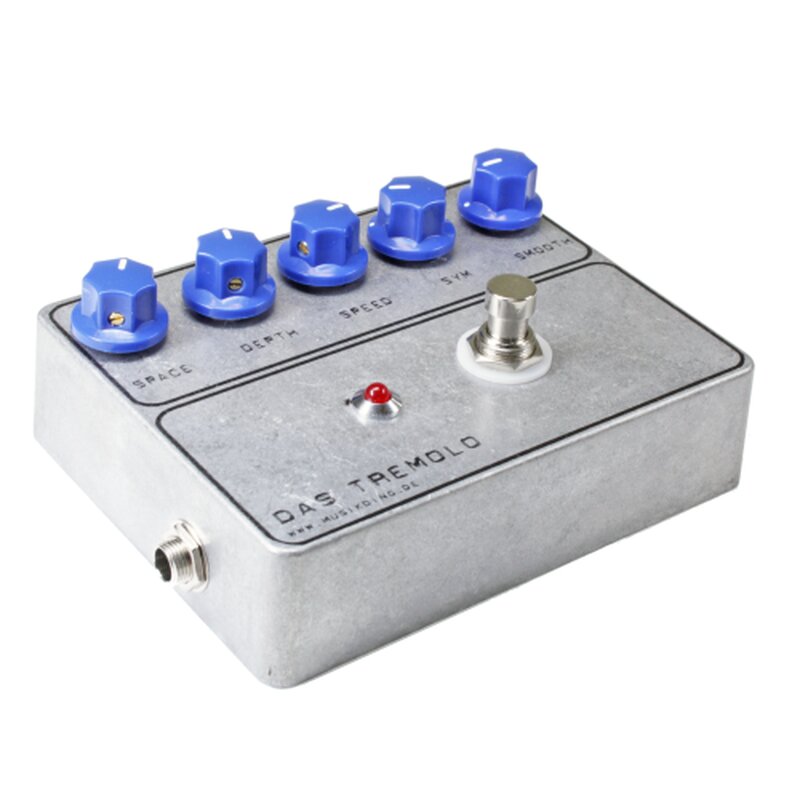
I am really looking for a great tremolo pedal that's close to blackface fender trem or just an amazing tremolo in general if anyone has a good recommendation?
 
Pedals that surprised me on how good they sound are:

Muroidea Distortion aka ProCO Rat, sounds amazing! Would be my number one recommendation.

Pauper aka Prince of tone, like it better than king of tone, honestly.

D3lay, just sounds really good to me.

Sproing Reverb, sounds great for subtle reverb.

Cepheid Chorus and Caesar Chorus, these are a must imo. They both sound amazing.


I don't really have many disappointments...

Mahayana Drive is OK... I built two and both are noisy and not really my thing.

Trembling Loon Tremolo is OK too, just a little on bright sounding side.

I am really looking for a great tremolo pedal that's close to blackface fender trem or just an amazing tremolo in general if anyone has a good recommendation?
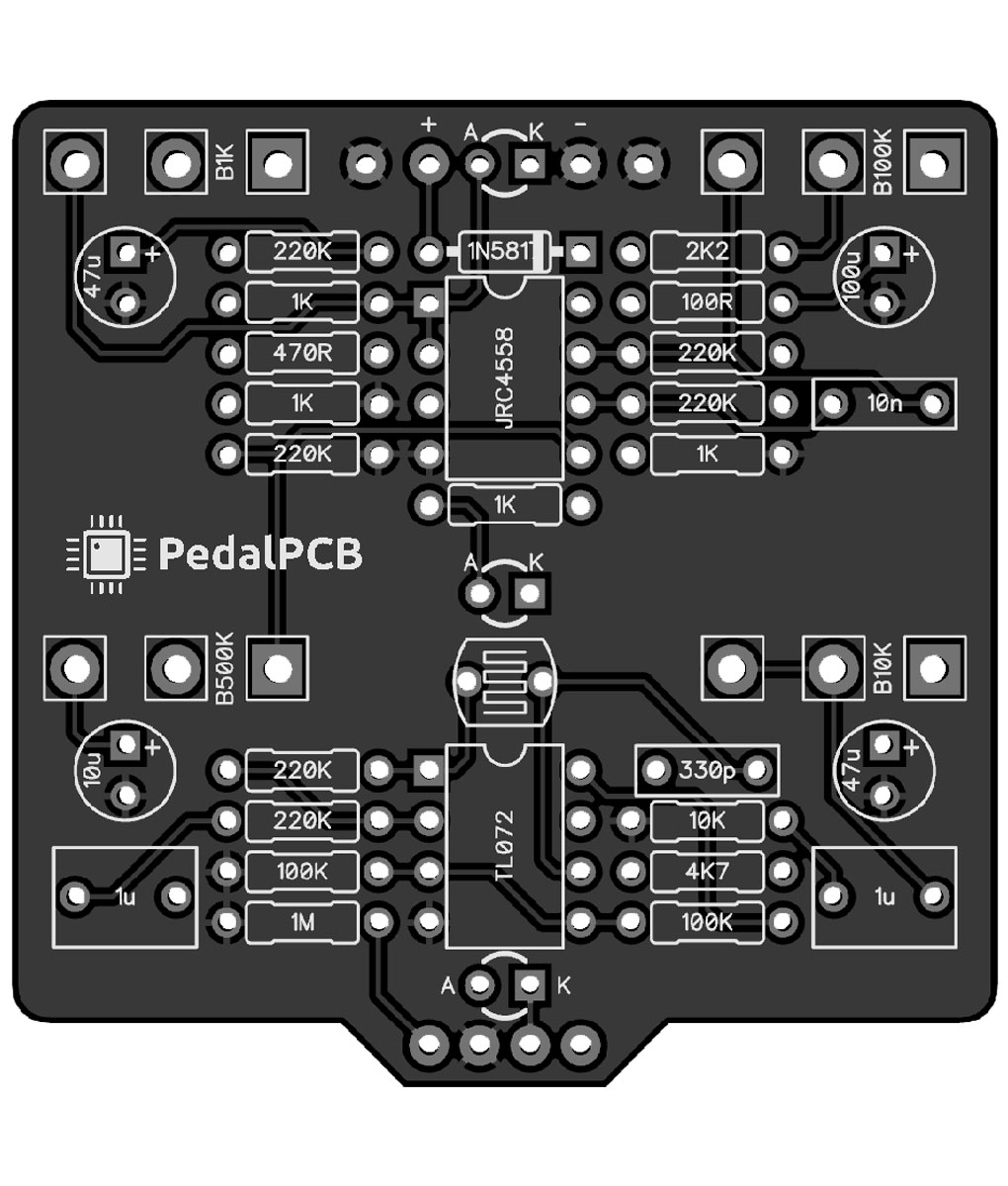
PPCB Moonshot
 
I am really looking for a great tremolo pedal that's close to blackface fender trem or just an amazing tremolo in general if anyone has a good recommendation?

I built this one and it's great. No one has been disappointed with this circuit so far, according to the many reviews.
 
Making some general comments on the comments in general...

Ge-Foist
For those "gotta be before everything" pedals — don't forget you can build a buffer-buster for yourself and stick it anywhere in the chain. Yes, there are caveats with doing so, I'm sure — BUT, it makes for a wee bit more versatility for that pedal.

2many knobs
I picked up 2 Brutalist boards — ONE I intend to have all the mods on it: extra switches, pots, trimmers-externalised; TWO will be the bare-bones version. "Why not just breadboard it, FF?" 'Cause I want to faff about with way too many controls and experiment and there's nothing worse than hidden controls you don't have easy access to — but I came to appreciate the beauty of a simple aesthetic, too. Subjectively there's complex, simple, and Goldilocks' "just right".


Stating the obvious
Everybody has unique tastes, wants, and needs — it's why we DIY, so we can build just the right number of knobs needed to match our tastes, wants, needs and position the jacks wherever our preference lies.


It's been interesting reading through the thread and coming across thoughts/ideas/processes that I never would've been cognizant of otherwise.
 
Versatility is overrated.

MultiFX are usually lame.

Mods rarely improve the stock unit.

Extra Knobs often disappoint.

Simplicity is beauty.
I agree (mostly) but I do love to mod overdrive circuits and I find my mods for my pedals can be incredibly useful. Especially if they reduce complexity, reduce gain or add clarity. I mainly modify pedals to get rid of excessive gain/dirt/noise and clear up the low end. I like to hear overtones on bass strings and rarely use lots of dirt. A lot of the time it makes the difference between me using a pedal or not. For example I recently built a Horse Meat and left out a few bits here and there and now I can actually use it. So many overdrives cut so much high end the bass strings turn to mush. Great is you use them with gain on ten but hopeless with gain down low.
 
Back
Top