Selling pedals as a “side hustle” vs simply enjoying the hobby.

I sold out and I sold out hard. I built my very first pedal in 2013 and as soon as it was finished a friend offered to buy it from me, and it felt good to make something someone wanted. So I kept going.

I'm not much of a salesman, but I love building, and selling has always been way for me to afford to keep doing that. I would still build pedals even if they weren't selling (and I did for many years), but I'm able to accomplish a lot more when I'm selling.

I don't plan on this ever being my full-time job, but it has paid for every piece of gear I own, loads of equipment so I can make better pedals, and given some extra cash for fun stuff when I want it. It doesn't pay the mortgage or put food on the table, and if it ever did then it would be a lot more stressful.

I think I also like doing it semi-professionally because I don't feel super fulfilled at my day job. I like to think I'm good at my job, but I'm a low-mid level worker in a huge multinational corporation and sometimes I don't feel important. When I build pedals, all of a sudden I feel like what I'm doing directly matters to people. So maybe I'm mostly doing it for emotional reasons rather than monetary reasons :P

I tried actively pursuing it for a few years with onboard preamps for one specific luthier, but I've just never had the salesman gene. Based my travel and vacation budget around NAMM for a few years, traded lots of R&D, parts, and build time for "free" booth space and barter credit on instruments and accessories, mostly had a blast, and I have been working with a few other cool luthiers for the last year or two. I always brought a few pedals along to NAMM too, but being locked into one luthier's booth didn't really work in my favor. My goal was always to sell design work rather than hardware though, and IME that just won't happen unless you have some good tangible products for people to try out. I made a big networking breakthrough in 2020 but a month later we had The Plague, and I'm just starting over now with the onboard stuff, but also enjoying exploring the pedal builder culture and doing some different things.

If I were going to sell pedals as a "side hustle" I'd look at what it takes to build at least 100 at a time, preferably 1000. And by build, I mean have someone else do it! ;)
Are you going to be at NAMM this year? I just made all my travel plans 😁
 
Are you going to be at NAMM this year? I just made all my travel plans 😁
Still not sure, but my primary client has only just started back into production after his disastrous shop fire a year ago, and I think he's taking a timeout from the show for this year. He has really big plans for 2024 and I'd love to go do it up in a different way at least one more time. I think my stuff was in basses in 5 different booths the last time I went...good times.

I've gone on less than a week's notice before though, so never say never! :ROFLMAO:
 
I exclusively buy PCBs that I intend to use myself, but I only end up liking about 1 in 8 enough to justify keeping.

It's not too much effort to drill a few extra boxes once I already have the press fired up, then wire 'em up and sell to (at least) break even so the hobby pays for itself.
 
Where's your favorite place to sell?
Unfortunately, Reverb.

Since they were bought by Etsy, they raised their selling fees to the point where it's borderline exploitation if you are selling something hand-built, but it's the best place to get the most boutique pedal junkie eyes on your builds.

Not lucrative, but to move one build out the door and fund the next, it's tolerable.
 
Where's your favorite place to sell?
I always recommend people start with social media, the virtual equivalent of "word of mouth" these days. I got started on facebook, you make a page for your "company" and post pictures of everything you build and people will start to notice. You'll get people following you, then you'll get comments asking how much for something, work out the details and money changes hands via paypal. Still has a fee, but loads better than reverb or ebay.
 
I tend to give them away or trade them for nice bottles of whiskey.

I have a friend who is all hustle - he's basically made his self-taught graphic design hobby in to multiple small businesses where he does design and physical displays for small stores, pretty cool stuff. Anyways, he's always on me to start selling stuff and I've turned him down for years. I told him the only way I'd ever do it is if I had my own website where I could just list stuff I made for the hell of it and people could buy them if they want.

Well, the jerk called me on it as it just so happens that web design is another of his talents. He said he'd build me a site later this year if I wanted. I'm still on the fence, but it does sound kind of enticing, especially since I don't actually have to make the website. We'll see.
 
I'm just building pedals for myself, and I'll take commissions from my friends for the cost of parts. Not interested in trying to make a profit, I'd be setting myself up for massive headaches if I tried and I already have more than enough stress in my life.

I think turning it into a side hustle is a nice idea, but becoming a rock star is a nice idea too and that plan hasn't worked out too well for most people I know.
 
Last edited:
I sold quite an few and didn’t overly care for it, but I love building, so I melded my enjoyment of building and put proceeds to charity. It’s my thing and it’s not for everyone. I’m just fortunate to be in a position to do it. I still occasionally sell one of my older builds to fund an amp build but selling for me wasn’t enjoyable at least to me. Don’t let that stop you for trying!
 
I had a well-paying job which I loved for a long time - commercial photography. Then as it started getting slow, which started before Covid, I had more time to devote to building amplifiers and the occasional pedal. I never had any intentions of selling them. These were purely for me, in an attempt to chase down sounds I wanted which available gear wasn't giving me. Nothing outrageous. I simply wanted a big fat sound which didn't get soggy in the low end, as I was playing rockabilly on Filter'tron Gretsches and every Fender would start to fart on the bass strings. It was a combination of slight overdrive with the right amp and I'm still developing my sound. Along the way I have learnt so much, and as you learn you realise how much more there is to learn! But still, the sounds I get now are so much better than they were ten years ago.. :)

As I built amps I started to run out of room for them. So I sold a few through a local shop which specialises in quality guitar gear. I was surprised at how accepting of my amps other guitar players were. The first ones went to regularly gigging players and recording studios. Then purely through word of mouth I am getting a few commissions for both amps and pedals. Again, this was never my intention - maybe it should have been! But like others I dislike the hustle. My main jobs have been so full of that kinda crap I have no appetite for it in my hobby.

Now I have made new friends locally through this hobby and met some guys who have been an absolute delight to know. One of these new friends has a band which uses three of my amps and about a 1/2 doz of my pedals, which makes me feel like a proud parent. I have done zero advertising, still don't have any graphics on my pedals (appalling, I know!), and have been able to steadily increase prices to a point where I make a small profit on the amps which is difficult to do. Good quality amps cost a lot to build! As long as the hobby pays for itself and I like the guys I'm building for it's all good though.

The best bit is being able to tweak things until the player is happy. That is super satisfying. And it is truly remarkable how much better well-made gear sounds compared to what you find in the average guitar store.
 
It doesn't happen to me very often, but I am always scratching my head when I have to give a price on my builds... I definitely don't have a big seller mindset. I guess i have to convince myself that my work is worth something...

I always hand-paint my builds and I am not sure what it is worth in terms of services and artwork... probably not much compared to the length of the process. I guess I could make higher prices if all enclosures were carefully etched, with very professional looks, etc. But, i don't want to add more health risks to the building process (aluminium particles, soldering fumes, etc.).

My main practice is to make prices according to the people's level of wealth. To poor people (like myself) I sell the first one or two stompboxes for the same amount of money I invested. It means I don't get anything for the time spent and the effort modding, calibrating, painting, etc. If they want more I'll consider raising the price, but it never happened yet. Usually I just lend them a few circuits for several months, and I can get them back anytime.

To people with regular incomes, and average wealth, I add 20 or 30 euros for the building process. But I can get quickly close to the market price of the original circuit... I need some good reasons to sell a clone for the same price as the original, many mods or expensive parts for exemple.

If people are coming to me for effects, i am guessing that it is mainly because diy is cheaper than industrial products. If I can't sell it for much less than the original, I fear it will discourage potential customers.

For exemple Flintlock Flanger kit + enclosure cost around 85 euros. The AD/A Flanger currently in production costs 150 euros, so the potential benefit can't be very interesting. As other members already explained, it has to be 100 units at a time to be interesting, and then it becomes a whole other occupation, selling online, making shipments, etc.

I wonder what are your opinions on this matter.
 
Last edited:
I've sold a handful of pedals and traded a few more of my builds for commercially produced units (Boss, MXR, EHX, etc). The more I've built the more I got into tweaking the gain, frequency response, volume, etc of circuits then trying to create my own fresh takes on old stuff. If I had a circuit that took off and I could just make the one pedal (sort of like Snouse Electric Co, 1981 Inventions, or Browne Amplification) as a side hustle I think I would be fine with that. I'm no engineer by any means, but neither is Jamie Stillman. Just looking at the build docs on some of these circuits Robert has traced gives me more confidence because I see what people have done and wonder what they were thinking. The most recent thing that comes to mind is that the Stellar Drive has a compensation cap, but the IC used is internally compensated.

With those Snouse and Browne they made improved versions of circuits people were looking for. I'd rather do something a little different and creative that stands on its own. There was some JHS video I saw one time where Josh said (paraphrasing) people say they don't want another tube screamer, but then their tube screamer clone is their best selling pedal because people want the familiar. I do have a few dirt circuits I think people would like if I just put them out there and had some kind of advertising. I think I'm rambling. Maybe I just need some decent graphics on my pedals so I can start pushing them lol.
 
Do you want a hobby or a job?

No. 🤣


The most recent thing that comes to mind is that the Stellar Drive has a compensation cap, but the IC used is internally compensated.

In a lot of cases quirky things like that are because they were present in the pedal they cloned (*were inspired by) and it blindly made it's way into the new design despite other circuit changes nulling their purpose.

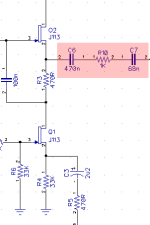
This is the one little snippet that I see quite often and it throws me for a loop every time.

Capacitor > Resistor > Capacitor with no other connections in between. I've also seen the inverse of this, Resistor > Capacitor > Resistor.

I can't wrap my head around why this is done... Chuck says it's probably a copy/paste job, and I certainly can't come up with a better explanation.

What bothers me is that I've seen this done by reputable builders, one who I believe is an EE... If anyone has an explanation I'd love to hear it.


1677678694752.png
 
A coworker's wife has been encouraging me to build a website for my pedal building so she can recommend me to some of her coworkers, and naturally as an overthinker in the couple of weeks I've been putting it together I've been thinking about this a lot!

I decided that I want the website to more or less be a business card / portfolio with the occasional one off pedal for sale alongside some DIY odds and ends that people have asked me to sell. My most rewarding commissions (personally, not financially) have all been collaborations - sure I'll bust out a fuzz face clone - but I have a lot of fun asking "what sound are you going for?" and letting that lead to a pedal. Before I started building pedals I could maybe name 15 non Boss stompboxes, and there's a lot of players like that out there. I'm sure my thoughts will evolve but that's kind of what I want to be focusing on for the stuff I'm building for other people. I build because I love it, I've always been more than fine with my wallet hating it.

To people with regular incomes, and average wealth, I add 20 or 30 euros for the building process. But I can get quickly close to the market price of the original circuit... I need some good reasons to sell a clone for the same price as the original, many mods or expensive parts for exemple.
I do this too, lol.

I recently did two commissions of the creamery compressor (dod milkbox) and felt like for any other similar build $150 would have been a fair price - it's a complicated circuit with a high component count, JFETs, a VCA and odd-taper pots. But you can snag the real thing for like $125 on ebay.
 
No. 🤣


In a lot of cases quirky things like that are because they were present in the pedal they cloned (*were inspired by) and it blindly made it's way into the new design despite other circuit changes nulling their purpose.

This is the one little snippet that I see quite often and it throws me for a loop every time.

Capacitor > Resistor > Capacitor with no other connections in between. I've also seen the inverse of this, Resistor > Capacitor > Resistor.

I can't wrap my head around why this is done... Chuck says it's probably a copy/paste job, and I certainly can't come up with a better explanation.

What bothers me is that I've seen this done by reputable builders, one who I believe is an EE... If anyone has an explanation I'd love to hear it.


View attachment 43103

Heh, I just posted something like that recently in my schematic for @BuddytheReow's current contest, and I was hoping someone would ask. In my case it's a modular build, one of the resistors is on each board and the R-C-R chain let me get just the right cumulative R value without having to do another Mouser order for one 1206 resistor that would end up being a different brand with different cosmetics than the rest if I wanted to get precious about the exact value .

Perhaps deWd just really wanted 59.4nF and the two caps fit better that way? ;)
 
Back
Top