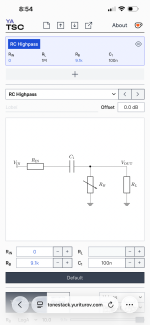
I don't think so. RL is the load impedance and RIN is the input impedance. Should be about 16K for RB and 100nF for C1. But that only renders a -3db slope. To get a -6db slope, you would need two of those HPFs in series.
Rin and RL depend on the impedance of whatever is before and after. Ideally you assume 0 for Rin if a buffer or active pedal (with low outpu impedance) is before it, and 1M for RL, as most pedals and amps have 470k~1M input impedace. But, if you're putting this first in chain (connected directly to the pickups), then the output impedance of the pickups will make a big difference.
A lot of calculators ignore Rin and RL and just calculate the RC, assuming low Rin and high RL.
A first-order filter calculator like that will tell you the cutoff frequency where the output is -3db. You'd have to set the cutoff freqency higher that 90hz to get -6db reduction at 90hz.
A 2nd order filter will be steeper, and I believe the cutoff frequency from a calculator tool will be at -6db. The pedalpcb Frequency Interchanger uses 2nd order (or 2-pole) for the highpass filter (Sallen & Key style).
Just saw Cybercow's, he covered some of the same things.
My understanding is an active 2nd order filter will be steeper and more defined than 2 cascading 1st orders filters, I'd guess better for your application
K cool the roll off can start a bit higher I think I can play with it. With 10k and 100n im showing -6.4db at 90 hz and the roll off looks gradual enough. Guess I’ll just see how it sounds.
Interactive tonestack (tone stack) calculator for guitar amps and pedals. Compare frequency response curves of Fender, Marshall, Vox, Hiwatt, and more while tweaking controls and component values in real time.
Share your videos with friends, family, and the world
youtube.com
It’s from a synthesizer perspective, but it mostly all still applies to pedals.
He goes from passive filters all the way through to active resonant filters with CV control.
It’s really easy to follow, and you can just stop whenever you get to the level of filter complexity you’re looking for