Stuff you wanted to know but were afraid to ask

How do you populate your pcbs. I know shortest parts come first but I’m asking do you fold both legs over to hold them in place and solder, populate and snip the legs then solder using putty or something to hold them in place? Some other way? I ask because I’ve been using the folded legs method and have a really tough time getting something out once it’s been soldered.
everyone is likely different but I use a pcb holder so I can spin the board from from to back when needed. I solder everything one component at a time...lightly bend legs so they don't immediately fall out,, I hold with my finger and solder from the back of the board then clips the legs begore going to next part.... I hate having to fish around a sea of leads to solder up a board.
 
How do you populate your pcbs. I know shortest parts come first but I’m asking do you fold both legs over to hold them in place and solder, populate and snip the legs then solder using putty or something to hold them in place? Some other way? I ask because I’ve been using the folded legs method and have a really tough time getting something out once it’s been soldered.
I don't know if my technique is the most kosher or not, but....

I pretty much do all my building on something like a silicone mat or neoprene mousepad.
for all the smaller/"shorter" components like resistors, diodes, IC sockets, small caps, etc I just put them thru the pcb and flip it over onto the mat... the weight of the pcb itself is steady enough to hold them in place while I solder.

for taller components I kind of do the same thing really. Except they are more liable to get crooked or off center, so basically I just give it a tiny tack of solder on one leg - just enough to keep it from falling out when I flip it over. Then I push the other leg all the way down to where I want it positioned and solder that one all away, then go back and reheat the "tack soldered" joint and put the leg all the way through as it needs to be and solder it fully down.

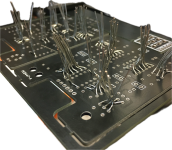
I don't really like having a bunch of unclipped leads sticking up as I'm trying to populate so tbh I usually am trimming leads after every 2-3 components. And I don't really care for using stuff like blue tack, and really don't care to do the folded-legs method for the reasons you mentioned

Like I said, i dunno if that's the most proper way, but it works for me
 
How do you populate your pcbs. I know shortest parts come first but I’m asking do you fold both legs over to hold them in place and solder, populate and snip the legs then solder using putty or something to hold them in place? Some other way? I ask because I’ve been using the folded legs method and have a really tough time getting something out once it’s been soldered.
Again, everyone is different but...
Populating all axial components and soldering from the component side of the board sped up my building a good bit and no chance of loosing components. You do need good clean technique and the right tip. You can be hanging out for 5 seconds. I'll contact just the pad for a second then bridge the iron between the pad and component before applying solder. In and out in 2 seconds.
Since your fillet is on top, as long as you use the correct amount of solder, you get a much smoother finish to the bottom. A much better alternative to cutting through your joints. It is a little more of a pain to clean flux, if you desire to do so, and depending on the solder you use.
I'll then do film caps in 2-4 passes with blutak, depending on the size of the board and number of caps. I'll tack on side of each cap, then flip and check alignment.
 
What would be the downside of building a relay system with a 5v reg, a cap and 1meg or so to ground and a 5v relay only?
It seems like that's all one would need. Forget all the switching. Just switch the control line to the relay.
I suppose you could get some relay chatter?
 
I usually bend both leads to secure the part (like in @Erik S's picture). But after 1 side is soldered I straighten the other lead before soldering--that way at least one is easy to remove.
I like to do this too. I’ll add most or all the resistors, do a pass on one side, straighten them all out, and then do the other side. I used to do them one at a time, but after I had more practice and a better iron it’s just so much faster to solder a whole bunch of components in one go.
 
How do you populate your pcbs. I know shortest parts come first but I’m asking do you fold both legs over to hold them in place and solder, populate and snip the legs then solder using putty or something to hold them in place? Some other way? I ask because I’ve been using the folded legs method and have a really tough time getting something out once it’s been soldered.

I'm sure most would say I populate like a 🤡 so I'll spare you my own take on the above tutorial
 
@jessenator You tutorial has been so helpful in me getting back into building that I even have a shortcut too it on my phones homescreen! I must admit I started off by cleaning the leads with alcohol and verifying each component with a multimeter before putting it in but it took me way too long. I’m slow enough as it is lol. But I use your same method on almost everything else! I would’ve never thought that if you had switched to just sear them on top of the enclosure and drop the board down on it with the pots.
 
@jessenator You tutorial has been so helpful in me getting back into building that I even have a shortcut too it on my phones homescreen! I must admit I started off by cleaning the leads with alcohol and verifying each component with a multimeter before putting it in but it took me way too long. I’m slow enough as it is lol. But I use your same method on almost everything else! I would’ve never thought that if you had switched to just sear them on top of the enclosure and drop the board down on it with the pots.
OH it's not mine, but glad you're getting back into the swing of things
 
OH it's not mine, but glad you're getting back into the swing of things
I don’t think there was a time I ever really did get into the swings of things lol! I just used to build an occasionally pedal and was lucky when it worked! Managed to build a Tychophrabe Octavia, Zen Drive and BSIAB plus a few more by dumb luck.
 
How do you populate your pcbs. I know shortest parts come first but I’m asking do you fold both legs over to hold them in place and solder, populate and snip the legs then solder using putty or something to hold them in place? Some other way? I ask because I’ve been using the folded legs method and have a really tough time getting something out once it’s been soldered.
well when you use a vise you get to solder resistors and diodes from the top of the board if it is plated through-hole, which is nice because gravity does a pretty good job of holding things in place while you work rather than tensioning the leads of parts to hold them in place
 
How do you populate your pcbs. I know shortest parts come first but I’m asking do you fold both legs over to hold them in place and solder, populate and snip the legs then solder using putty or something to hold them in place? Some other way? I ask because I’ve been using the folded legs method and have a really tough time getting something out once it’s been soldered.
If it's something in the shape of a resistor, then fold each leg in a 90 degree so they are pointing in the same direction and insert them into the PCB. If the resistor doesn't go thru and lay flat against the pcb surface, use pliers from the otherside of the pcb to pull it down. lay the board flat on the desk with the resistor facing down (so the leads are facing up at you) and solder them. Then clip them off.

Usually resistors will stay in place before soldering them in. When you go to turn the board upside down and squeeze the resistors against the table, any that have slid up will go back down so they are pressed up against the PCB and you can solder them all in.

if it's a component like a box capacitor, you can do the same method, except these are a bit more finnicky due to the shorter leads. It can help to slide the board onto the edge of the table upside down while holding the components legs from the back, and let go of the legs once the top of the capacitor is making contact with your desk. I solder one leg then check out the component and see if I need to recenter it.

With any component you can insert the leads, solder one, then hold the top of the component with a finger while you re melt the solder so you can position it better. I do this with elec caps and LEDs most often.

I don't fold the legs over unless I have to, and even then I just do one to hold it in place, then after I get the second leg in straight, I go back and re melt the first leg's solder and bend it straight. I just don't like bending them, it's not very clean.

But for everything you can, insert the shortest components first and press the PCB down into the desk while soldering from the other side. If you have to come back and insert a small component afterward (like if you didn't have it when you built the rest of the PCB) then do what you can and likely fold one leg over to hold the component in while you solder it. Sometimes resistors or MLCC capacitors like to lift away from the board while moving it around, and maybe I'll re melt the solder while quickly pulling down on a leg with pliers, or maybe push the component down with my finger.

A lot of the time I tack components in place by one leg with solder so I can do a cleaner job with the other leg, and then I'll come back and reflow the first leg.

I don't use helping hands or blue tack or one of those fancy holders as it's just faster not to. Sometimes I wish I had blue tack on hand, but there's always another way to make it work.

 
Back
Top