steviejr92
Authorized Vendor
I’ve seen a video on YouTube on Eastwoods official page. They said never to vacuum up powders as they can ignite. Now I’m not so sure?



I’ve seen a video on YouTube on Eastwoods official page. They said never to vacuum up powders as they can ignite. Now I’m not so sure?
Hey that’s what I got except mines red so that means I can sweep faster


From what I remember, not all powder types are compatible with this type of gun.He uses a triboelectric gun, so no external power source is needed.
Im having the same issues. I was thinking maybe if i dropped the voltage down and put the nozzle on that would prevent it but i havent tried it in practice.question for practitioners - how do you deal with the excess of powder accumulating near the edges - on the opposite side from the currently sprayed one? I often shoot the powder on the two sides of the piece. I start from the inside. But there is always some powder that escapes to the other side. This can be a problem with textured finishes because it changes the texture where the powder is thick. Same with transparent finish.
View attachment 47783
The store where I buy powders lists what technologies are compatible with a given powder. There are two - corona (HF gun) and tribo (nordic pulver type gun). Many special finishes (for example metallics, antique) are only recommended for corona.Ive never heard of that thats pretty interesting. @temol what kind of powders are needed for this type of gun?
I try to shoot all sides equally. I made my booth big enough that I can hang enclosures far enough away from the sides to get the gun in to coat them. I will note that I don't coat the insides of my boxes, so I hang it with the top facing toward me and don't move it at all during the coating process.question for practitioners - how do you deal with the excess of powder accumulating near the edges - on the opposite side from the currently sprayed one? I often shoot the powder on the two sides of the piece. I start from the inside. But there is always some powder that escapes to the other side. This can be a problem with textured finishes because it changes the texture where the powder is thick. Same with transparent finish.
View attachment 47783
In my enclosures, the side edges of the upper piece are wider by about 2mm than the lower piece, so I have to cover 2 sides.I try to shoot all sides equally. I made my booth big enough that I can hang enclosures far enough away from the sides to get the gun in to coat them. I will note that I don't coat the insides of my boxes, so I hang it with the top facing toward me and don't move it at all during the coating process.

May i ask what are you paying attention to and looking for when your powder coating?In my enclosures, the side edges of the upper piece are wider by about 2mm than the lower piece, so I have to cover 2 sides.
An example.
Right, that does complicate things a bit. Have you tried shooting "sideways", i.e. have the thin edge facing you and shoot from the sides like that? You would probably waste more powder with overspray, but it might help consistency of making it stick evenly. I obviously don't have experience with folded enclosures (which, I've said before, look incredible), but just a thought.In my enclosures, the side edges of the upper piece are wider by about 2mm than the lower piece, so I have to cover 2 sides.
An example.
May i ask what are you paying attention to and looking for when your powder coating?
Yeah, I've tried that. It all depends on the enclosure. It's problematic with small edge/corner radius (faraday cage effect).Right, that does complicate things a bit. Have you tried shooting "sideways", i.e. have the thin edge facing you and shoot from the sides like that?
 that should let you know I was laying it on thick. I think I might try either black or textured black this time.
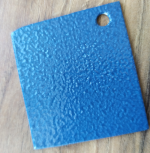
Do you have good oil and water filters on your air supply? (again, my reference is spray painting, not powder coating…) Those type of “fish eyes” are almost always from small spots of contamination on the surface—or from small water or oil droplets that are in the air supply. In humid climates, professional booth installations will include a chiller unit on the air supply, to condense much of the moisture that becomes a real problem when air is compressed. One good habit is to always bleed your compressor tank before spraying; the amount of water in there can be quite surprising.I try to keep (more or less) even coverage. I avoid thick powder layers. Except hammered finishes. I have bad experience with most of them. They seem to like much thicker layers. And despite the fact that I put a lot of powder, I often have small "eyes" with aluminium shining through. See the picture.
View attachment 47871
I use strong flashlight to inspect powder buildup. With a flashlight you can monitor thickness of the powder (100% powder coverage, no alu visible under the powder) and evennes of the coverage - texture of the powder (flashlight at very low angle above the surface, like car headlights illuminating the road).
You need to make sure that the element that will be powdered in a moment is free of dust particles, threads, hair, etc. The electrified element likes to attract various particles, which are later difficult to remove without disturbing the delicate powder.
Yeah, I've tried that. It all depends on the enclosure. It's problematic with small edge/corner radius (faraday cage effect).
That's a good point, and in-line moisture filter is more or less a must in more humid climates. When I first started I was living in the Mojave desert and I could get away without a filter, but now when I run without a filter my powders get clumpy and the coating is uneven. @temol I've unfortunately never been to your part of the world (yet, though it's on my bucket list), I understand it's a bit humid there yes?Do you have good oil and water filters on your air supply? (again, my reference is spray painting, not powder coating…) Those type of “fish eyes” are almost always from small spots of contamination on the surface—or from small water or oil droplets that are in the air supply. In humid climates, professional booth installations will include a chiller unit on the air supply, to condense much of the moisture that becomes a real problem when air is compressed. One good habit is to always bleed your compressor tank before spraying; the amount of water in there can be quite surprising.