Thoughts on EAE's jab at the Mofeta Schem?

The simplest way to state this is that I'm bothered that something I made is, due to reverse engineering, no longer entirely in my control. It's something I've struggled to come to terms with, but it's given me lots to think about.

  1. I'd say this is accurate. I am a relentless self-critic and know this design inside out, so it wasn't hard for me to apply that same level of criticism to the Mofeta layout.
  2. This is, candidly, a projection of my anxieties. There are exceptions that could prove the rule (Centaur/KTR, 1981 DRV, arguably the Hudson Broadcast), but assuming it'd apply to my own work does require a few leaps.
  3. That was more of a remark about trying to figure out which version was traced. We used to use a series diode, but the current production version (as of the Summer/Fall 2020 revamp) has a more sophisticated power protection scheme (over-voltage and reverse polarity) that IMO is not practical for a DIY product.

I think DIY pedal building is immensely valuable. It's where almost anyone building pedals for a living got started. I have tried to pay it forward by sharing information where I can with up-and-coming pedal builders, running classes, and providing open source materials online. All that to say, I am trying to leave the community better than I found it.

I have personal issues with the increasingly widespread proliferation of clone PCBs of small companies whose primary failing is not being able to manufacture enough to meet demand. I remember in the early 2000s when DIYStompboxes and Freestomboxes would take apart designs only to find another tube screamer or FF derivative that lied about its origins. That was a good thing, though I think this resulted in a lot of (not unfounded) cynicism in the DIY community. However with the rise of cheap PCB prototyping circa 2013-2014 came a wave of cool, original work. That, to me, is why we're in somewhat of a golden age of pedals now. But I digress.

What can be cloned? I'm not a moral philosopher or an IP lawyer. I don't know if a hard and fast rule is possible. I generally adhere to a punching up vs punching down dichotomy. I think some pedal designs are, for better or for worse, effectively public domain. Usually the originators of those designs are associated with big companies that are still doing just fine due to brand recognition and big margins. Conversely, small companies aren't going to have the same margins, and the risks of reverse engineering are potentially greater.

When it comes to personal and educational use, I suppose nearly anything is fair game.

If I am working with a circuit that is not original, I play it safe. I either 1) pick something from a long-defunct company and be transparent about the origins or 2) make substantial changes to the design. Sometimes I do both.

I suppose I'd say no to basically all of the above. You make good points. There is little to no market confusion. We had an issue with a reverb seller using our branding for a pedal based on the coda schematic, which I think would have been misleading due to the lack of power amp emulation. Otherwise, I do think we've been fortunate to have our own identity.

I agree there is a disconnect. I hope that I have now meaningfully answered your questions.

Thanks for sharing your thoughts. What problem were you trying to solve coming up with a different power and polarity protection? I gather you are not just talking about pedals using charge pumps, but I could be mistaken. I've seen a few other design approaches and also some posts from builders that express little concern about providing any protections on a PCB.
 
Thanks for sharing your thoughts. What problem were you trying to solve coming up with a different power and polarity protection? I gather you are not just talking about pedals using charge pumps, but I could be mistaken. I've seen a few other design approaches and also some posts from builders that express little concern about providing any protections on a PCB.
Lots of people nowadays use bricks with 18V taps, and in the last year or two (prior to the design update) we noticed an increase in people blowing their charge pumps with over-voltage. The ICL7660S can only handle about 12V before it dies and it is also sensitive to ESD spikes. I don't mind the rework but there are only so many hours in a day and I wanted to avoid dealing with warranty repairs. So, we use a MOSFET-based circuit to shut down the incoming power if it exceeds about 11V. Works great, and warranty repairs have dropped to nearly zero which feels good.
 
Lots of people nowadays use bricks with 18V taps, and in the last year or two (prior to the design update) we noticed an increase in people blowing their charge pumps with over-voltage. The ICL7660S can only handle about 12V before it dies and it is also sensitive to ESD spikes. I don't mind the rework but there are only so many hours in a day and I wanted to avoid dealing with warranty repairs. So, we use a MOSFET-based circuit to shut down the incoming power if it exceeds about 11V. Works great, and warranty repairs have dropped to nearly zero which feels good.
good idea - plus charge pumps are prone to heterodyning issues with other badly designed equipment
 
Lots of people nowadays use bricks with 18V taps, and in the last year or two (prior to the design update) we noticed an increase in people blowing their charge pumps with over-voltage. The ICL7660S can only handle about 12V before it dies and it is also sensitive to ESD spikes. I don't mind the rework but there are only so many hours in a day and I wanted to avoid dealing with warranty repairs. So, we use a MOSFET-based circuit to shut down the incoming power if it exceeds about 11V. Works great, and warranty repairs have dropped to nearly zero which feels good.
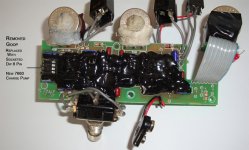
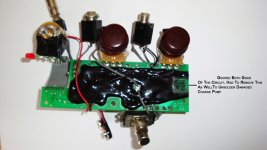
That's why nearly every build on this forum use Op Amp Sockets, I will show a classic example of stupidity by the Builder of this well known circuit!
You may recognize this , The first time it Blew, the Builder repaired it for a nice fee & told the owner he didn't want to see it again because it was dirty & sweaty!!!

The 2nd time, I made it replaceable in 2014, still gigging after 400+ shows :

Klon PCB Repair 1.jpg
Klon PCB Repair 2.jpg
 
There should be a pedal forum version of Godwin's law: every sufficiently long thread invokes klon at some point :LOL:

Anyway, I'll see myself out now. Email inbox is always open (john [at] electronicaudioexperiments.com). If you build a Mofeta and like what you hear, please consider supporting us down the line or checking out the open source versions of older models that we are releasing soon. Thanks.
 
Last edited:
Back
Top