

synthesiserror
Well-known member
I've been doing some work in a sound booth at an old church, and thought I'd share this neat early electronic carillon. What's a carillon? Basically, it's a set of bells played like a keyboard instrument. This carillon was retired decades ago, but left in place for one reason or another. It originally sent signal to a PA system that was audible inside and outside of the church.

This one's a relatively simple 2-octave chromatic, 1-voice unit. Stamp on the side of the enclosure indicates it's tuned to A-440. Some of these can get pretty elaborate, with 5 or more voices, many octaves of range, mechanical timers, player reels, etc. I can't find a manufacturer's badge, but to the best of my knowledge this particular system would have been installed sometime between 1947-1952. The number 36 is stamped multiple places- I'm guessing that's a serial number. This unit would have been controlled either by a stop on the organ or a separate console in the organ booth. That old organ has long since been replaced by a modern digital system, so I can't really know for sure.
Each brass rod is a physical chime, struck by a hammer actuated by individual solenoids. The aluminum bar that runs through the middle houses the pickup coil.
Close-up of a solenoid and free-swinging hammer. Feels like a hard rubber striker.
Bank of Mallory electrolytic caps, one connected to each input terminal. It's hard to read the ratings on these, but I think they're all 25uf, 25v.
Looks like the preamp is housed in here, with only one pot labeled "Hum". I think it's just a gain knob.

Gutshot of the preamp. Tube is a 6SJ7.
Vickers Electric Division selenium rectifier. No rating shown.
Beefy-looking transformer considering the rest of the circuit and the apparent lack of a power stage.
Sharing for no other reason than I'm fascinated by obscure instruments, and I bet some of you are, too. There's not a whole lot of information out there about electronic carillons from this era, but interestingly enough, there are a few companies that still make completely digital versions of these.
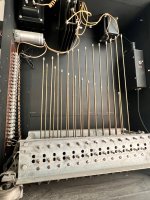
This one's a relatively simple 2-octave chromatic, 1-voice unit. Stamp on the side of the enclosure indicates it's tuned to A-440. Some of these can get pretty elaborate, with 5 or more voices, many octaves of range, mechanical timers, player reels, etc. I can't find a manufacturer's badge, but to the best of my knowledge this particular system would have been installed sometime between 1947-1952. The number 36 is stamped multiple places- I'm guessing that's a serial number. This unit would have been controlled either by a stop on the organ or a separate console in the organ booth. That old organ has long since been replaced by a modern digital system, so I can't really know for sure.
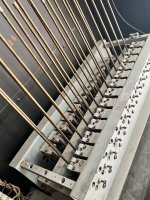
Each brass rod is a physical chime, struck by a hammer actuated by individual solenoids. The aluminum bar that runs through the middle houses the pickup coil.
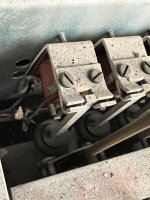
Close-up of a solenoid and free-swinging hammer. Feels like a hard rubber striker.
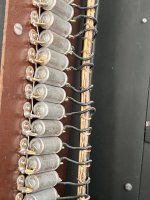
Bank of Mallory electrolytic caps, one connected to each input terminal. It's hard to read the ratings on these, but I think they're all 25uf, 25v.
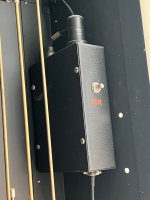
Looks like the preamp is housed in here, with only one pot labeled "Hum". I think it's just a gain knob.
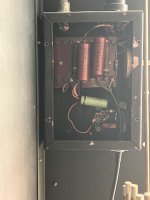
Gutshot of the preamp. Tube is a 6SJ7.
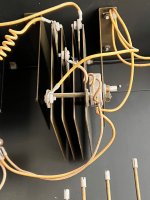
Vickers Electric Division selenium rectifier. No rating shown.
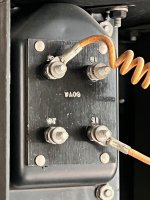
Beefy-looking transformer considering the rest of the circuit and the apparent lack of a power stage.
Sharing for no other reason than I'm fascinated by obscure instruments, and I bet some of you are, too. There's not a whole lot of information out there about electronic carillons from this era, but interestingly enough, there are a few companies that still make completely digital versions of these.


