What’s on *YOUR* workbench?

In my misguided youth, I had a Strat set up with 13s. It was awful.
This is basically what got me started down the baritone rabbit hole - put 13s on a guitar when I was younger, hated the tension so I downtuned until it was comfortable. Now I play longbois with lighter guard to get the same pitches :ROFLMAO:
These still aren't quite heavy enough 😞

These might work for you. The shortest I've tried them on has been 27" scale, but they sounded and felt great. I still use them on my 30" guys
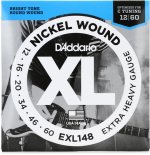
1000016777.jpg
 
This is basically what got me started down the baritone rabbit hole - put 13s on a guitar when I was younger, hated the tension so I downtuned until it was comfortable. Now I play longbois with lighter guard to get the same pitches :ROFLMAO:


These might work for you. The shortest I've tried them on has been 27" scale, but they sounded and felt great. I still use them on my 30" guys
View attachment 58175
That's part of my problem - this is a 24.75" scale length guitar. Somewhere somehow some compromises will have to be made
 
That's part of my problem - this is a 24.75" scale length guitar. Somewhere somehow some compromises will have to be made
Hmm... What about the GHS Boomers Baritone set? 14-70. I imagine they'd probably feel close to 10s tuned to A on your shorter scale
 
Hmm... What about the GHS Boomers Baritone set? 14-70. I imagine they'd probably feel close to 10s tuned to A on your shorter scale
The guy who fixed my Solar told me to use a tension calculator website (I think he had an excel set up), and go by tension. So put in the notes you want, the scale of the guitar and select the string thicknesses that give you a reasonable tension. It's a bit tricky since I think it varies a little by string brand, but I think it should get you in the ballpark.
 
Speaking of string tension, someone with a brain please enlighten me.

The longer a string is at the same pitch, the more tension it has, right? And the thicker it is the more tension it has, right?
So on a Strat with a reverse headstock, the low E is longer (more tension) and the high E is shorter (less tension) than on a standard Strat.
I was thinking that Jimi Hendrix's string gauge of 10-38 probably feels like 9-42 with a reverse headstock.
Or am I wrong? I can't science anymore.
 
Speaking of string tension, someone with a brain please enlighten me.

The longer a string is at the same pitch, the more tension it has, right? And the thicker it is the more tension it has, right?
So on a Strat with a reverse headstock, the low E is longer (more tension) and the high E is shorter (less tension) than on a standard Strat.
I was thinking that Jimi Hendrix's string gauge of 10-38 probably feels like 9-42 with a reverse headstock.
Or am I wrong? I can't science anymore.
The length of the string that determines pitch starts at the nut, not at the string tree. So Jimi’s strat tension is the same as a regular guitar. However the long low E does feel different and interacts with the tremolo differently I was told.
 
The length between the tuning peg and the ball end determines the tension though doesn't it? The nut sets the scale length with the bridge regardless of how much string is beyond the nut and bridge. So Jimi's 38 low E would have a higher tension at the same pitch and his high E would probably have less tension than one on a nonreversed headstock.
 
The length between the tuning peg and the ball end determines the tension though doesn't it? The nut sets the scale length with the bridge regardless of how much string is beyond the nut and bridge. So Jimi's 38 low E would have a higher tension at the same pitch and his high E would probably have less tension than one on a nonreversed headstock.
No, tension is not determined by length, it’s a measure of the force needed for the string to become loose again. That is, it depends on the potential energy we put into tuning the string. The modes of resonance of the string depend directly on tension, so for a given cross section size, only one value of tension will give you the pitch you want. That implies that a 38 low E string will have the same tension on Jimi’s guitar as any other Strat, if tuned the same.

Check out the wiki: https://en.wikipedia.org/wiki/Tension_(physics)
 
The length of the string that determines pitch starts at the nut, not at the string tree. So Jimi’s strat tension is the same as a regular guitar. However the long low E does feel different and interacts with the tremolo differently I was told.
How does it feel different? If not different tension, different stiffness? Something must be different, strings are not cut off at the nut
 
Friend asked me to re wire his SG with 'Jimmy Page' Wiring, four push pulls and PU split, out of phase, series/parallel options.
Was a beast to fit in and it didn't help that all the pickup manufacturers have different wire color codes. PUs are original Gibson, diagram was for Seymour Duncan codes. Sigh...
Shieled inside of cavity with copper foil while we're at it.
Also while at it made a new bone saddle instead of the composite aka plastic one, setup and buff up. All in all made a good difference, I think he'll be pleased.

hGso6gX.jpg


GETgaRC.jpg


Zcdwlmh.jpg


WZ3U2DG.jpg


The ol' half pencil trick...

UzmsNZA.jpg


AoWsPm2.jpg


All done.

4hPs14W.jpg
 
How does it feel different? If not different tension, different stiffness? Something must be different, strings are not cut off at the nut
The nut effectively divides it into two parts though, so I think that affects it. The fretboard side of the string is the same length, same thickness and tuned to the same frequency even if the part after the nut is longer or shorter.

In a normal strat the part of the string after the nut has a much higher tension (and higher frequency). Imagine if that part was for example two meters long. That part would probably be very floppy, but I suspect that the part before the nut (over the fretboard) would still be similar? So the string is sort of "cut off" at the nut, or at least close enough for this situation.

As a sidenote, I don't know for sure whether it does affect the tension or not, but that's my theory on why it would not affect the tension if that is the correct way it works.
 
The nut effectively divides it into two parts though, so I think that affects it. The fretboard side of the string is the same length, same thickness and tuned to the same frequency even if the part after the nut is longer or shorter.

In a normal strat the part of the string after the nut has a much higher tension (and higher frequency). Imagine if that part was for example two meters long. That part would probably be very floppy, but I suspect that the part before the nut (over the fretboard) would still be similar? So the string is sort of "cut off" at the nut, or at least close enough for this situation.

As a sidenote, I don't know for sure whether it does affect the tension or not, but that's my theory on why it would not affect the tension if that is the correct way it works.
The tension on the part of the string after the nut is the same in both cases. Think about it this way: if you take a 5” string attached to a 10lb weight and lift the string from the end, the tension on the string is 10lb and you are lifting 10lb. That’s true if the string is 5” long, or any other length. There is an interesting study that discusses how physics students associate tension to string length incorrectly which is proof that this is a confusing topic for most people :)
 
I wired up my friend's Tele with the 4-way switch and I was surprised by what I heard.

Position 2 (both pickups in parallel) is skewed towards the neck pickup, same volume as single pickups. Darker than a normal Tele.
Position 4 (both PUs in series) actually sounds like position 2 in a normal Tele but louder.

So I checked my wiring, solder joints, grounding, continuity. I also looked at how the switch works to make sure it was actually doing its job. All good.

I did some reading and apparently pickup order affects the series position. Bridge first (my case) sounds brighter, neck first muddier - what I would expect.
Does that make sense to you?

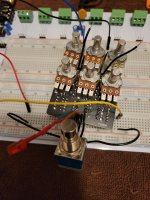
On a good note, the Pinecil does work on the back of pots but I have to use the knife tip and the boost function - besides running hotter, it gives the iron more power.
 
Back
Top