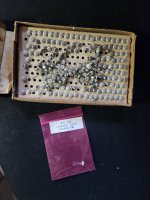
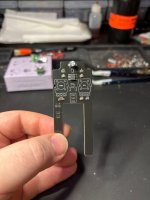
Dual lock (heavy duty Velcro) - the teeny, thin plates crybabys come with want to buckle when I attach them to my pedal board.
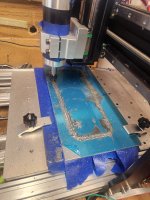
This is like, oh, 1/8" thick aluminum plate. Seems to work OK. First pass was...eh...fine.
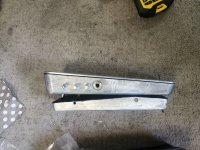
Might not want to use aluminum for these though. Even this is a little weak given the screw placement.
Thinking carbon fiber is gonna be the ticket here. Gonna be hell on my tool edges, but it should be easier on my machine. Just need to wear a respirator while I do the work. Stuff's expensive though, gonna cost me like 20 bucks a pedal to do those.
Might just use CF with whatever is currently on my board. Machining aluminum this thick is difficult on my little router. My spindle tops out at 9k RPM which only nets me about 500ish mm/minute with an O flute end mill. That tends to vibrate quite a bit. Three flute mills seem to work a lot better and let me triple that feed, but for some reason my Z axis seems to either be too weak and is losing downward steps, or something funky is happening with that tool algorithm in carbide create. I end up gaining like 1.7mm on my z axis on each time when I run through a program with the 3 flute cutter.
Might be time for me to sink some time and energy in completing my DIY machine. Nema 23 motors, c-beam construction, square mount spindle. The thing is mostly complete: I just need to assemble it and do all the cabling between the panels and the machine.
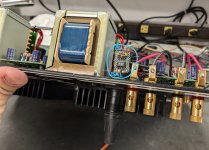
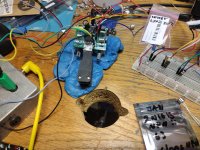
I just made a unity gain, balanced in to balanced out board, because the original balanced input is not balanced enough (still hums a bit with long input cables). Hum sucks.
If you run into something similar, SSM2141 or the THAT 1200 series are great balanced line receivers that really solve this kind of problems. They're not $0.50 though, so manufacturers tend to use cheaper solutions instead, which do not work as well!
Yes and yes, I think. But metal 3d printers are $$$$
If @jessenator had the kinda dough for metal 3d printers, he wouldn't be hanging out with us troglodytes.
I think it's just shiny filament.
Shiny filament. There are metal-bearing filaments that one can 3D print and send in for processing - which basically solidifies the part into solid metal mass.
Expensive filament and processing though. Can be done with cheap printers.
Clay is another option: I know a few artists that incorporate 3d printing with clay into their sculpture work. That's much less expensive to set up, but like other clay-based work it requires access to a kiln for best results.
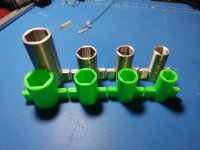
Only thing I'd say about the 3d printed rocket sockets is that layer adhesion is gonna be super important there. Torque will easily expose any flaws in that regard.
Auditioning bits in @jessenator 's 'clops project.
Basic recipe this far for anyone building, low hfe (50-70) Si for the NPN, LOW leakage Ge PNP and Ge diodes are a must. Si PNP is too fizzy and couldn't find a Ge NPN that has *that* sound. Any substantial leakage on the NPN either broke it or it turned into a dead battery fuzz. 2N1206/8 with <10uA still didn't quite cut it.
Settling on a JAN2N1613 for now. 2N1893 was a close second.
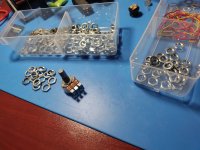
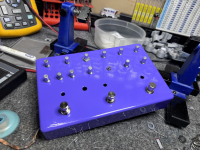
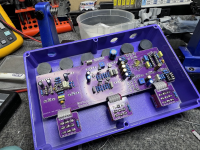
Got almost done and realized I have zero 3pdt on/on toggle switches..... Gonna have to sit until I can afford a decent parts order... I'm running out of all kinds of stuff.
Shiny filament. There are metal-bearing filaments that one can 3D print and send in for processing - which basically solidifies the part into solid metal mass.
Yarp. Metallic/shiny filament; nothing special If I was less lazy I'd switch back to PETG at least, but that'll need to wait for winter. Gets hot up in here.
I had a confusing problem with z axis position not repeating on a manual mill job a while back that ended up being the collet not being tight enough on a smooth carbide tool shank. The helix of the cutter was pulling the tool out of the collet little by little.
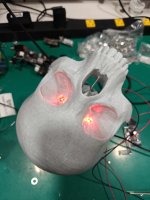
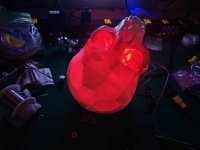
Me and the kids have been planning some DIY halloween decorations. Just finished wiring this up, and because I printed at such low infill it's basically a giant diffuser lol
I have bigger more exciting plans for it than just light up eyes, but the remaining parts for it won't be here until Monday.









 If I was less lazy I'd switch back to PETG at least, but that'll need to wait for winter. Gets hot up in here.