What Do You Look For in a Pedalboard

BuddytheReow

Moderator
I've built a few pedalboards for my needs at the time and I'm thinking it may be time for a revision. I'll most likely be making it myself out of some scrap wood (plywood, pine, or maybe something fancier). My first "board" was literally just a plank board, but that was just a placeholder and more to get everything off the ground at once so I could run a vacuum real quick (I DO clean from time to time, you know?). My first real board was 2 tiered plank boards raised up so I could mount a power supply underneath along with built in side jacks instead of plugging in/out of a pedal on the ends of the chain. Then I tried the wedge design and I think I like that best since they are angled up toward me instead of hunched down trying to read the knob labels. That's for my fx loop pedals (reverb, delay, and modulation). I'm thinking I want to revise my original 2 tiered board.

My question to you is what are features you wish you had or currently like built in to your pedalboard? First "wish list" item for me would be a built in tuner (a good one) to free up some pedal space.
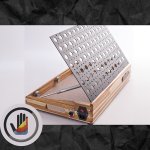
 
My current one is pretty good - about 22" long, two tiered, angled about 10 degrees, the second tier is about 1.5 inches higher than the first, I have pass thru jacks installed for audio and power, the bottom is secured in place and the back comes off to get to the power supply which is underneath the second tier, and it has a top that attaches during transport with latches. The pedals are as low to the ground as I can get them and there is a good amount of room for things without it being too big.

I've built 5 or 6 and improved the designs as I've gone along, and this is the best of everything I've come to want from a board.

My only "gripe" is that I made this one out of soft ish plywood, so I'd like to do another one with a more durable hardwood. But I like the design itself

jJUtlMf.jpeg


GR8Bic5.jpeg


R7DzNce.jpeg
 
Ooh this is relevant to my interests.

I pretty much have exclusively only made my own boards for the last decade or so. I flip back and forth between angled and flat but either way like OP prefer to design to precisely suit my own needs.

I’m a big fan of installing Neutrik D-panel type connectors. One of my favorites is powercon for power. It’s more secure and you won’t get your cable mixed up or hav someone else take it, cuz odds are they won’t be able to use it. Of course, downside is if you forget it or damage it or something it’s a lot harder to snag a replacement. IEC is everywhere… idk I still like it.

In the same vein integrated ins and outs are an easy one but nice quality of life feature. If you use an amp sim or something, in the past I’ve had a headphone (TRS) jack wired in. Of course this requires a sim with separate main/headphone out.

If you use anything that can be hooked up to your PC for editing, patch management, etc, having integrated USB is super nice. In the past I’ve built into boards a small USB hub that connects to a D-panel USB. Run the requisite cables to your usb-enabled pedals and then one usb cable to your pedalboard lets you connect to all of them.

An additional TRS (or TS, depending) connection can be nice if you ever use an external expression pedal or something like that. You can usually leave the “board end” connected to your pedal’s expression input and then just connect an outboxed expression pedal when needed.

I also really like having “audition spots” built in. This can be done with panel connectors or a dedicated enclosure. Basically a switched loop that is only active when something is plugged in. Lets you test out a new pedal (at whatever fixed position you place the loop) without having to unplug, move, or rewire anything.

If you use multiple guitars regularly, having an integrated AB switch is really fun.

In terms of physical construction… for “angled” style I greatly prefer having an enclosed bottom. It does add weight but gives way more flexibility for extra pedals, power supply, and knick knacks like the USB hub mentioned above. I also like to have a hinged top surface. Use some decent cabinet hinges that “snap” open and can support the weight of the top without flopping around once it’s loaded with pedals.

I also prefer a hinged top that’s custom cut for the pedals you’re using. I lay everything out and trace some guidelines then drill/route out some holes and/or channels/slots for power and audio. I like to try and have as solid of a top surface (I.e. minimal holes/slots/etc) as possible.

Okay, I think that’s enough for now😅
 
I like to have feet or supports that will somehow or another straddle the amp handle. Big fan of the small amp top board, I'm always fiddling with stuff
I was thinking about this - and having a remote switching foot board that communicates to the main board via ethernet cable and relays. Could only be a max of 7 pedals tho
 
How important is size to you guys? Do you prefer a board for your current needs or one you can "grow" into and add extra pedals later on?
 
How important is size to you guys? Do you prefer a board for your current needs or one you can "grow" into and add extra pedals later on?
So this might sound silly but I’ve pretty much limited myself by case size for years now. I’ve had a nice wheeled pelican case that I really like. So I basically use that as my maximum size. It’s a pretty good size though, I wanna say 21x16 board size. Much bigger is heavier than I care to deal with lol
 
I’ve been rocking a 11x30 and I don’t think I would want to go much bigger. I use a loop switcher and that takes up a decent chunk of space.

If I’m not using a loop switcher, I like to use a small board (like PT nano sized) with 3-4 pedals and a tuner. Sometimes I’ll keep the same pedals on it for more than one jam. A lot of times I don’t though- variety is the spice of life and all that.

I used to want a big do-it-all spaceship console, but it’s just not by style. 80-90% of my pedals are more like toys than tools.
 
How important is size to you guys? Do you prefer a board for your current needs or one you can "grow" into and add extra pedals later on?
I went with "grow in to it" and bought a large Mono board. Over the years I had built larger and larger plywood wedge type pedalboards. No regrets but it hasn't yet been more than 80% filled at any point, which is admittedly kind of a huge setup.
 
I went with "grow in to it" and bought a large Mono board. Over the years I had built larger and larger plywood wedge type pedalboards. No regrets but it hasn't yet been more than 80% filled at any point, which is admittedly kind of a huge setup.
Maybe "grow into it" is not the right term. If you've only got a handful of pedals, then I see the argument until you acquire more. My big board can hold 8-12 pedals depending on the size and I wanted all the options when I first made it. Fx loop aside, it's now down to 6 including a tuner. The more I think about it the more I realize I like what I like and might want to throw 1 extra on there just to try it out. I just have to consider the size of the enclosures I put on there: a 1590DD eats up 3 125b spaces.
 
There is a sweet spot between enough room for your effects and transportability. I have a Pedaltrain nano that I can just throw a few pedals on, but I haven't used it since I built the main board as it's easy enough to haul around.

I try to be conscious of size when I make my pedals so they fit on the board. I have one 1590XX pedal and it takes up a ton of room, so it only goes on if I really need that sound for a certain song etc. Otherwise they are mostly 1590b and 125b
 
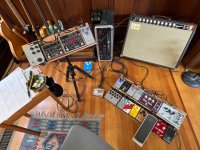
Over the years I’ve built several, usually plywood with two or three angled tiers, with the lowest as a plate that the others bolted down onto, using cut conduit as spacers. But then, after discovering this place, and suddenly wanting more than the 8 or 10 pedals I’d normally have mounted, I decided to build something modular. The first step was to make several mock up angled sections, that stepped up in height, so I could move them around. That’s as far as I’ve gotten. Well, I actually designed the whole system, but haven’t built it. The picture I’m attaching shows two of the modules on the floor, and a shorter one mounted up on a tripod at a good height to fiddle with while seated.

The funny thing is, about four months ago, I took it apart, and have more or less limited myself to using a tuner, volume pedal, either a compressor or boost, one mod pedal (chorus 90% of the time) and one delay. My main amp has a great master volume, so as long as I don’t need to be switching guitars and marching levels, etc., I can get by without any boosts and really enjoy the sound of the amp. (Then, when I do pull in a boost, I really enjoy what it does in a more focused way.)

But the concept is for a vertical ladder of these modules, that hang on an aluminum frame. Half the modules would have mounts for power supplies under them, and each module would have an in/out patchbay. My thought was to have a loop controller going to each board. So, it began to get pretty complicated. But I’d love to have a module of all delays, one of all boosts, one for fuzzes, etc. and not taking up the entire floor, but with a bit of repatching, being able to loop in what I want by hitting a switcher on the floor, next to my volume pedal.
IMG_0963.jpeg
 
Last edited:
My only requirements are being lightweight and have a handle. I only use a single piece of cheap board. Light as possible. If you need a Iid, buy a case. Just adds weight. (I travel by train to shows). In my current band, I'm finding it's nice the have a two channel loop strip with switches right up front. No more tapdancing.
 
Back
Top