What's in the mailbox? 📬 📦

I've finally done it!!!

A few months back I picked up an old Tascam M-35 mixer. I believe it's from around 1980-81.

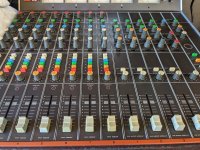
I spent a good amount of time cleaning it up before testing it fully. I pulled all the knobs and cleaned them in the ultrasonic cleaner, flushed out and lubed every pot and slider. I also cleaned out all of the I/O on the back of it. It really is a gorgeous piece of equipment (to my eyes, at least!):

mixer.jpg

Once I got it cleaned up and ready I gave it a full testing. Half of the channels worked and the other half were extremely quiet. All of the I/O functioned properly with the channels that did work.

This thing is modular, so I pulled out all of the channels and swapped them around to see if that changed anything but the same channels that worked previously still worked... kinda weird.

So I got on the hunt for a service manual. This was in April!

I searched a bunch of forums, emailed a few folks who sell manuals, but I couldn't find anything that had schematics.

@harryklippton suggested emailing Tascam directly. Good idea, but I reached out to their US service center as one of my first steps, a company called TAP electronics, who are actually only abour 30 minutes from me. They got back to me and told me that they didn't have one, so I just continued the search.

When I reached out to Tascam through their form email, I got an email from TAP Electronics again saying that they didn't have it but to reach out to Teac directly. I contacted Teac on Monday. Tuesday a person got back to me letting me know that they had a copy. it's $40 but they would sell it to me for $20.

Yes! I'd have paid $100 for it at this point.

The wonderfully helpful person at Teac shipped it yesterday and it got here today! The Teac parts shop is also only about 30 minutes from me, it turns out.

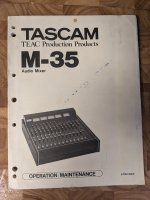
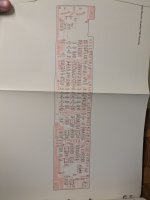
So here it is, in all it's glory: the Tascam M-35 service manual!

This thing looks like it has been sitting on someone's desk for the last 40 years.

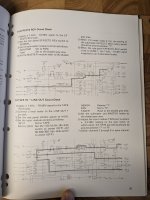
This has fold-out pages with schematics, parts lists, board layouts and tracings. It also has step-by-step troubleshooting for every function of the mixer. I am shedding happy tears.

When it cools off I'm going to head back out to the garage and start finding my way through it, but I was just so pumped that this came in the mail today that I had to share.

PXL_20240906_002017208.jpg

PXL_20240906_002218406.jpg

PXL_20240906_002141543.jpg
 
I've finally done it!!!
Be sure to start a thread when you dig it. Check you voltage lines and PSU caps first. Contrary to pedals(somewhat), opamps will make a difference in mixers. Once you're up and running, a couple of bits here and there will probably open it up a bit. What's great is it's modular and you can try thing on just one channel.
Mic pre opamps, summing bus opamps(depending on what's in there) and good electros in the signal path should lower self noise.
I wouldn't suggest a full recap. It's not really worth the investments, unless the caps are at fault for your dead channels. Then you know the others are likely right behind them.

But as unsexy as it is, start at the PSU.
 
Be sure to start a thread when you dig it. Check you voltage lines and PSU caps first. Contrary to pedals(somewhat), opamps will make a difference in mixers. Once you're up and running, a couple of bits here and there will probably open it up a bit. What's great is it's modular and you can try thing on just one channel.
Mic pre opamps, summing bus opamps(depending on what's in there) and good electros in the signal path should lower self noise.
I wouldn't suggest a full recap. It's not really worth the investments, unless the caps are at fault for your dead channels. Then you know the others are likely right behind them.

But as unsexy as it is, start at the PSU.


I'm planning recapping the PSU no matter what as one of the first things. It being modular is really wonderful. The entire PSU board slides right out.

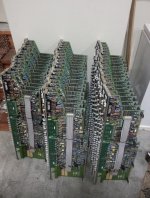
You just reminded me that I actually did start a thread about this a while back but abandoned it because I didn't want to tear it apart without a manual. Here's that thread if you want to see more photos with lots of gut shots. It's very clean inside.

 
Last edited:
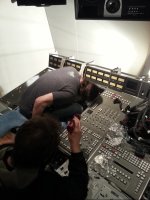
Reminds me of the good ol days… I’ve moved and installed a G series and J series.

View attachment 81442
View attachment 81444
I was looking at the latest digital stuff and all the connections take place with a single Ethernet wire.... All unbelievably expensive. Mixers, microphone preamps from focusrite, compressors, etc. I think it's laser, called lightpipe or something. I didn't look at it long for fear I might purchase something.
 
I was looking at the latest digital stuff and all the connections take place with a single Ethernet wire.... All unbelievably expensive. Mixers, microphone preamps from focusrite, compressors, etc. I think it's laser, called lightpipe or something. I didn't look at it long for fear I might purchase something.

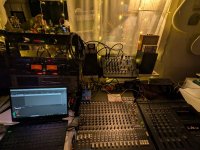
80% of my setup is from like 1996 or earlier. I can't stand looking at screens, so I scour the internet for leading edge 80's and 90's technology at bargain prices :ROFLMAO:

stuff.jpg
 
I was looking at the latest digital stuff and all the connections take place with a single Ethernet wire.... All unbelievably expensive. Mixers, microphone preamps from focusrite, compressors, etc. I think it's laser, called lightpipe or something. I didn't look at it long for fear I might purchase something.
Rednet/Dante is the newish thing. Started 10 years ago. It uses Ethernet. 128 channels of 192k audio in both directions over a single cable.
Light pipe(fiber optic) is ADAT technology. It's hung around because it's cheap and so much legacy gear has it. 8 channels of 48k, 4 channels on 96k, 1 direction per cable.
Dante is a godsend for live sound and large multichannel installs.
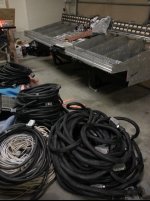
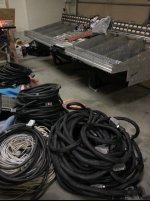
I remember pulling snake as an A2. Hours of pulling heavy 64 channel snake. I'll take an Ethernet cable instead.
Basically, you have you AD converter boxes at the source and you DA at the outs. Few Ethernet runs back to the console. No worries about jumping power(noise) etc.

@peccary if you want the.pinacle of gear for that era, keep an eye out for a RADAR system. Made by Otari, later IZ Corp, it was a 24 channel digital recorder but functions more like a tape machine, in a way. The Nyquist converters are the most analog sounding AD converters ever made, besides maybe some of the BURL Audio stuff(many prefer the radar converters over BURL saying the BURL tries too hard). There are actually 3 different revs of radar converters, but I won't go into that here. Similar in form to an ADAT but waaaay better.
They're also excellent live recorders as the things are rock solid reliable. And a quick Google show they, unlike much of the older gear, have gone down in price a good bit. I'm seeing full systems with meter bridge sub 3k. Some RADAR 24 systems for 1200-1500 even. $50-60 per channel of AD and DA ain't a bad deal.
 
@peccary if you want the.pinacle of gear for that era, keep an eye out for a RADAR system. Made by Otari, later IZ Corp, it was a 24 channel digital recorder but functions more like a tape machine, in a way. The Nyquist converters are the most analog sounding AD converters ever made, besides maybe some of the BURL Audio stuff(many prefer the radar converters over BURL saying the BURL tries too hard). There are actually 3 different revs of radar converters, but I won't go into that here. Similar in form to an ADAT but waaaay better.
They're also excellent live recorders as the things are rock solid reliable. And a quick Google show they, unlike much of the older gear, have gone down in price a good bit. I'm seeing full systems with meter bridge sub 3k. Some RADAR 24 systems for 1200-1500 even. $50-60 per channel of AD and DA ain't a bad deal.
I’ll 2nd the RADAR. The studio I worked at also did live recordings at festivals. We had two studio trucks and one had a RADAR system in it. It was great. Our head engineer usually used that one though. I normally used the one with an Alesis HD24. For prosumer gear, I was always impressed with the HD24. Unlike it’s ADAT predecessor, it was pretty damn reliable. Used several different ones for years with zero issues.
 
Rednet/Dante is the newish thing. Started 10 years ago. It uses Ethernet. 128 channels of 192k audio in both directions over a single cable.
Light pipe(fiber optic) is ADAT technology. It's hung around because it's cheap and so much legacy gear has it. 8 channels of 48k, 4 channels on 96k, 1 direction per cable.
Dante is a godsend for live sound and large multichannel installs.
I remember pulling snake as an A2. Hours of pulling heavy 64 channel snake. I'll take an Ethernet cable instead.
Basically, you have you AD converter boxes at the source and you DA at the outs. Few Ethernet runs back to the console. No worries about jumping power(noise) etc.

@peccary if you want the.pinacle of gear for that era, keep an eye out for a RADAR system. Made by Otari, later IZ Corp, it was a 24 channel digital recorder but functions more like a tape machine, in a way. The Nyquist converters are the most analog sounding AD converters ever made, besides maybe some of the BURL Audio stuff(many prefer the radar converters over BURL saying the BURL tries too hard). There are actually 3 different revs of radar converters, but I won't go into that here. Similar in form to an ADAT but waaaay better.
They're also excellent live recorders as the things are rock solid reliable. And a quick Google show they, unlike much of the older gear, have gone down in price a good bit. I'm seeing full systems with meter bridge sub 3k. Some RADAR 24 systems for 1200-1500 even. $50-60 per channel of AD and DA ain't a bad deal.
I've recorded in a studio with a radar system several times and was happy with the results
 
I’ll 2nd the RADAR. The studio I worked at also did live recordings at festivals. We had two studio trucks and one had a RADAR system in it. It was great. Our head engineer usually used that one though. I normally used the one with an Alesis HD24. For prosumer gear, I was always impressed with the HD24. Unlike it’s ADAT predecessor, it was pretty damn reliable. Used several different ones for years with zero issues.
I still use an Alesis HD24 on a regular basis... rock solid. Start it recording and forget about it, it just works.
 
Rednet/Dante is the newish thing. Started 10 years ago. It uses Ethernet. 128 channels of 192k audio in both directions over a single cable.
Light pipe(fiber optic) is ADAT technology. It's hung around because it's cheap and so much legacy gear has it. 8 channels of 48k, 4 channels on 96k, 1 direction per cable.
Dante is a godsend for live sound and large multichannel installs.
I remember pulling snake as an A2. Hours of pulling heavy 64 channel snake. I'll take an Ethernet cable instead.
Basically, you have you AD converter boxes at the source and you DA at the outs. Few Ethernet runs back to the console. No worries about jumping power(noise) etc.

@peccary if you want the.pinacle of gear for that era, keep an eye out for a RADAR system. Made by Otari, later IZ Corp, it was a 24 channel digital recorder but functions more like a tape machine, in a way. The Nyquist converters are the most analog sounding AD converters ever made, besides maybe some of the BURL Audio stuff(many prefer the radar converters over BURL saying the BURL tries too hard). There are actually 3 different revs of radar converters, but I won't go into that here. Similar in form to an ADAT but waaaay better.
They're also excellent live recorders as the things are rock solid reliable. And a quick Google show they, unlike much of the older gear, have gone down in price a good bit. I'm seeing full systems with meter bridge sub 3k. Some RADAR 24 systems for 1200-1500 even. $50-60 per channel of AD and DA ain't a bad deal.
Thanks for that explanation! I was a bit taken back by all the option-itis on all the sound equipment. Personally I'm still using analog balanced cables, lol.

Spent my career as a programmer which entails knowledge of computer architecture (wow I spelled that right, lol) so I can understand how networking all the signals would be a godsend. Before networks were common, I had to run data cables (well I had to tell the warehouse guys where to run them) and if you wanted 4 terminals and 2 printers it took six RS232 cables and ports. P.I.T.A. It was a pleasure removing them all and replacing with one cable and a remote router.
 
Back
Top