Oh man, I need to dive in on that SMD action because I feel like it would make the worst parts of building pedals (offboard wiring) a little bit easier.
Do you know (or @szukalski ) if these turn on when power comes on? That happens with the older board I built and it's a little bit annoying since I run a weird setup where I turn all my pedals on in the morning and they stay on during the day (also please let me know if that's something I should avoid), and I have to turn off the Figbuster manually after that. Or if it's something I messed up. It works fine, just turns on when you power it.
Oh man, I need to dive in on that SMD action because I feel like it would make the worst parts of building pedals (offboard wiring) a little bit easier.
Do you know (or @szukalski ) if these turn on when power comes on? That happens with the older board I built and it's a little bit annoying since I run a weird setup where I turn all my pedals on in the morning and they stay on during the day (also please let me know if that's something I should avoid), and I have to turn off the Figbuster manually after that. Or if it's something I messed up. It works fine, just turns on when you power it.
I had this problem on a relay bypass board I built using the same circuit. For me, the solution was increasing the 22nF10nF switch-debounce capacitor (ref des C2 in Chuck D. Bones schematic) to 47nF. It looks like it may not be an easy fix on @szukalski's SMD boards (that cap appears to be 0402 sized), but a simple change in the BOM file could remedy this on those boards moving forward.
I had this problem on a relay bypass board I built using the same circuit. For me, the solution was increasing the 22nF10nF switch-debounce capacitor (ref des C2 in Chuck D. Bones schematic) to 47nF. It looks like it may not be an easy fix on @szukalski's SMD boards (that cap appears to be 0402 sized), but a simple change in the BOM file could remedy this on those boards moving forward.
I think it would be cool to make them fit the ‘Fanged’ (is that what they’re called?) switches also so there’s not an extra step of securing them down.
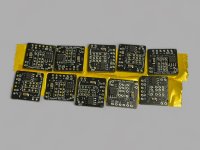
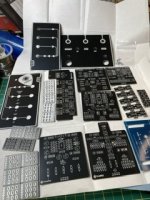
The PCBs came in earlier mid-week, but I don't think the cover-plates for the 3-CH Splitter/Mixer PCBs are going to work with how I'm doing things, which is too bad. The PCBs are also a couple mm too tall for what I had planned (H — that damned dogleg just for the !@#$%^&* LED!), so having to rethink the whole 3-CH project.
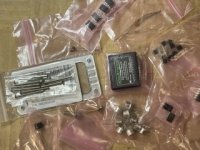
Yesterday got a small order from Amplified parts, which I happily paid duty and tax on AND the shipping-handling charge was very reasonable. GO POSTAL!
Alas, the damn screws don't fit the friend's Tele. The pickup corner I was test-fitting, well the spring went sproing and I've yet to find it... I'm going to break down and contact Mr Creamery and have him send the correct screws, once and for all.
The two sets of Russian diodes for a couple related Muffs, and at least one set doesn't look Russian. Not that I'd know what Russian diodes look like, but they should look different than Western diodes — maybe these are Estonian diodes. I shall ask them politely...
A few chips and transistors for this n that, and I ordered the wrong Belton for the Moonn Space Is Fun PCB that came in the Rainbow Mystery Pack — that's okay, I have another use for it and I'll borrow a 2H brick from Peter to PayPal Paul and get another 2H down the road.
Gretsch rings look good, we'll see if this one works with my Tele...
I think it would be cool to make them fit the ‘Fanged’ (is that what they’re called?) switches also so there’s not an extra step of securing them down.
I try to avoid having fixed connections to any part which may come loose and cause mechanical movement like jacks or foot switches.
My favourite way to use these relays is to connect them to the main PCB with pin headers. It’s simple and quick. Then you just connect to LED and SPST with cables. Cabling up to the main PCB was my main annoyance.
I did a few prototypes with the switch hole in the board but they always ended up larger than I wanted.
I try to avoid having fixed connections to any part which may come loose and cause mechanical movement like jacks or foot switches.
My favourite way to use these relays is to connect them to the main PCB with pin headers. It’s simple and quick. Then you just connect to LED and SPST with cables. Cabling up to the main PCB was my main annoyance.
I did a few prototypes with the switch hole in the board but they always ended up larger than I wanted.
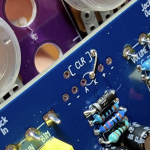
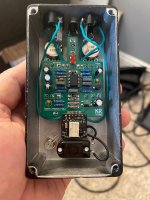
Exactly. I usually jumper from the 9V going into the CLR to the LED negative, but what you said also works.
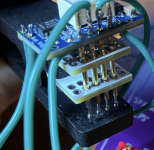
This lets you power the board from the bottom IO connectors, which is great for rocking before you box with a pogo pin adapter!
Exactly. I usually jumper from the 9V going into the CLR to the LED negative, but what you said also works. View attachment 62768
This lets you power the board from the bottom IO connectors, which is great for rocking before you box with a pogo pin adapter! View attachment 62769
Exactly. I usually jumper from the 9V going into the CLR to the LED negative, but what you said also works. View attachment 62768
This lets you power the board from the bottom IO connectors, which is great for rocking before you box with a pogo pin adapter! View attachment 62769
Weird but I just logged back in and found d a “Global Standard Direct Line” and that’s $15. So I’m happy now! Only 8-12 days. That’s way better. They must have seen my rant on here and changed it.



 github.com






 GO POSTAL!
 I'm going to break down and contact Mr Creamery and have him send the correct screws, once and for all.

 FFS
FFS 


