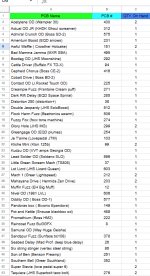
My pcb collection is getting outta hand

Last spring I spend most of a rainy Saturday putting all my pedal stuff into a spreadsheet. Every component organized into tabs by type. My stash isn't nearly as huge as a lot of folks here so it wasn't too terrible, but my god it's been so helpful and I feel like it's helped me avoid so many extra shipping fees.

My strategy is pretty simple: if I start to feel nervous about how many whatevers I have left, I just mark it as "low stock" in the spreadsheet. Whenever I make an order somewhere, I try to pull up the spreadsheet and grab whatever's getting low. One nice side effect is that it's a lot easier to look at a BOM and quickly pick out any "weird" things I'm unlikely to have; those items go into their own tab for later 🤓.
 
@Band of Dans I do something similar.
  • Low stock normal stuff goes into a Tayda cart immediately. I just always have a Tayda cart going. I do this if I notice I'm low during a build. Example would be 100NF caps or 220k resistors.
  • I wrote a program where I can put parts from any new order in a list and it'll consolidate it, order by value, and tally up the totals. Anything odd looking from the output, I check to see if Tayda stocks and otherwise put it on a tab for "order elsewhere" for my next sbp/mouser/dig ikey order.
  • If I'm researching a pedal or reading a thread and someone mentions a substitution I'll put that on a separate tab with a link to the recommendation. Otherwise I'll forget.
  • I put all my transistors, diodes, caps and resistors in two trading card binders, and all my ICS and bigger parts in two cheap slide-drawer organizers. So I don't need to tabulate inventory because I can check in a few seconds if I have the binders out.

I really hate missing parts and shipping costs, and this system has worked well for me with minimal mental or procedural overhead.
 
Last spring I spend most of a rainy Saturday putting all my pedal stuff into a spreadsheet. Every component organized into tabs by type. My stash isn't nearly as huge as a lot of folks here so it wasn't too terrible, but my god it's been so helpful and I feel like it's helped me avoid so many extra shipping fees.

My strategy is pretty simple: if I start to feel nervous about how many whatevers I have left, I just mark it as "low stock" in the spreadsheet. Whenever I make an order somewhere, I try to pull up the spreadsheet and grab whatever's getting low. One nice side effect is that it's a lot easier to look at a BOM and quickly pick out any "weird" things I'm unlikely to have; those items go into their own tab for later 🤓.
We are a lot alike… I do the exact same for my resistors, pots and capacitors and have every value I’ve ever ordered..I have a column for “order” yes or no.. lol
 
I love my spreadsheet has all the projects and parts I have on hand plus what I need order for future projects. Each line even triggers to turn red when I get to a certain level of parts.

Say I’m down to 10 - 10k resistors, turns red and I know I need to reorder.

When there is no red on the sheet. So satisfying.

Oof. Y'all are killing me.

I'm so seeing the benefit of using spreadsheets for keeping track of stock and organizing my purchases.

But fuck I hate spreadsheets. Like, really bad. My eyes always glaze over and I start looking around for something to fix.
 
I love my spreadsheet has all the projects and parts I have on hand plus what I need order for future projects. Each line even triggers to turn red when I get to a certain level of parts.

Say I’m down to 10 - 10k resistors, turns red and I know I need to reorder.

When there is no red on the sheet. So satisfying.
Color coding is the best part of spreadsheet nerdery. :)
 
You know what would be "Legendary Nerdery"? Having the Mouser part numbers in the spreadsheet so you can just upload it directly.........

Challenge Accepted!
Seriously… I don’t even order stuff from mouser because I can’t figure out their website and how to find what I need
 
Mouser's easy, I'll walk you through it:

  • Step 1) search CAPACITORS, for example;
  • Step 2) refine search to ELECTROLYTICS;
  • Step 3) further refine search to size needed: 220µF;
  • Step 4) Repeat process for other needed items;
  • Step 5) Wait for and finally receive items;
  • Step 6) Wonder what you're going to do with 600v 220µF caps that are bigger than the size of your thumb,
    • and what you'll do with transistors the size of the tip of your ballpoint pen;
  • Step 7) Decide you're going to build the world's first solid-state hybrid SMD-THD amplifier,
    • and solder together the other bits too big to fit into the amp and sell these neo-classical abstract sculptures at the local farmer's market...


Easy-peasey.
 
I can’t confirm nor deny I spent about 2 hours at work trying to find everything I could need from there and add it.

Seriously… I don’t even order stuff from mouser because I can’t figure out their website and how to find what I need
 
it's not as bad as I thought.... just got through about 90% of my drawer and so far inventory for pedalpcb I have 46 different pcbs and some I have doubles... probably have another 10-12 to add then Im gonna tally up other brands... probably another 10-12 different types.
View attachment 85528
Quantities, product name, product number, and circuit all in the same cell? Straight to the gulag with this bullshit.
 
My job is 98% spreadsheets and very early on in my build journey I used them basically to help make a shopping list based on the build docs. Now I just use pencil and paper when I take inventory to remind me to update my Tayda cart. Taking inventory is a necessary evil. I only do it once or twice a year fully. Otherwise if I notice I’m running low on a part I just tack it on to my next order.

My PCB backlog it pretty low (MAYBE a dozen)
 
Mouser's easy, I'll walk you through it:

  • Step 1) search CAPACITORS, for example;
  • Step 2) refine search to ELECTROLYTICS;
  • Step 3) further refine search to size needed: 220µF;
  • Step 4) Repeat process for other needed items;
  • Step 5) Wait for and finally receive items;
  • Step 6) Wonder what you're going to do with 600v220µF caps that are bigger than the size of your thumb,
    • and what you'll do with transistors the size of the tip of your ballpoint pen;
  • Step 7) Decide you're going to build the world's first solid-state hybrid SMD-THD amplifier,
    • and solder together the other bits too big to fit into the amp and sell these neo-classical abstract sculptures at the local farmer's market...


Easy-peasey.
You're missing crucial steps in step 3 there 🤣.

  1. Refine by capacitence
  2. Refine by lead spacing
  3. Refine by min voltage
  4. Refine by Max diameter
  5. Refine by Max height if necessary
 
Back
Top