You are using an out of date browser. It may not display this or other websites correctly.
You should upgrade or use an alternative browser.
You should upgrade or use an alternative browser.
Such a DEAL!!!
- Thread starter MichaelW
- Start date

benny_profane
Well-known member
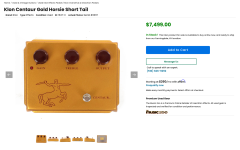
At this point, I think klons are essentially music gear nerds’ point of access into money laundering à la art.
Edit in line
Edit in line
Last edited:


Fingolfen
Well-known member
...crouching centaur... hidden dragon...Well it is the short tail one…

Harry Klippton
Not Interested
Ok I really don't mean to be obtuse here but I can't help but think about this every time a klon is mentioned lately. What actually is the deal here?
I first heard about the klon maybe 10 years ago but I don't really know. It was already relatively expensive and "mythical" but didn't seem relevant to any kind of music I was interested in, nor was it being touted by another whose opinion I respected. I haven't felt compelled to ever really look into it. No musicians I like use one. So what makes it so ubiquitous? Is it just sheer curiosity from the hype? is it just really that good? I have a hard time believing that last one
And just to clarify I'm using "klon" here to refer to any klon type circuit.
I first heard about the klon maybe 10 years ago but I don't really know. It was already relatively expensive and "mythical" but didn't seem relevant to any kind of music I was interested in, nor was it being touted by another whose opinion I respected. I haven't felt compelled to ever really look into it. No musicians I like use one. So what makes it so ubiquitous? Is it just sheer curiosity from the hype? is it just really that good? I have a hard time believing that last one
And just to clarify I'm using "klon" here to refer to any klon type circuit.

Laundryroom David
Keyboard Cowboy 🤠
It’s a very nice overdrive with a soap opera attached to it. I understand the engineering that went into it is impressive. I built one and find it fun sometimes. But it’s just another overdrive at the end of the day.Ok I really don't mean to be obtuse here but I can't help but think about this every time a klon is mentioned lately. What actually is the deal here?
I first heard about the klon maybe 10 years ago but I don't really know. It was already relatively expensive and "mythical" but didn't seem relevant to any kind of music I was interested in, nor was it being touted by another whose opinion I respected. I haven't felt compelled to ever really look into it. No musicians I like use one. So what makes it so ubiquitous? Is it just sheer curiosity from the hype? is it just really that good? I have a hard time believing that last one
And just to clarify I'm using "klon" here to refer to any klon type circuit.
Laundryroom David
Keyboard Cowboy 🤠
ThisAt this point, I think klons are essentially music nerds’ point of access into money laundering à la art.

Mentaltossflycoon
Well-known member
I was 100% with you until the chuck bass klone hit my radar. I don't use it like most klon users do on guitar. I like it with the gain up past noon. I've still never played through any version of standard klon. Absolute snoozefest to me.Ok I really don't mean to be obtuse here but I can't help but think about this every time a klon is mentioned lately. What actually is the deal here?
I first heard about the klon maybe 10 years ago but I don't really know. It was already relatively expensive and "mythical" but didn't seem relevant to any kind of music I was interested in, nor was it being touted by another whose opinion I respected. I haven't felt compelled to ever really look into it. No musicians I like use one. So what makes it so ubiquitous? Is it just sheer curiosity from the hype? is it just really that good? I have a hard time believing that last one
And just to clarify I'm using "klon" here to refer to any klon type circuit.

cwsquared
Well-known member
I like Social Distortion, where both Mike Ness (sandblasted klon-shaped enclosure, probably klone) and Jonny Wickersham (J. Rockett Archer) use them, currently. Mike had basically the exact same tone with an SD-1 for years. I think it's probably just subjective "I can hear the mojo in my toan" BS.Ok I really don't mean to be obtuse here but I can't help but think about this every time a klon is mentioned lately. What actually is the deal here?
I first heard about the klon maybe 10 years ago but I don't really know. It was already relatively expensive and "mythical" but didn't seem relevant to any kind of music I was interested in, nor was it being touted by another whose opinion I respected. I haven't felt compelled to ever really look into it. No musicians I like use one. So what makes it so ubiquitous? Is it just sheer curiosity from the hype? is it just really that good? I have a hard time believing that last one
And just to clarify I'm using "klon" here to refer to any klon type circuit.
I'll build one with Chuck's bass mod, but that's about as far down that rabbit hole I plan to go.
Laundryroom David
Keyboard Cowboy 🤠
It’s an intriguing hole. I had a Soul Food, an Archer Ikon, a Tumnus Deluxe, a Han Taun, a Tauren, some tiny Amazon klone and now have only the Kliche I built.I like Social Distortion, where both Mike Ness (sandblasted klon-shaped enclosure, probably klone) and Jonny Wickersham (J. Rockett Archer) use them, currently. Mike had basically the exact same tone with an SD-1 for years. I think it's probably just subjective "I can hear the mojo in my toan" BS.
I'll build one with Chuck's bass mod, but that's about as far down that rabbit hole I plan to go.
They all sounded basically the same, but I kept my Kliche. I rarely use it, though I do like it. To be fair, a fuzz face into a Klone sounds pretty magnificent. Gives you the mids. Gives me an idea.

DAJE
Well-known member
People believe bullshit. That's how marketing works.
I love my Kliché, it's one of my favourite overdrives. I also built the Chuck Bass version, and I'm a big fan of that one too. But they're just pedals, a few bucks worth of parts in a metal box. There's no magic about them, we all know that.
So why is my Klone worth $50 or whatever I paid to build it and a genuine Klon Centaur worth thousands of bucks? Objectively they are not. Same circuit, same sound, within the range of component tolerances. The one I built sounds a little better than the Klones I've tried, in my opinion, but close enough that it makes no real difference to anyone but me.
But people don't want to hear that, they want to hear about magic. So the Klon guy came up with a story about magic diodes, and that he owned the world's entire stock of them, which everyone here knows - or should know - is marketing bullshit. But people eat it up, because they want to believe in a special magical pedal that only special magical people get to use. People want exclusivity - they want to own something that guttersnipes like me will never be able to own.
Lots of well-known players use Klons. Keith Richards and Ronnie Wood have them on their boards. I think that some of the snooze blues guys like Bonamasser and Mayer use them. People want to have some connection to their idols.
So, you get someone who believes the hype and has a lot of money, and they start bidding up the thing they want. And very soon utility value - a fair price for a useful object - becomes incidental and collectible value - whatever people are willing to pay for an authentic doodad made by the magical guy and that the other magical guys all like and use - becomes the going price.
At which point the owning of the thing becomes more important than the use of the thing.
I'd like to say fools and their money are soon parted, but realistically collectibles will remain collectible for the foreseeable future. Peoples' belief in bullshit ain't going away.
I love my Kliché, it's one of my favourite overdrives. I also built the Chuck Bass version, and I'm a big fan of that one too. But they're just pedals, a few bucks worth of parts in a metal box. There's no magic about them, we all know that.
So why is my Klone worth $50 or whatever I paid to build it and a genuine Klon Centaur worth thousands of bucks? Objectively they are not. Same circuit, same sound, within the range of component tolerances. The one I built sounds a little better than the Klones I've tried, in my opinion, but close enough that it makes no real difference to anyone but me.
But people don't want to hear that, they want to hear about magic. So the Klon guy came up with a story about magic diodes, and that he owned the world's entire stock of them, which everyone here knows - or should know - is marketing bullshit. But people eat it up, because they want to believe in a special magical pedal that only special magical people get to use. People want exclusivity - they want to own something that guttersnipes like me will never be able to own.
Lots of well-known players use Klons. Keith Richards and Ronnie Wood have them on their boards. I think that some of the snooze blues guys like Bonamasser and Mayer use them. People want to have some connection to their idols.
So, you get someone who believes the hype and has a lot of money, and they start bidding up the thing they want. And very soon utility value - a fair price for a useful object - becomes incidental and collectible value - whatever people are willing to pay for an authentic doodad made by the magical guy and that the other magical guys all like and use - becomes the going price.
At which point the owning of the thing becomes more important than the use of the thing.
I'd like to say fools and their money are soon parted, but realistically collectibles will remain collectible for the foreseeable future. Peoples' belief in bullshit ain't going away.


SillyOctpuss
Well-known member
I sometimes wonder how many fakes are out there now.

cwsquared
Well-known member
Just say "Josh Scott". It's quicker.At which point the owning of the thing becomes more important than the use of the thing.
He has the box....