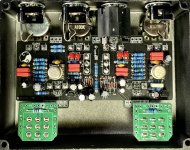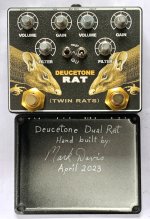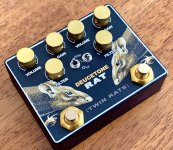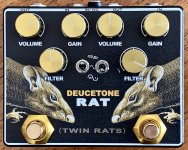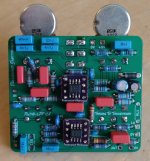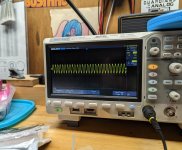
What’s on *YOUR* workbench?

For the 2nd coat would you hot flock it? Or let it cool down and try to cover the 2nd coat with the higher voltage setting?

You have to run the tests yourself, on your powder and your equipment. Sometimes I have to apply a second coat, but very rarely. Hot, cold - it all depends on the powder I'm using at the moment. It happened to me that after applying poweder on hot part, the second layer became slightly milky / hazy. And it was clearly visible because of the black, glossy finish. You are using a transparent finish here so an extra layer will rather darken it.
Btw. I don't pre-heat/degas my enclosures - for several reasons. I usually don't have too much time in my workshop. Cost of the energy. I've hever had any problems with adhesion of the cured coat.
 
You have to run the tests yourself, on your powder and your equipment. Sometimes I have to apply a second coat, but very rarely. Hot, cold - it all depends on the powder I'm using at the moment. It happened to me that after applying poweder on hot part, the second layer became slightly milky / hazy. And it was clearly visible because of the black, glossy finish. You are using a transparent finish here so an extra layer will rather darken it.
Btw. I don't pre-heat/degas my enclosures - for several reasons. I usually don't have too much time in my workshop. Cost of the energy. I've hever had any problems with adhesion of the cured coat.
This is awesome info. Ill be honest the de-gassing was very time consuming and next time i was going to leave it out. I think im going to let it cool down then run the 2nd coat.
Thats what im hoping for is to darken up the paint. Its a little transparent in some areas and you can see where i sanded the drill holes underneath the powder.

BTW what do you use to strip your powder coat after its been cured?
 
@temol @Alan W this question is for both of you.

For the 2nd coat would you hot flock it? Or let it cool down and try to cover the 2nd coat with the higher voltage setting?
As @temol has said, you really need to experiment with your equipment. And your workplace—by this, I mean that as hobbyists, we often have to work in non ideal spaces. Humidity is less critical for powdercoating than it is for conventional painting, but can still create problems. It’s worth it to take notes on things like that; you may start to see pattern emerge, and decide to wait “until it’s drier” or something else, based on experience.

And, I’m sure you know this, but transparent (clear with tints) are always more difficult to get nice results with, no matter the medium. Even the slightest thickness inconsistencies become apparent. Pretty much everyone in my (old) shop is good with spraying lacquers, but when clear tinting coats are involved, only three of us felt confident about giving it a go.

Degassing most metals is less critical; they need to be clean, and very dry. Because aluminum oxidizes so easily, (and it’s not like you’ve got an oxygen purged container to store it in), I would opt to cut the time between prep and coating to a minimum.
 
As @temol has said, you really need to experiment with your equipment. And your workplace—by this, I mean that as hobbyists, we often have to work in non ideal spaces. Humidity is less critical for powdercoating than it is for conventional painting, but can still create problems. It’s worth it to take notes on things like that; you may start to see pattern emerge, and decide to wait “until it’s drier” or something else, based on experience.

And, I’m sure you know this, but transparent (clear with tints) are always more difficult to get nice results with, no matter the medium. Even the slightest thickness inconsistencies become apparent. Pretty much everyone in my (old) shop is good with spraying lacquers, but when clear tinting coats are involved, only three of us felt confident about giving it a go.

Degassing most metals is less critical; they need to be clean, and very dry. Because aluminum oxidizes so easily, (and it’s not like you’ve got an oxygen purged container to store it in), I would opt to cut the time between prep and coating to a minimum.
This is all very good info. Puts a lot of things i had ideas for into perspective. What are you looking for when "clear tinting"? Even coverage obviously but anything else i should be paying attention to? I also have a hydrometer to monitor the humidity in the area. Maybe ill set up a booth with a dehumidifier and see what happens with dry conditions.

Degassing im going to skip next time that takes up way too much time!
 
This is all very good info. Puts a lot of things i had ideas for into perspective. What are you looking for when "clear tinting"? Even coverage obviously but anything else i should be paying attention to? I also have a hydrometer to monitor the humidity in the area. Maybe ill set up a booth with a dehumidifier and see what happens with dry conditions.

Degassing im going to skip next time that takes up way too much time!
The main difficulty with a clear tint is coat evenness—less of a problem with something the size of a pedal, but even a breadbox can be a challenge. But also, the fact that you can see through it, to the surface below—it almost seems to amplify small surface imperfections, rater than cover them up. And, with any type of clear, cloudiness becomes more of an issue. All-in-all, the most forgiving finishes, in pretty much any medium, are matte, or flat coats. As they get glossier, they get more difficult.

I'd take classes through, showing them how to use spray equipment. It's not difficult, but much harder than it looks—there are (with paint) about 7 variables to keep track of, which an experienced painter does without much thought. In general, most people got the gist of it after about an hour's practice. Every now and then, I'd get someone who just laid down near perfect coat first try (of course, I had pre-shined the paint, and set the pressure and other gun adjustments for them)—and every so often, I had students that would never really get good at it.
 
The main difficulty with a clear tint is coat evenness—less of a problem with something the size of a pedal, but even a breadbox can be a challenge. But also, the fact that you can see through it, to the surface below—it almost seems to amplify small surface imperfections, rater than cover them up. And, with any type of clear, cloudiness becomes more of an issue. All-in-all, the most forgiving finishes, in pretty much any medium, are matte, or flat coats. As they get glossier, they get more difficult.

I'd take classes through, showing them how to use spray equipment. It's not difficult, but much harder than it looks—there are (with paint) about 7 variables to keep track of, which an experienced painter does without much thought. In general, most people got the gist of it after about an hour's practice. Every now and then, I'd get someone who just laid down near perfect coat first try (of course, I had pre-shined the paint, and set the pressure and other gun adjustments for them)—and every so often, I had students that would never really get good at it.
I might try a matte black or just black period. I know they have a textured black that I like. This is all pretty helpful. I’m going to continue to mess around with my equipment to find what works best and continue to adjust and pay attention to the way I’m applying powder and whatnot. I love getting things down to a science so this should be fun!
 
I might try a matte black or just black period. I know they have a textured black that I like. This is all pretty helpful. I’m going to continue to mess around with my equipment to find what works best and continue to adjust and pay attention to the way I’m applying powder and whatnot. I love getting things down to a science so this should be fun!
Textured matte black is the worst look on a pedal
 
The art came out great! I have some oscillation in mine that I need to track down. maybe shielded wire is the way to go.
Thanks!

For the oscillation, dbl-check try increasing the 30pF caps (across pins #1 & #8 of the chips) to around 100pF. But if your Deucetone is wired in parallel, I'd rethink that configuration. I've encountered oscillation issues when running high gain dirt circuits in parallel. Something strange happens that I've not sussed out yet when they're in parallel.
 
Back
Top