What's your thoughts on Brian Wampler's new Video Courses?

Some versions of Spice is free, it's a software app.

Definitely!
E.g., Analog Devices's LTspice is 100% free and pretty easy to use (the GUI can be a bit painful/awkward at first putting down & connecting the components, but you get used to it pretty quickly). But it's very well documented, and they continue to regularly issuing software updates. .

I oscillate between breadboarding vs LTspice when futzing around with circuits, using whatever is faster/easier for addressing my question. LTspice is nice because you can get frequency responses and other analytic answers easily (e.g., why is it oscillating, or whatever). Breadboarding is better for when you want to hear the difference.
 
There's a new one out, "How to Design and Build Better Guitar Pedals: For Intermediate DIY’ers". It looks pretty interesting, not going to lie, but $125 (with the discount) for 6 hours feels like a lot? I dunno, I'm still considering it. I guess there is a 30 day money back guarantee if you're unhappy so I could give it a try, I'm not the kind of guy to abuse those but if I feel bad I would go for the refund.

https://www.guitarpedalcourse.com/courses/design-build-guitar-pedals?coupon=30offdiy2 link for anyone interested (the coupon is the 30% off for the first week)
 
Hmm ... do I spend the money on parts, or on edification...

School of hard knocks might stick better, but sssssooooo much sssllllowwwwwerrrrrr...
 
Hmm ... do I spend the money on parts, or on edification...

School of hard knocks might stick better, but sssssooooo much sssllllowwwwwerrrrrr...
YMMV, and it does feel like a lot of money.

For me, learning some things by independent research and by doing it myself works well. For other things, it doesn't work very well or at all.

Music theory is one of those, for some reason it was very hard for me to learn, or maybe rather to find the motivation to focus enough on learning it. I took a (I guess community college is the closes equivalent) course on it last semester, and it helped a ton. It was much easier for me to learn and actually understand it.

Similarly, looking this kind of stuff feels very intimidating, so I'm hopeful the course will help me jumpstart or catapult me forward a lot. Obviously I still need to put in the work, but it would hopefully feel easier. That is worth money, if it works out like that. It's also easy to buy courses and never watch them. That's why the money back guarantee also sounds good because it gives me an extra kick in the ass of "Go through it in 30 days or you won't get your money back if it sucks".

I'm not trying to sell it for anyone else though, if nothing else maybe you can use it to get motivation out of spite ("Oh look at that idiot, paying so much for that, I bet I can pull it off for free just so I can gloat to them!") or whatever.
 
I was recently looking at compressors when I came across Moritz Klein's build-video.

He has a whole series of vids with Erica Synths producing Eurorac kit versions so you can watch the vid, order the kit and build what you watched begin developed.

The compressor has two parts to it:


The COMPRESSOR BUILD DOC PDF is extensive, getting into a lot of details about how things work, why they work the way they do.


From my personal perspective, I'd like to see WHY a 100k resistor was chosen over a 10k/500k/whatever — but then the vids wouldn't be as compact and they already delve into a lot while remaining succinct.


Highly recommended.
There are painfully few tutorials on compression online. I'd also add the vaults of https://thatcorp.com/design-notes/

Also Lantertronics on YT does some great higher level engineering discussion.
 
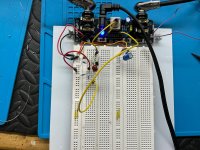
So i broke down and bought the beginner course on cyber monday. It was 40% off. I am a visual learner and thought i would give it a shot. I am not a beginner but i am no expert either. I have done some breadboarding in the past but not much. I did a lot of tagboard stuff when i first started. I dabble in KiCad and make some of my own boards etc…. So far the course is very basic (its fine i knew it was a beginner course). He does a good job explaining things and uses lots of diagrams etc.. if you learn that way its great. It’s also broken down into a lot of little sections so if you wanted to reference something later it would be easy to find. Thats my favorite part so far. I would have loved this when i just started building. There is a lot of build up before you actually build anything so be prepared. He really does assume you know nothing about guitar electronics. I started with this vs the intermediate on the chance i would miss something. I don't regret it even though i haven't really learned much new. It’s nice having a little refresher. I will work my way through the rest of the course and likely get the intermediate the next time it goes on sale. The first real project you do is a simple jfet buffer. Could you find all this on the web and in the forums? Of course. Its nice having it in a nice easy to follow format with out having to dig all over though. I would say dont pay full price for it but if you catch it on sale its worth you time and effort. Its like an extended pedal build with info salt and peppered in there. If you do Chucks breadboards all the time easily i wouldnt waste your time. If you are a casual breadboarder or want to get into it this is a good place to start. I just posted a pic of the jfet buffer to show something. They do get a lot more complex as it progresses but he starts small.
 

Attachments

  • IMG_1706.jpeg
    IMG_1706.jpeg
    1.1 MB · Views: 3
There is a lot of build up before you actually build anything so be prepared. He really does assume you know nothing about guitar electronics. I started with this vs the intermediate on the chance i would miss something.
That approach makes sense to me. I started studying jazz guitar this year. I hadn’t taken a lesson in 20 years and I found someone local teaching advanced students. I have a bachelor’s in music, and I was kind of groaning in my head when we started- doing pentatonic scales and triad inversions. But someone skilled in pedagogy builds on top of the previous lesson. Before too long I was chewing on a lot.

Really I’m just agreeing with your approach in where to start on a learning path. Anyway, thank you for the excellent review.
 
With the latest sale I purchased Wampler's Intermediate Pedal Building course along with the LTSpice and the PCB course. I already had the beginning Pedal Building course.

I thought the beginner course was too basic for me but would have been great to have when I first got started. I'm not sure why I didn't ask for a refund when I purchased it but I must have found the later chapters to be useful in some way. I'm getting ready to go through it again to find out.

So far I've only been through the LTSpice course and I have requested a refund. It is actually an excellent course and Sascha did an amazing job on it... but I have both of his books and he didn't cover anything in the video course that is not in the books. Plus the books cover way more. I really recommend his two books. They are amazing and teach so much in an easy to understand format. I hope he does more.. I would love to see him do a book on some common amplifier circuits (like the JCM 800). He actually explains what the components and circuits are actually doing. It's mind blowing for a non-engineer like me.

I'm going to start the Intermediate course soon and will report back.
 
My initial response: nah. You gotta cut your teeth the hard way, like the rest of us…

After thinking about it for a while: most of us here are pretty lucky. We started learning about all this stuff in the age of the pocket computer. In the blink of an eye all of the information available in the world is delivered to the pockets of our Jnco jeans…

But some fellas learned before then, back when you had to ask a grouchy old guy at Radio Shack why your pedal no work good. Or some cranky old timer at the music shop how your Fuzz Face works. And of course those old timers learned from the Anderton book, or from Mike Matthews, who used to personally sky dive into your backyard to show you the latest moon-tech. And then the real old-timers, like @Chuck D. Bones , who was there when Franklin invented electricity…and then pointed out all the components of the bell jar that did nothing for the tone…

Final answer: this is a good resource, and should be added to the collective library. There are lots of different ways, and it takes all kinds. Personally, Wampler Effects always gave ‘someone who puts mayo on white rice and calls it spicy’ vibes…
 
Back
Top