What’s on *YOUR* workbench?

Just 3/4" plywood. It's like a set of drawers if you turn it sideways. I just made it sized for the bin cabs that go inside. 3/4" ply is overkill on the "drawers" but I had a bunch of 3/4 sheets available in the wood shop and some time to kill. The next set will likely be 1/2" ply for the "drawers". The drawer slides are heavy duty ones which are necessary for the weight of the drawer on the bottom slide. I have some HWIN rails left over from another project and may end up using them instead - two rails on the bottom and one rail guide on the top.
I mean, yeah 😅. I was actually curious as to what the outer chassis is? Is it built into a shelving unit?

Other news...fuck my life. My 4mm cutter preset had been fat-fingered with a 1mm programmed diameter.

So my lower plate is about 1.5mm overcut. Balls. Gotta re-do the thing.
 
I mean, yeah 😅. I was actually curious as to what the outer chassis is? Is it built into a shelving unit?

Other news...fuck my life. My 4mm cutter preset had been fat-fingered with a 1mm programmed diameter.

So my lower plate is about 1.5mm overcut. Balls. Gotta re-do the thing.

Oh I get it... it is a metal rack shelf 48" long, 18" deep and 72" tall. The drawer cab sits on the shelf with about 1" of space at the top.
 
The pickup can be modeled as an RLC circuit, where R is the DC resistance (somewhere in the 5k to 20k range), L is a few Henrys and C is somewhere between some tens of pF to maybe a couple hundred, depending on the pickup. (In?)Arguably what gives a pickup its "toan", or timbre (physical shape and dimensions being equal) is its resonant peak amplitude and frequency (which, BTW, are significantly affected by the cable capacitance). A tone cap only really starts to matter when the tone pot is perhaps at 50% or below, which is when the capacitance starts to interact significantly with the pickup's inductance, producing that low mid hump when the tone pot is rolled off. Now, you may like that hump. Personally I'm not a big fan. I just want the tone pot to darken/brighten the pickup, like a treble cut EQ, not to also make it honky. Getting rid of the cap does just that. Now the tone pot is just a variable resistive load across the pickup. The more resistive load, the more it dampens the pickup's resonant peak, making it sound darker. You just need to replace the cap with a stopper resistor, so you don't go all the way to shorting out the pickup when rolling the tone pot all the way.

Again, not everybody will like the result, since we're so conditioned by the way a classic passive tone pot acts, bit it's a simple thing to try. Just swap the cap with a 30k-or-so resistor and see if you prefer it that way.

View attachment 112444
Thank you, that is very interesting. However, my question still remains, does it act differently in practice than the volume pot in your setup? It sounds like with no treble bleed you would basically have two pots that do almost the same thing (lower volume while darkening the signal), except one has a stopper. Or is there something I'm missing about how the volume pot is wired slightly differently, and how that affects it?

Or the aforementioned treble bleed where the difference would be "lower volume and darken the tone" for the tone pot, and "lower volume but don't darken the tone" for the volume pot - which arguably of course is already what most guitarists aim for, I guess, even if the tone pot's function is not spelled out like that.
 
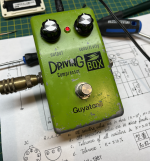
The Fire Red Fuzz I was converting somewhat in the direction of the Ultrastoner is progressing. I first tried to get both the high and low pass to similar frequencies while keeping the 22k resistors, which mostly worked, although it's not the Ultrastoner stack anymore. However, the two positions I found good were Tone and Shape bottomed out, or Tone and Shape topped. Which is annoying, why have two pots when there's combinations I find good between the two of them.

So I did some more fiddling with Yet Another Tonestack Calculator and came switched one of the caps back to the stock value (it had a parallel cap added earlier to raise the value, so just snip one leg of that) and now it's the best one (for me) so far. The middle values are much more usable now too, at least while using the shape control - I guess I just don't like the muff mid scoop that much. There is still the scoop if you keep the Shape at 0, although it's a bit higher than normal (and not as steep).

I wonder if using a dual pot for shape/tone would be an interesting experiment at some point too.

The next "issue" I find is that the Sustain works fine with my setup when it's at 0, which makes me want to try lower gain transistors or increasing the input resistor. The "Doom" switch is also kind of redundant in that it's mostly nice for cutting the noise when tone is high, not so much for the actual tone, at least with the guitar I've been testing it so far. However, when Tone is bottomed out, it takes away a bit too much high end where dead notes sound worse. Maybe a smaller value bypass cap always wired would work, and I could turn the Doom switch into an input resistor switch, where the name would make more sense anyway IMO.

Edit: Forgot to mention that I think I did not socket the transistors partially due to them being simple silicon ones so I didn't think they need that much fiddling, but also partially because this forum has so many people who just hate sockets. It would have made my life much easier if I had socketed them, so I guess it's another lesson on "don't give in to group pressure".
 
Thank you, that is very interesting. However, my question still remains, does it act differently in practice than the volume pot in your setup? It sounds like with no treble bleed you would basically have two pots that do almost the same thing (lower volume while darkening the signal), except one has a stopper. Or is there something I'm missing about how the volume pot is wired slightly differently, and how that affects it?

Or the aforementioned treble bleed where the difference would be "lower volume and darken the tone" for the tone pot, and "lower volume but don't darken the tone" for the volume pot - which arguably of course is already what most guitarists aim for, I guess, even if the tone pot's function is not spelled out like that.
I'm afraid I'm not the best guy to ask about treble bleeds. I don't need one, since I have a buffer inside my guitar that negates the need for one. With a buffer, reducing the volume has no effect on the tone, no matter what cable you use.

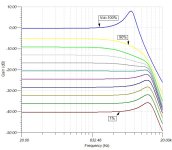
Having said that, this is what happens when you roll off the volume in the circuit I drew above, with a 500pF cable going into an amp with a 1M input Z:

tinadiag.jpg
 
Last edited:
I'm afraid I'm not the best guy to ask about treble bleeds. I don't need one, since I have a buffer inside my guitar that negates the need for one. With a buffer, reducing the volume has no effect on the tone, no matter what cable you use.

Having said that, this is what happens when you roll off the volume in the circuit I drew above, with a 500pF cable going into an amp with a 1M input Z:

View attachment 112489
Right, yeah, it looks very different. I assume it's due to one being just a variable resistor going to ground, while the other is a voltage divider. Thanks!
 
There was a recent post on direct to film (DTF) UV printed stickers. These posts offered a different and cheaper way to add art to our pedals. I found a semi-local printer and sent in my design. I was worried that the print was too small and would be hard to weed and place on the pedal. However, it was relatively easy. To easily and accurately place the sticker, I had marks for all the pilot holes. I predrilled the enclosure, using my 3D printed jig, and used these holes to align the sticker. It worked really well. The stickers are very durable. In fact, to remove it, you have to heat the sticker and then scrape it off. I think it will be very durable and suitable for our use.

IMG_7978.jpeg
 
Oh that's going to happen.


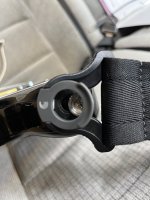
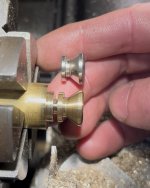
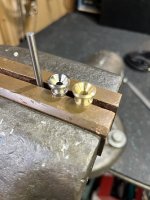
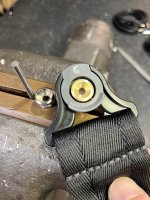
That's going to have to be on the CNC machine, but I think I still have some brass that's about the right thickness, I can totally make the bitchin sawblade slammer like I had when I was a kid and my mom threw away. SUCK IT MOM I'M AN ADULT NOW

You're my kinda people, brother.

That Jazz is going to look superb!! I've never played a jazzmaster (??!!), like ever, which would make it one of the few guitars I've never touched. Never repaired one. Never had to restring one. Weird.

Ya know...neither have I!

But its one that I've always been intrigued by. Never knew what the controls did before, didn't even realize the pickups aren't P90s, strictly speaking.

But I like the look of em, and figured this would be a good opportunity to learn about 'em.

They've got quite a following in certain areas. A whole subreddit and forum dedicated to these and jags and mustangs and the like. And a *bunch* of crazy aftermarket tremolo options.

I'm sticking to a pretty standard setup, except for the bensonite bridge I picked up. That thing was reasonably priced and has a look that charmed me.
 
Fuckkk I gotta trade in my mini-mill for a mini-lathe.

Porky no lost dross?

the-road-to-el-dorado-both.gif
 
Reminded again of how well Pedalpcb boards are laid out and how much more I enjoy soldering them up than other peoples. I currently have a Tonegeek TS10 board on deck and frankly it feels haphazzard and thrown together.. some of the values are labelled and then here and there they are just numbered and you have to go to the google doc to see what the value is... overall it just feels messy and not thought out.. even with component sizing and placement. Seriosly.. I'm probably not gonna even finish wiring it.. I just started a LGSM and going to just build it out to TS10'ish specs and some clipping switches for a buddy.
 
Reminded again of how well Pedalpcb boards are laid out and how much more I enjoy soldering them up than other peoples. I currently have a Tonegeek TS10 board on deck and frankly it feels haphazzard and thrown together.. some of the values are labelled and then here and there they are just numbered and you have to go to the google doc to see what the value is... overall it just feels messy and not thought out.. even with component sizing and placement. Seriosly.. I'm probably not gonna even finish wiring it.. I just started a LGSM and going to just build it out to TS10'ish specs and some clipping switches for a buddy.
A split between values and RefDes makes some sense if it's a board that's meant to build multiple different variants - populate most by numbers and check docs for what you want to use for the rest. But that didn't sound like it.
 
Back
Top