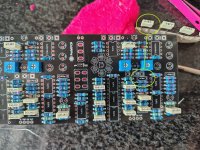
So the kit requires x4 .47j63 capacitors, but I received only 2 with +2 extra .1j63 in the package.
So, hypotetically, I could still complete the build if I put the two extra .1j63s in the remaining two .47j63 slots. Do you think I can proceed, or is there a risk of creating a black-hole-universe-destroying explosion?
So the kit requires x4 .47j63 capacitors, but I received only 2 with +2 extra .1j63 in the package.
So, hypotetically, I could still complete the build if I put the two extra .1j63s in the remaining two .47j63 slots. Do you think I can proceed, or is there a risk of creating a black-hole-universe-destroying explosion?
BTW it's a good idea to populate the board by component height. I would solder the IC sockets before the caps.
I usually go diodes, resistors, trimpots, sockets, ceramic caps, transistors, film caps, electrolytic caps.
Also, not to pry but your username makes me think we come from the same boot-shaped country.
Ok yesterday I managed to solder the whole thing without any problems before mounting the offboard stuff.
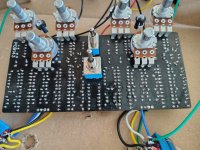
I was incredibly tired but also super excited to finish the build, so started working on it again after dinner. HUGE MISTAKE! I started piling one careless sloppy mistake after another. Like, I fried some plastic on the wires by clumsily handling the iron, I accidentally touched the plastic on the switch, but the most tragic mistake, and the one that probably costed me the build, was installing the toggles backwards... oh my, it took me forever to unsolder them, and I think I damaged the lugs and the PCB by leaving the solder on it for too long...
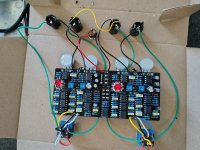
March on! I wired everything up and miracle, the lights turn on, but when plugged in, I can't hear anything. After a good night sleep, I noticed that the holes connecting the switches had little solder, so I managed to fix them and hold-and-behold I can hear something.... but no phaser.
The right LFO is practically fixed, while the left LFO works perfectly; so the side that passes the signal has the LFO that doesn't work, while the LFO that works doesn't pass the signal - this build trolled me.
I imagine it's impossible to find a solution without a probe, but I'll post some photos of the build anyway; maybe you can point me some mistakes that I cant see and learn from.
Maybe I bit off more than I could chew by overestimating my soldering skills and problem-solving abilities by choosing a build that was too difficult for my first pedal, but I think I learned a lot by fucking up a lot
BTW it's a good idea to populate the board by component height. I would solder the IC sockets before the caps.
I usually go diodes, resistors, trimpots, sockets, ceramic caps, transistors, film caps, electrolytic caps.
Also, not to pry but your username makes me think we come from the same boot-shaped country.
I was persistent today and managed to fix the left phasor and now it works perfectly, it sounds magnificent aaaaaaaaaaaaaaaaaaaaaaaaaaaaaaaah. Now I just have to figure out why the right side LFO doesn't move at all and stays fixed.
So after hours of clumsy debugging with the multimeter I think I found out what the problem is, but I have no solution.
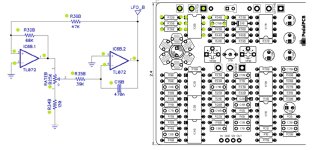
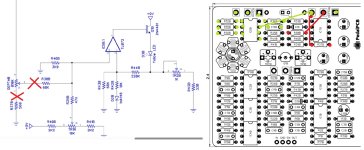
There's an interruption in the oscillation signal between the DEPTH pot and resistors R37 and R38. Both resistors appear to be working as they both result connected to the circuit (checked with a multimeter and battery), but there's absolutely no contact between R37 and DEPTH, 0 signal. There's a signal between R38 and DEPTH, but it's still, so I think R37 is the culprit???
I tried desoldering and re-soldering both the DEPTH pot and the 37 resistor, but to no avail. I'm stuck.
That seems logical. I'd try to reflow the solder and check again. Check to see if the 560ohm goes to ground. If it's still bad, maybe there's a bad trace. OR perhaps the depth pot went bad. At least you've narrowed it down to one spot.
That seems logical. I'd try to reflow the solder and check again. Check to see if the 560ohm goes to ground. If it's still bad, maybe there's a bad trace. OR perhaps the depth pot went bad. At least you've narrowed it down to one spot.
I think the pot is ok, the multimeter shows moving parameters and results connected to the pcb and other components. For example it shows a connection with R38. That connection should oscillated but it's not, however with R37 there's just 0
Do you mean, is there continuity between the jacks and the resistor? The multimeter tells me yes, but it tells me there's no continuity with the culprit pot (there's continuity with the others).
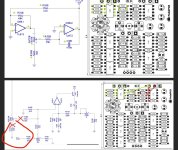
So, where I circled is where 37B is supposed to connect to ground. If it connects to ground, awesome. It was a thought that maybe it wasn’t fully soldered in and was floating.
Experiment: can you hook or alligator clip wire directly from the two ends of the resistor to the potentiometer lugs (on the pot itself). This way you jump the pcb trace, which could be lifted ever so slightly or a bad solder joint at the potentiometer lugs. Trying to rule out a bad pcb trace before looking at the potentiometer.
Might need to look at the voltages off of ICB2 to make sure the LfO is working
View attachment 116997
So, where I circled is where 37B is supposed to connect to ground. If it connects to ground, awesome. It was a thought that maybe it wasn’t fully soldered in and was floating.
Experiment: can you hook or alligator clip wire directly from the two ends of the resistor to the potentiometer lugs (on the pot itself). This way you jump the pcb trace, which could be lifted ever so slightly or a bad solder joint at the potentiometer lugs. Trying to rule out a bad pcb trace before looking at the potentiometer.
Might need to look at the voltages off of ICB2 to make sure the LfO is working
interesting, how can I hook that resistor without an alligator clip? the space is too small for an alligator clip there.
I'm sorry if I sound extra dumb but I'm learning on the go. I know I probably fucked up somewhere but I'm having fun troubleshooting and learning from it
Allright, something very wyrd happened. I tried to bridge r37 legs to the pot and something very strange happened. First of all, the red light remained off, but when I made contact between R37 and the pot to see if the lfo was passed through, the bypass led started to light up... ????????????????????? Even when touching the ICs legs, the bypass led starte to turn on until it didnt anymore...???????
After removing the bridge the led right is still off, I guess I fried it? The bypass led is still ok though
I thought I was getting close to the solution but now it seems to me that things have reached a level of lovecraftian incomprehensibility
What I would do now is look at the voltages on the working side that connects to the LFO and then compare them to the non working side.
My guess is things lit up because you might have bumped something, and I’ve done that by accidentally shorting something I shouldn’t have or bumping voltage across something.
It’ll get sorted. Voltages might help - you got this.
What I would do now is look at the voltages on the working side that connects to the LFO and then compare them to the non working side.
My guess is things lit up because you might have bumped something, and I’ve done that by accidentally shorting something I shouldn’t have or bumping voltage across something.
It’ll get sorted. Voltages might help - you got this.
so I changed the led that I fried yesterday and started debugging from 0 ALL THE CIRCUIT with what you suggested in mind.
I don't know what the fuck happened but I was checking the relationships between the ICs in the "all pass filter" section and all in a sudden the still led started oscillating... WTF. I tried to figure out what triggered that, and realized I had the PCB upside down leaning on the center toggles. So I touched the DPDT toggle and the light did stop, then it started again fucking with it, but then it went still permanently.
As I said at the beginning of the thread, I mounted the toggles on the wrong side, and desoldering them may have damaged them (especially the DPDT feels weird) so I'll try waiting for the toggles I ordered and see what happens.
I thought the LFO gatekeepers were the resistors after DEPTH but between DEPTH and IC6 (lfo) there is also SW2 which I had not considered. I hadn't noticed because it seems to be passing the LFO signal, but at this point and at the same time it seems like the real culprit? I don't know, but just because the signal was getting through I didn't think there was any problem maybe I'm doing something wrong with the multimeter.
On a side note I noticed that IC6b passes the LFO on all three depth lugs, while IC6a (the one that works) only passes it on one depth lug... well, I'm not qualified enough to figure out if it's a problem with SW2, which mediates the signal between the two or if it's a problem at all. I'll wait for the toggle and see