
You are using an out of date browser. It may not display this or other websites correctly.
You should upgrade or use an alternative browser.
You should upgrade or use an alternative browser.
What's on the workbench?
- Thread starter PedalPCB
- Start date

Feral Feline
Well-known member
Hmm so ...



falco_femoralis
Well-known member
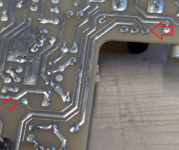
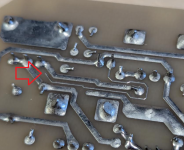
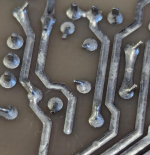
Are they meant to be a ground trace in lieu of a plane to prevent parasitic capacitance between the traces either side of them? They all seem to be much thinner than their neighboring traces

jessenator
Well-known member
I've heard that cartographers do something similar. Call 'em "trap streets" where it's either subtly misspelled, or something innocuous so the reader doesn't suffer. Gives them evidence of copying.

Aleph Null
Well-known member
There are also false entries in dictionaries for the same reason.I've heard that cartographers do something similar. Call 'em "trap streets" where it's either subtly misspelled, or something innocuous so the reader doesn't suffer. Gives them evidence of copying.

Robert
Reverse Engineer
Are they meant to be a ground trace in lieu of a plane to prevent parasitic capacitance between the traces either side of them? They all seem to be much thinner than their neighboring traces
They vary in size and aren't connected to ground (or at least not all of them).
Some are in parts of the circuit where you typically wouldn't want little antennas running all over the place.
The one in the first photo, for example, is right here:
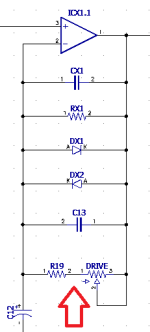
Precision tuned parasitic capacitance?


temol
Well-known member
They vary in size and aren't connected to ground (or at least not all of them).
Are you sure it was there before you started tracing? Maybe it's some new kind of protection? As soon as you start poking around, random blind traces appear...
Feral Feline
Well-known member

vigilante398
Authorized Vendor
That was my first thought, at my day job we call them guard traces and use them to separate sensitive signals to prevent crosstalk/interference. But if they're in places that don't make sense and aren't even ground, then yeah it's just there to make tracing more difficult.Are they meant to be a ground trace in lieu of a plane to prevent parasitic capacitance between the traces either side of them? They all seem to be much thinner than their neighboring traces
Robert
Reverse Engineer
What's with the two yellowed knobs?
Wait just a damned minute..... why doesn't this one have those custom knobs that improve the sound?
I bet if I put the knobs off my String Slinger on this thing even Howard couldn't distinguish it from a real Dumble.

Nostradoomus
Well-known member
Wait just a damned minute..... why doesn't this one have those custom knobs that improve the sound?
I bet if I put the knobs off my String Slinger on this thing even Howard couldn't distinguish it from a real Dumble.
I mean…not in his current state.
Nostradoomus
Well-known member
That was a caged opamp, not a free range grass fed hormone free opamp.I mean..... there was an opamp encapsulated in plastic for absolutely no good reason whatsoever.

I, for one, am shocked it wasn’t in the literature.
Robert
Reverse Engineer
I, for one, am shocked it wasn’t in the literature.
Please....
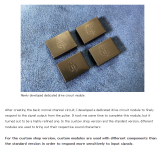
"Ultimately, I added a drive circuit that uses a dedicated module before the normal channel circuit and adopted a method to adjust how much signal is sent to the input stage of the normal channel. "

giovanni
Well-known member
But does it do what the marketing copy claims? Dedicated module for the drive before the normal channel?That's what we're calling it now when we take three absolutely essential components out of the circuit and place them on a little board covered in plastic...

Aleph Null
Well-known member


Similar threads

- Replies
- 5
- Views
- 871

- Replies
- 1
- Views
- 374

- Replies
- 5
- Views
- 368