
You are using an out of date browser. It may not display this or other websites correctly.
You should upgrade or use an alternative browser.
You should upgrade or use an alternative browser.
Bring out yer Diptrace
- Thread starter Grubb
- Start date


falco_femoralis
Well-known member
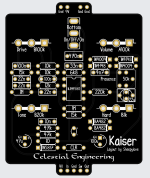
I just sent this into production. It's an MXR Il Diavolo meant for a 125b with all components board mounted. I spent some time dialing in the pad dimensions. Power and ground is on the top layer, and the bottom is signal path. It's meant to mount like a boss pedal, with the components facing toward the top of the pedal.

I made the audio jacks so that they can either be mounted on the top or bottom, such that all 3 jacks can either be in plane, or the DC jack can be closer to the top. You can use either long leg or short leg pots to accommodate. The way the board is meant to be populated is components first, then fit to enclosure with jacks and footswitch loose, then solder in at the appropriate angle. I'll elongate the audio jack and footswitch/pot holes to allow for removal. The elongations will be disguised by washers etc. I'm not quite sure what the cleanest way to approach the toggle switch will be, but I'll work that out in situ.

I kept the length just shy of 100mm. This brings the footswitch closer to the knobs than I usually do but we'll see how it works. Maybe there will be room for a battery, but I didn't bother making it part of the schematic for this one.
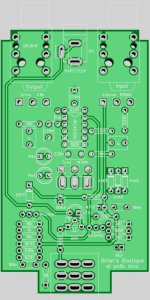
I made the audio jacks so that they can either be mounted on the top or bottom, such that all 3 jacks can either be in plane, or the DC jack can be closer to the top. You can use either long leg or short leg pots to accommodate. The way the board is meant to be populated is components first, then fit to enclosure with jacks and footswitch loose, then solder in at the appropriate angle. I'll elongate the audio jack and footswitch/pot holes to allow for removal. The elongations will be disguised by washers etc. I'm not quite sure what the cleanest way to approach the toggle switch will be, but I'll work that out in situ.
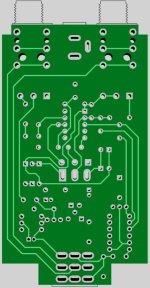
I kept the length just shy of 100mm. This brings the footswitch closer to the knobs than I usually do but we'll see how it works. Maybe there will be room for a battery, but I didn't bother making it part of the schematic for this one.

Nostradoomus
Well-known member
Hopefully you have no crosstalk between the in and out traces. 
Don’t think it’s high gain enough it will matter tho. Time will tell.
Don’t think it’s high gain enough it will matter tho. Time will tell.
falco_femoralis
Well-known member
I'm okay with this being an experiment. A few months ago I made another version of this circuit but in a much more condensed form factor. I'm going to use this circuit as a control as I learn about PCB design, so I can have something constant to compare different layouts.Hopefully you have no crosstalk between the in and out traces.
Don’t think it’s high gain enough it will matter tho. Time will tell.
Almost everything I watch on youtube about PCB design is aimed at high frequency switching applications, like in the MHz and GHz range, and there's less info about what's in the audio range, so I'm not quite sure what design practices are directly applicable to our circuits.
I spaced out their long traces to be equidistant from each other and the edge of the board. At the footswitch, their close proximity is unavoidable, so I'm not so much worried about that.
Looking back on it, I could move the outer trace closer to the outer edge of the board and get more separation. Originally I had a ground plane on both sides and I set this one inward from the edge to allow for space for the ground pour, but I decided to just go with the single ground plane up top just before sending this in. After sending this to JLC I moved around some of the components in the middle to get better flow in the traces that I didn't see before so I'll be able to apply those changes as well as whatever I learn from this in future versions.

leadfoot
Well-known member
If anything you can run the input and output on different edges of the pcb.I spaced out their long traces to be equidistant from each other and the edge of the board. At the footswitch, their close proximity is unavoidable, so I'm not so much worried about that.
I've noticed that even with my worst designs (aka first ones) I haven't had any problems with the traces causing oscillation or interference. I suppose I could go dig out my engineering books and look it up.. but where is the fun in that?

falco_femoralis
Well-known member
yeah it's hard bc I want the footswitch hanging off the end of the board because I like it as far down as possible, so space is limited. If i ran the in/out traces on either side, then the trace connecting the bottom left and bottom right lugs would interfere with the bottom center lug of the footswitch's ability to connect to the IN of the circuit. Because I put all the signal traces on one side for some reason idk. For this, I redid the pinout of the switch to allow the traces better access to the lug pads, but the result is both in/out on the same side.If anything you can run the input and output on different edges of the pcb.
I've noticed that even with my worst designs (aka first ones) I haven't had any problems with the traces causing oscillation or interference. I suppose I could go dig out my engineering books and look it up.. but where is the fun in that?
Maybe I'll make another design on a board to fit a 1590xx with trace spacing of 1 inch and we'll compare findings

would you not just stick the LED switch in the middle?If i ran the in/out traces on either side, then the trace connecting the bottom left and bottom right lugs would interfere with the bottom center lug of the footswitch's ability to connect to the IN of the circuit.

Feral Feline
Well-known member
A few different grounding options...

This is what I usually do when I'm not using a daughterboard:

The following method may be able to be extrapolated for accommodating Falco's needs with minimal rejigging; should enable the run of the OUTPUT JACK trace on the opposite side of the board from the INPUT JACK's trace:

*All diagrams in this post were found online.
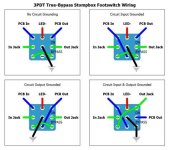
This is what I usually do when I'm not using a daughterboard:
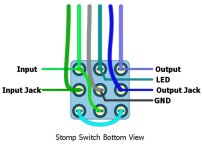
The following method may be able to be extrapolated for accommodating Falco's needs with minimal rejigging; should enable the run of the OUTPUT JACK trace on the opposite side of the board from the INPUT JACK's trace:
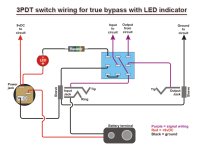
*All diagrams in this post were found online.
falco_femoralis
Well-known member
The LED switch could go in the middle, but check out the trace that grounds the input of the pedal when the circuit is bypassed.would you not just stick the LED switch in the middle?

PedalBuilder
Well-known member
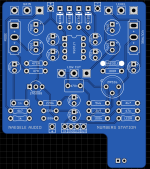
Putting the finishing touches on this take on the Hudson Broadcast/Dylan159 Narrowcast. It's got a germanium Q2 (with a few resistor tweaks to accommodate it), a charge pump, and a switch to select between 9v and 24v operation.


Harry Klippton
Not Interested
You have my full and undivided attention. And that name is perfectPutting the finishing touches on this take on the Hudson Broadcast/Dylan159 Narrowcast. It's got a germanium Q2 (with a few resistor tweaks to accommodate it), a charge pump, and a switch to select between 9v and 24v operation.
View attachment 113441

jessenator
Well-known member



falco_femoralis
Well-known member
I finally had a chance to try out assembly, and it's a bust. I tried 3 different approaches - first was to pivot the board in, then I tried having the entire board slot into the top and then push forward so the audio jacks would seat, and lastly I tried opening up the audio jack holes into a tombstone shape with their bottoms open so the board could just be inserted vertically. I don't really want to get into describing them in detail because none of them worked! Drilling circular holes is relatively easy, but making slots is very difficult, so the first two methods are out. The last method was the closest to working, but there were two problems: the audio jack washers didn't entirely cover the gaps at the corners of the holes, and because I had to mount the board as close to the bottom as if would go, in the 125b enclosure my footswitch was shorter than I would have liked, and the toggle switch did not reach the surface at all.I'd love to see a pic when you are done - I wonder if the height and flexibility of the long pins will give you the room you need to maneuver the audio jacks where you need them.
There's also this DC jack from Wurth electronics which I think is what the cheapie Taydas are modeled after, if you need to squeeze the top tighter together (It might buy you a couple mm!)
I mounted the audio jacks to the bottom of the board and the DC power jack to the top, which brought the footswitch and toggle switch closer to the top. Even with this they aren't quite tall enough.
A 1590b would be a better fit for those components, but it spaces the audio jacks closer together. Still, I'm working on a redesign using Neutrik NMJ4HCD2 jacks (the normal ones), which do place the audio jacks closer together by 4mm or so, but offer a way to insert the PCB into the enclosure referencing only one dimension. I'm going to go for the 1590b at first, but maybe there is a way to design the PCB so the jacks would be able to seat in an alternate series of pads to allow for wider spacing of the 125b. This way if the 1590b doesn't work out I won't have to wait until another revision is produced.

z2amiller
Well-known member
I wonder if you could do a custom 3d-Printed washer/grommet to do the slot/tombstone style.
Oh, or maybe you could do a faceplate (sideplate?) on that side to mostly hide the slots.
(Though I'm not sure how you'd have that drilled, I dunno if Tayda can do it and it seems like a
hassle to do at home)
I have seen pictures of other pedals built that way to solve this problem, but it's inelegant unless
you could cover the gap.
Oh, or maybe you could do a faceplate (sideplate?) on that side to mostly hide the slots.
(Though I'm not sure how you'd have that drilled, I dunno if Tayda can do it and it seems like a
hassle to do at home)
I have seen pictures of other pedals built that way to solve this problem, but it's inelegant unless
you could cover the gap.
falco_femoralis
Well-known member
I remember reading Tayda can drill irregular shaped holes, but I drill mine on my drill press at home after paint, as having the holes predrilled interferes with the way I paint them.I wonder if you could do a custom 3d-Printed washer/grommet to do the slot/tombstone style.
Oh, or maybe you could do a faceplate (sideplate?) on that side to mostly hide the slots.
(Though I'm not sure how you'd have that drilled, I dunno if Tayda can do it and it seems like a
hassle to do at home)
I have seen pictures of other pedals built that way to solve this problem, but it's inelegant unless
you could cover the gap.
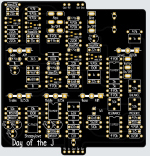
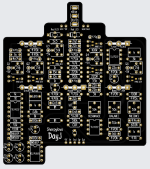
I believe the larger Neutrik style jacks will work for 125b enclosures, and they are only 4mm closer together so it's still worth trying. It may be possible to squeeze them in a 1590b, but I'm not holding my breath on that one.
vigilante398
Authorized Vendor
After what feels like 800 years of working this I finally cleared up all my DRC errors.
481 vias lol

481 vias lol
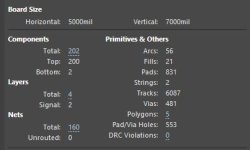
what on earth is it?After what feels like 800 years of working this I finally cleared up all my DRC errors.
481 vias lol
View attachment 116681
vigilante398
Authorized Vendor
It's my latest attempt at a better tube tester. It's a giant mess.what on earth is it?