the ts100 shells came and went pretty fast, but I have a few pinecil replacement bodies stashed away in case the internals are fine but the exterior breaks - they're pretty cheap on ebay
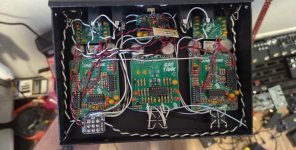
That there's a parallel-blend looper that puts the loops in series when bypassed.
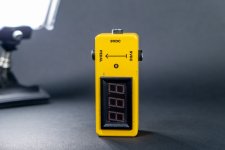
I'll do a full write-up before long but that switch is such a spectacle- I had to share it!
Good memory, @Feral Feline!
I'll admit- I didn't 'pull the trigger' right away either, but I think I'll be getting my money's worth..
I mean, just look at it!
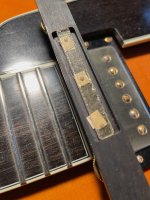
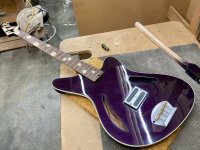
I think I mentioned the "rebirth" of my Eastman arch top recently, after they sent me a new tailpiece to replace the broken one. But, in playing it again, I remembered a problem it always had—the floating bridge gets pulled towards the bottom because of how much bending I do; even (or maybe because) of the medium (12-54) strings on it, there's not enough downward pressure on the bridge to keep it in place. I thought about pinning the bridge, but didn't want to lock into one intonation position, which varies a small bit with strings used.
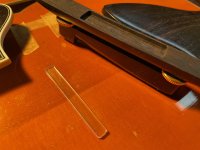
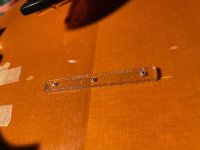
So I came up with a clever work a round. Last week I brought it into my old shop, and milled out a pocket under it, and made a strip of PETG (plastic) that was a tight fit length-wise, but had 1/8th inch to either side to allow for intonation movement, and used a super strong PSA on it (pretty much what auto makers use to hold their names etc. onto car bodies). It worked, but not 100%, so I decided yesterday to pin the plastic strip down. I drilled three .028 holes (the pin diameter I was using), but then had to deal with the pin heads—I had made the pocket .085 deep, to account for .075 thick plastic strip and the PSA (~.008) so there wasn't any space for the pin heads. I spun a very small ball point burr between my fingers on each of the holes to create tiny countersinks for the pin heads, clipped the pins off at about 3/8th inch, and drilled some .018 pilot holes for them. I don't see how this can move.
On the photo showing the strip inside the pocket, you can see the clear PSA on the top surface. Under the strip, I have three small wads of a light tack PSA to hold the strip in lace while I flip the bridge into position (located by the tape on the guitar)—then, after pressing down on this, I lifted the bridge up, with the strip in place.
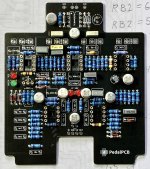
Robert did a great job of replicating the original circuit. Each and every component value matches that of the original circuit - only without the buffered bypass and 'Low Battery' indicator bits.
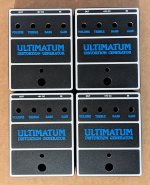
Right now, they are out of stock. But more are coming.
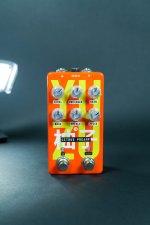
not the work bench per se, but I'm reaping the benefits of our tattoo shop's new professional photography setup:
a coworker's wife has been on my case about making a website for my pedal building (so she can give it to her coworkers - so I genuinely appreciate the gentle push) and I'm trying to take photos of any decent looking pedals I have laying around for it.
a coworker's wife has been on my case about making a website for my pedal building (so she can give it to her coworkers - so I genuinely appreciate the gentle push) and I'm trying to take photos of any decent looking pedals I have laying around for it.
a coworker's wife has been on my case about making a website for my pedal building (so she can give it to her coworkers - so I genuinely appreciate the gentle push) and I'm trying to take photos of any decent looking pedals I have laying around for it.