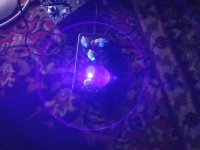
I've used UV LEDs a couple of times, and as I recall it I went below 2K with no problems. Possibly as low as 1K. I'd have to open pedals and check to be sure.
There are LED resistor calculators online - Googling that phrase will find you some. For our purposes the numbers needn't be exact, the point is that most LEDs will work at much lower resistances than we'd typically use, they'd just be way too bright. Personally I find 4.7K too bright for most uses and typically use anything from 5.6 to 15K. I test LEDs to see what looks acceptable to me.
UV LEDs are not bright, though. So lower resistance makes them usable for humans. It is possible that they're pumping out invisible-to-humans UV light which is potentially harmful. As in, it can harm your eyes even if you can't see it. I doubt there's much chance the UV will harm your skin any more than a sunny day, but hey, people die of melanomas on a regular basis here in Australia. So I'm a bit wary of using UV LEDs and I wish someone would just make a white LED with a dark purple plastic lens, so we could have genuinely purple LEDs without potentially scarring our retinas.
That's a fair point. I did a bunch of digging (keep in mind, I'm not an expert and this is just simple googling based on potentially unreliable sources - although these people sure seem like they know what they're talking about):
Top answer here
https://electronics.stackexchange.com/questions/123674/are-uv-leds-really-dangerous gives us some guidelines on the maximum safe power, and seems quite cautious in general. So anything over 5mW should be used with eye protection. Using the Tayda UV led in a calculator, at full 20mA the resistor is 275 ohms and output is 0.11W, so 110mW. That's possibly something you should avoid, even though there are other parameters in play which means it's not just 22 times over the safe threshold, mainly that the Tayda LED is actually 410-415nm which isn't actually in the UV range, it's more of blue, but since it's not just a single frequency it's emitting, it's also emitting some UV light - but most of the power will be used for blue visible light.
5mA would mean a 1100 ohm resistor, and 27.5mW. 5mW would mean something like a 6k ohm resistor, so if you want to be absolutely safe, it's best to avoid them completely.
If you're not so easily scared, here's a longer reply from someone who seems to have studied it a bunch due to causing their wife to burn their eyes with an UV lamp
https://electronics.stackexchange.com/questions/25851/safety-guidelines-for-ultraviolet-leds
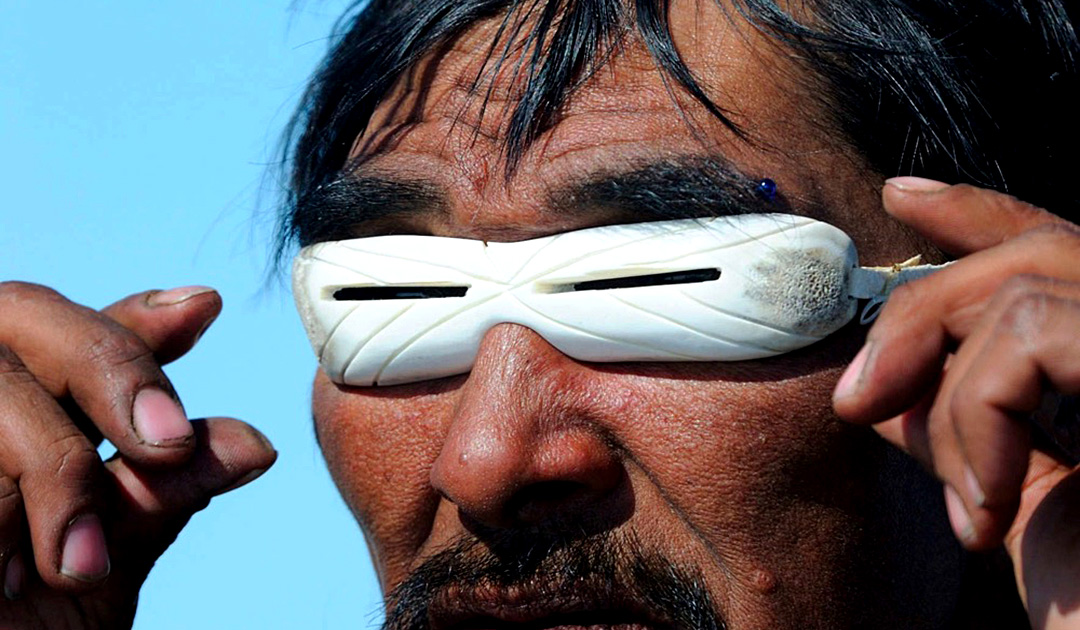
But the tl;dr is that UV light damage in eyes is basically "snowblindness", as in your eyes get sore and inflammated, which could lead to temporary blindness due to your eyes literally swelling shut. But probably no permanent damage, unless it was much more powerful or focused than the light that causes snowblindness. So it's pretty reasonable to assume that a LED that mostly doesn't emit UV light anyway (and then there are UV-A, UV-B and UV-C - UV-C is more scary, but again the LED barely gets into UV-A territory which is considered pretty harmless) and emits that rather weakly, plus whatever the diffusion caused by sanding causes, that using them in pedal lights is safe. UV light is also considered harmful because it doesn't cause a blink reflex since you can't see it, but again, if you're emitting visible light, you're probably hitting the blink reflex first before the UV is strong enough to do even any damage.