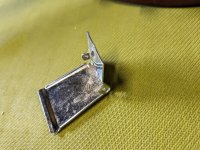
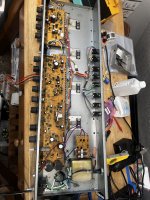
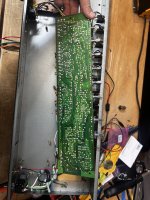
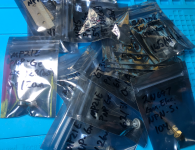
Fortunately, those “blue bomber” coupling caps are likely still good. Rarely have I seen them bad.getting the twin on the bench for a tune up and new caps.View attachment 74837View attachment 74838View attachment 74839View attachment 74840
The cardboard Mallory’s were probably ready to say goodbye a couple decades ago (I mean, who would think cardboard is a good container for long term liquid storage).
The only surprising thing (and I’ve always changed as a cap job), those white Mallory’s everywhere are prone to being good one day, dead short the next— what surprised me the most is that apparently there was a service bulletin and voluntary recall on them in the late 70s/early 80s because of this behavior (we are talking caps doing this that are well within the 15yr expected life… and tested good prior to the failure). Apparently a few hifi mfrs had enough warranty claims on these caps shorting and taking out whole output sections in high end equipment! And Fender had them in their bias supplies, yet never took part in the recalls!
If you get a chance, check the carbon comp plate resistors. Typically they are known to get noisy and drift high, but in my experience (and it may be related to age), but the late 70s Fenders don’t seem to show this as bad as older models. (Personally, I just replace as I don’t want an amp being a boomerang and coming back to me prematurely… but there are folks who have a hard on for it looking “all original”, so there may be a case where newer production carbon comp resistors may be a way to keep them happy. I just don’t have enough data either way to have a warm fuzzy about it



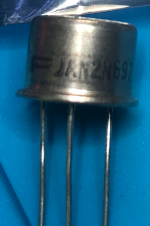


 . Time to get on the computer and layout some shit.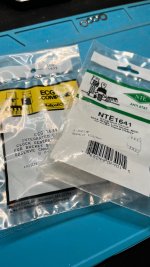

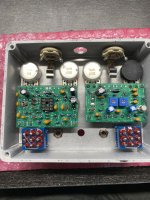
 . Nothing there is ever cheap though