CONTEST What? Another Contest?

CONTEST
See, I’m on the other side, I’ve used eagle for about 6 months and I find it east to use.
Have you tried anything else? Eagle just doesn't feel intuitive to me at all, it felt like an uphill battle getting anything done. Diptrace was my friend from the start, I didn't have to read a tutorial or anything.
 
Have you tried anything else? Eagle just doesn't feel intuitive to me at all, it felt like an uphill battle getting anything done. Diptrace was my friend from the start, I didn't have to read a tutorial or anything.
A lot of the MBP crew got their start on eagle because of the MBP library and the JMK tutorials.
 
  • Like
Reactions: fig
Well....off the top of my head...how about this? :p

44c86710-4a7d-4c7a-b455-ad6427a164be-jpeg.21583
 
Here's the Motorola datasheet. For a typical pedal application, check out the Woodpecker.

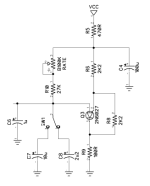
Here's the oscillator part of the circuit:

woodpecker oscillator.png
Assume SW1 is in the position shown. C6 & C8 charge up thru R10 and the RATE pot. When the voltage on Q3-A (pin 1) is one diode drop (approx 0.6V) above the voltage on Q3-G (pin 2), Q3 goes into conduction and rapidly discharges C6 & C8 thru R9. The point when Q3 goes into conduction is called the Peak Voltage and it is "programmed" by R6 & R8 because R6 & R8 set the voltage on Q3-G. C6 & C8 discharge down to the Valley Voltage, that's where Q3 turns off and the cycle repeats. The voltage waveform on C6 & C8 is a sawtooth.
 

Attachments

Last edited:
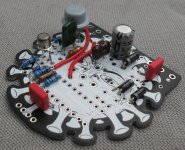
I've been going thru my "This Week on the Breadboard" posts looking for circuits that could be built on a Muffin board. Found one. As you can see, the board is pretty sparsely populated. That's everything except the FUZZ & VOLUME pots, jacks & switch. The TO-18 can is a vintage JANTX2N2222A.

The Black Knight Fuzz - board 02.jpg
 
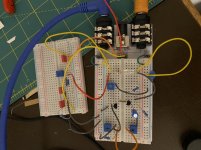
AAEF1A10-9FC8-429B-9D12-E69D772261E5.jpeg 805DA97D-686B-4950-A216-BB292B12DB24.jpeg I started working on a crude optical tremolo. Still working on it, The intensity and rate work well so far not sure if I will get around to finishing it in time... I was just kind of making it up as I went stealing bits and pieces of circuits from here and there.. I don’t even know if It will pan out on the muff board but I’m sure if I get creative I can make fit probably won’t be pretty by any means.
 
Last edited:
Have you tried anything else? Eagle just doesn't feel intuitive to me at all, it felt like an uphill battle getting anything done. Diptrace was my friend from the start, I didn't have to read a tutorial or anything.
I have not. Eagle doesn’t have that spike setting, it just does it. To make a ground plane, you just have to draw a polygon around the board and name it ground or grnd. These are a few of the differences I’ve noticed as a newbie myself. It’s hard to tell what’s intuitive and what isn’t, I’m learning as I go. I still haven’t figured out completely, how to make cool shaped boards.
 
I was just kind of making it up as I went stealing bits and pieces of circuits from here and there
That’s pretty much the secret, IMO. In todays world there really aren’t “original” circuits anymore, but merely smatterings of different circuits slightly tweaked and mashed together. Kinda like LEGOs: the blocks don’t change but you can put them together however you want it.Just don’t step on either of them barefoot….
 
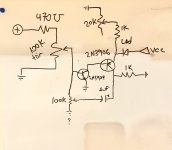
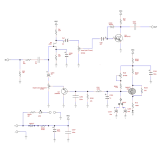
In keeping with the “Lego/nothing is original” idea, here is a woodpecker into a bazz fuss.

It works and I figured out how to put it on a muffin board, but… I went back and forth between “trem into fuzz” or “fuzz into trem”, which is easy to do on the breadboard. Both have pros and cons, I finally decided I like it better with the fuzz first. So I am reworking it to install on the muffin board.

In either case, if you lower the depth pot all the way, you effectively kill the tremolo and are just left with the fuzz.

In the schematic below, if you max the Level pot, it drives the fuzz too hard. So some components would need to be swapped, but the circuit works. I’m going to stop working on this version and focus on the “fuzz first” version.

5CF7FDF7-2457-46AD-8078-88A794950F30.png
 
In keeping with the “Lego/nothing is original” idea, here is a woodpecker into a bazz fuss.

It works and I figured out how to put it on a muffin board, but… I went back and forth between “trem into fuzz” or “fuzz into trem”, which is easy to do on the breadboard. Both have pros and cons, I finally decided I like it better with the fuzz first. So I am reworking it to install on the muffin board.

In either case, if you lower the depth pot all the way, you effectively kill the tremolo and are just left with the fuzz.

In the schematic below, if you max the Level pot, it drives the fuzz too hard. So some components would need to be swapped, but the circuit works. I’m going to stop working on this version and focus on the “fuzz first” version.

View attachment 21680
Very cool, Dan. Why not have an order switcher. Go all kinds of out.:p
 
Very cool, Dan. Why not have an order switcher. Go all kinds of out.:p

Thank you. I messed with that idea today, but I can’t get it to sound good in both directions with the same components.

Wow! Very creative. Did you draw this with TinyCad? If so, I'll make a PUT symbol for you.

Thank you. Yes, TinyCad. I didn’t see the correct symbol, so I used an NPN and put a blob over it.

I guess I’d like to see the application of what you CAN do with it. Still seems to me like any ole tranny

The main thing for the tremolo, is the 2 switched capacitors change the available rates. There is some overlap between them, but the smaller one maxes out at a very fast rate and the larger one can slow down to what seems like an eternity between pulses. In typical EQD fashion, the setting endpoints are ridiculous.
 
You should be able to find a cap that is a happy medium and if you want a little more range out of the RATE control, try lowering R201. I don't know how high or how low you can go with R201 & the RATE pot before the oscillator stops.

One PUT symbol coming up. TinyCAD's symbol editor is pretty easy once you get used to it.
 
Back
Top