That's my thing - bleak and utilitarian. Never thought of it as bleak, but I can do that. Bleak AF. Some of my pedals are so bleak that I forget what they are.No worries, we're all friendlies here. We've all got our own aesthetic, and I love seeing em all. Even though I go for a utilitarian and kinda bleak look, I do enjoy seeing everyone's visual take on their builds

You are using an out of date browser. It may not display this or other websites correctly.
You should upgrade or use an alternative browser.
You should upgrade or use an alternative browser.
Worlds First Augmented Analog Pedel.
- Thread starter dlazzarini
- Start date

giovanni
Well-known member
Could that be a controller for switching?Clipping circuit may be analog but....
View attachment 32933


bowanderror
Well-known member
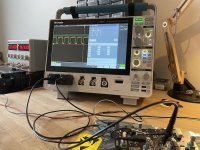
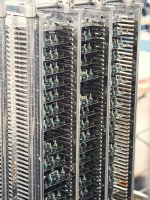
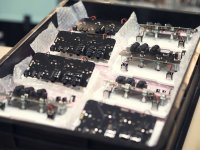
For anyone intersted, here is a link to the User Manual. I also dug through the Kickstarter for more board photos, maybe we can suss out the math from the myth (pics aren't amazing quality, but it's a start):
First two are from what looks like a prototype with green solder mask:

The others look closer to the production version, in black solder mask:


First two are from what looks like a prototype with green solder mask:
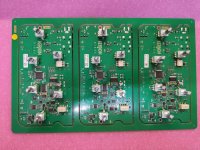
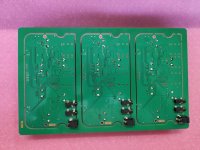
The others look closer to the production version, in black solder mask:
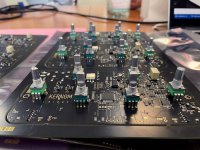
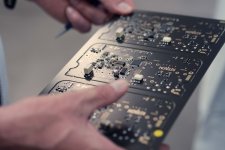
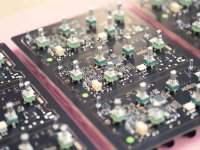

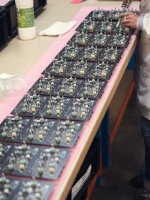
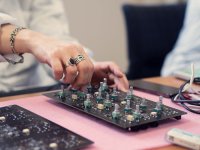
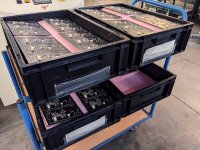
bowanderror
Well-known member
and a few stragglers:
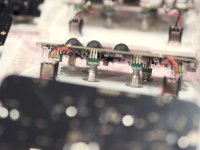

bowanderror
Well-known member
They mentioned
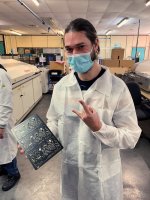
I remember reading that this was a visit to a board assembly partner, otherwise that would've had to be a hell of a Kickstarter!That’s some serious hardware in the background.

tegendemuur
Well-known member
Looks to be a little more explaination on how it works these days, teasing all three pedals' tweaks within the same format...I was just reminded of this pedal today and all the hype at the time of release. Did we ever get to the bottom of what makes it work?


Last edited:
fontoponto
Well-known member
It‘s been released for a while now, reviews at thomann are good, I never heard of it before I saw the thread today. Does not seem to have an impact in the scene but I‘m not a pro.

spi
Well-known member
Wow, so while they say they keep the signal in the analog domain, their block diagram shows that they convert from A->D then back D->A, then into their analog circuit, then A->D and D->A again. Why do it in the analog domain if you're going to go through two ADCs?Looks to be a little more explaination on how it works these days, teasing all three pedals' tweaks within the same format...
giovanni
Well-known member
I thought they said that they use digital signal for filtering and signal analysis (not sure what that means) and analog components to generate non linear behavior (which makes sense to me). So they are marrying the “best of both worlds”. I think this idea has merit but I want nothing to do with it.Wow, so while they say they keep the signal in the analog domain, their block diagram shows that they convert from A->D then back D->A, then into their analog circuit, then A->D and D->A again. Why do it in the analog domain if you're going to go through two ADCs?
Yeah so basically clipping in analogue, signal filtering in DSP. I came across this recently, I wonder if they are essentially just digitally controlling something similar to the biased clipper they implemented here.
tegendemuur
Well-known member
The platform he desgned is okay, but why play so safe with all the conventional sounds? Surely there's more interesting things to be done with this...I thought they said that they use digital signal for filtering and signal analysis (not sure what that means) and analog components to generate non linear behavior (which makes sense to me). So they are marrying the “best of both worlds”. I think this idea has merit but I want nothing to do with it.

Fama
Well-known member
Probably a business decision, "TS and Klon and everything in between!" gets the blues lawyers salivating much more than "any experimental sound you want!", I would imagine.The platform he desgned is okay, but why play so safe with all the conventional sounds? Surely there's more interesting things to be done with this...
This is an interesting concept, although I'll have to reserve judgement until I hear more demos. I am interested in the technology behind the Ridge, here is the info I gleaned from their Q&A video:
I could not find a US, French, or EU patent under either the holding company (Monday Noise), or the engineers (Antoine Petroff & Jeremy Savonet). Antoine has a bunch of prior patents under the assignee Devialet, but as they are an acoustical engineering company they mostly deal with acoustics & loudspeakers. The Kernom, Ridge, Analog Morphing Core, and Augmented Analog trademarks were only registered in September, so it may be that the patents haven't made it into the INPI database yet.
- Clipping stage is 100% analog (not DSP-based or a simulation approach), with control & flexibility granted by the way they control the nonlinear elements of the clipping stage.
- Patented technique allows them to control the threshold of clipping diodes, making them behave in new ways. For example, diodes can physically behave as Si & Ge at the same time, clipping the signal asymmetrically a lot or not at all.
- Augmented Analog - Name of approach to ultraflexible analog clipping
- Analog Morphing Core - Name of patented technology that enables that approach
In terms of how they're approaching this from a technical perspective, I can think of a few ideas, but I think the most likely option is with Biased Diode Clippers - Basically using a voltage source to positively or negatively bias the audio signal, effectively moving it to a different part of the diode I-V curve. Independently controlling the positive & negative bias would be an effective way to control both the amount of clipping, as well as the symmetricity/asymmetricity.
- from Wikipedia: "The clipping action can be made to happen at an arbitrary level by using a biasing element (potential source) in series with the diode. In the following diagrams the green plot is the input voltage, the orange plot is the output voltage, and the blue plot is the clipping level voltage."
View attachment 17778
Using both positive & negative bias:
View attachment 17779
I couldn't find many photos of the board or circuit, but this X-ray image of the PCB has net names like "OUT_BIAS" connected to a bunch of diodes:
View attachment 17781
I'm thinking you might also be able to do this with FETs, but exactly how is a bit over my head. Anyone have more insight?
There's a number of ways I could see how todo this:
1. Bias the opposite side off the diode to the signal.
2. Use a fet to scale the signal like a FET compressor.
3. Use variable two phase to cancel a portion of the amplitude with less noise.
You could clip a parallel duplicate signal and then use that with a fet to scale the signal.. lots of weird ways..
That's actually pretty coolYeah so basically clipping in analogue, signal filtering in DSP. I came across this recently, I wonder if they are essentially just digitally controlling something similar to the biased clipper they implemented here.
Similar threads

- Replies
- 11
- Views
- 207


- Replies
- 34
- Views
- 2K

